H567/03 Section A - Biological treatment of a specific disorder
Explain how selective serotonin reuptake inhibitors can treat major depressive disorder, assess the evidence and limitations, and apply the reasoning to a fictional situation.
SSRIs and serotonin signalling
The specific disorder used throughout this sequence is major depressive disorder, an affective disorder involving sustained depressed mood and/or loss of interest with other symptoms and impaired functioning. Treatment follows clinical assessment; an isolated unhappy day is not a diagnosis.
One biological treatment is an antidepressant from the selective serotonin reuptake inhibitor (SSRI) class, such as fluoxetine. This treatment changes neurotransmission rather than directly teaching new thinking or behaviour skills.
Serotonin released from a sending neuron enters a synaptic gap and can bind to receptors on a receiving neuron. A transporter normally takes some serotonin back into the sending neuron: reuptake. An SSRI inhibits this transporter, leaving more serotonin available in the gap for signalling. It does not manufacture serotonin, block all neurotransmitters or instantly erase distress. The exact pathway from this drug action to clinical improvement is more complex than the transporter step alone.
[DIAGRAM: asset_slug: mh06_ssri_signalling; file: mh06_ssri_signalling.png; description: Three conceptual panels show serotonin release, inhibition of return through the reuptake transporter, and increased availability for signalling. Clinical improvement is delayed and variable.]
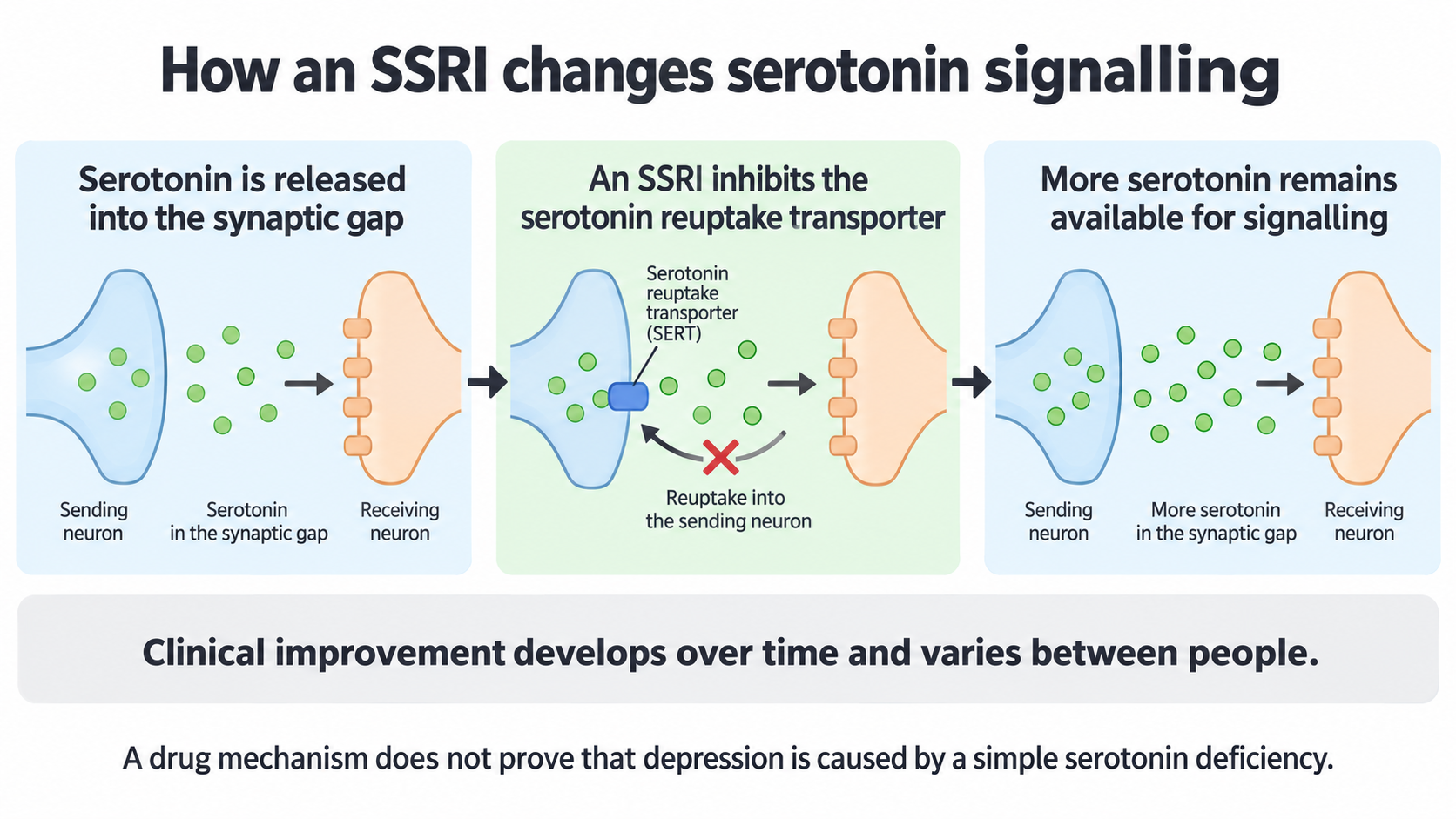
Diagram description: The crossed return arrow represents inhibited uptake into the sending neuron. Forward signalling is not crossed out. The dots illustrate serotonin rather than a measured number of molecules, and the caption distinguishes a drug mechanism from a proven cause of depression.
The biochemical action begins before full clinical improvement. Benefits commonly develop over several weeks, and some people respond incompletely or not at all. A response to an SSRI therefore cannot establish that the person's depression began with a simple serotonin shortage: a treatment may alter a system without reversing the original cause.
Treatment evidence and inference
Evidence of usefulness requires a comparison between outcomes, rather than an improvement story alone.
In DeRubeis et al.'s 2005 randomised trial of adults with moderate to severe major depressive disorder, the medication condition used paroxetine, an SSRI, with possible augmentation. At eight weeks the medication response rate was 50%, compared with 25% for pill placebo. This supports the studied treatment package; it does not isolate every effect to paroxetine alone or guarantee an individual's response.
Random allocation reduces systematic pre-existing differences between groups. A placebo condition helps account for expectations, clinical contact and changes over time. A standard severity scale makes repeated outcomes comparable. However, trial eligibility, duration, treatment adherence and missing follow-up can limit transfer to ordinary services. Side effects may also let participants guess their condition, weakening blinding.
Consider an original fictional trial, not a finding from DeRubeis et al. Adults with assessed depression are randomly allocated to the same monitored eight-week programme with either an SSRI or a placebo. A response means at least a 50% reduction on the same symptom scale; all allocated participants are included in the reported summary.
| Condition | Participants | Responses |
|---|---|---|
| SSRI | 100 | 60 |
| Placebo | 100 | 35 |
The response rates are 60% and 35%, a difference of 25 percentage points. The SSRI group shows greater response in this fictional sample. Yet 40 people in that group did not meet the response threshold, and 35 improved with placebo. Neither universal effectiveness nor a unique biological cause follows. A significance decision would require additional statistical information; a visible difference alone is insufficient.
Continue this lesson.
You’re previewing NovaLearn without an account. Create a free account to read the rest.
Create free account