H567/02 Section A - Loftus and Palmer (1974): eyewitness testimony
The words used after an event can influence how that event is remembered. This lesson follows two experiments on accident films, distinguishes their findings, and considers how far they help us understand eyewitness testimony.
Reconstructing an event
Remembering an accident involves interpreting what happened and later retrieving a representation of it. Reconstructive memory means that recall is an active reconstruction, rather than a perfect recording. Existing knowledge can guide that reconstruction: a schema is an organised mental representation built from experience, such as what a serious collision usually involves.
Loftus and Palmer investigated whether the wording of a question asked after an accident film would affect estimates of vehicle speed. A stronger verb might suggest a more violent impact. This matters because an eyewitness may be sincere yet give a report influenced by the interview.
Leading question
A question whose wording or content suggests a particular answer.
The cognitive explanation concerns internal processing: information from the original event may become integrated with post-event information, making the sources difficult to distinguish. However, a changed answer does not by itself show a changed memory. An uncertain participant could simply choose the answer implied by the question. This alternative, response bias, is why a second experiment was needed.
Experiment 1: estimating speed
The first laboratory experiment varied one word in a speed question. Forty-five students took part, with nine assigned to each of five wording conditions. The verb conditions used an independent measures design: each participant answered with one critical verb, although all viewed seven accident clips. Repeated viewing of clips does not make the comparison between verbs repeated measures.
The clips lasted 5–30 seconds and came from driver-education films. After each, participants first described the accident, then answered questions including an estimate of the cars' speed using “smashed”, “collided”, “bumped”, “hit” or “contacted”. Film order differed between testing groups. The independent variable was the critical verb; the dependent variable was estimated speed in miles per hour.
| Critical verb | Mean estimate, mph |
|---|---|
| Smashed | 40.8 |
| Collided | 39.3 |
| Bumped | 38.1 |
| Hit | 34.0 |
| Contacted | 31.8 |
These are the values in the original paper's Table 1. The OCR teaching guide prints 40.5 for “smashed”; the other four values agree. Use the values supplied in a data question. The strongest and gentlest verbs produced the highest and lowest estimates. Using the original table, their difference is .
[DIAGRAM: asset_slug: cs07_speed_estimates; file: cs07_speed_estimates.png; description: Experiment 1 mean speed estimates for five critical verbs, using the original paper's values]
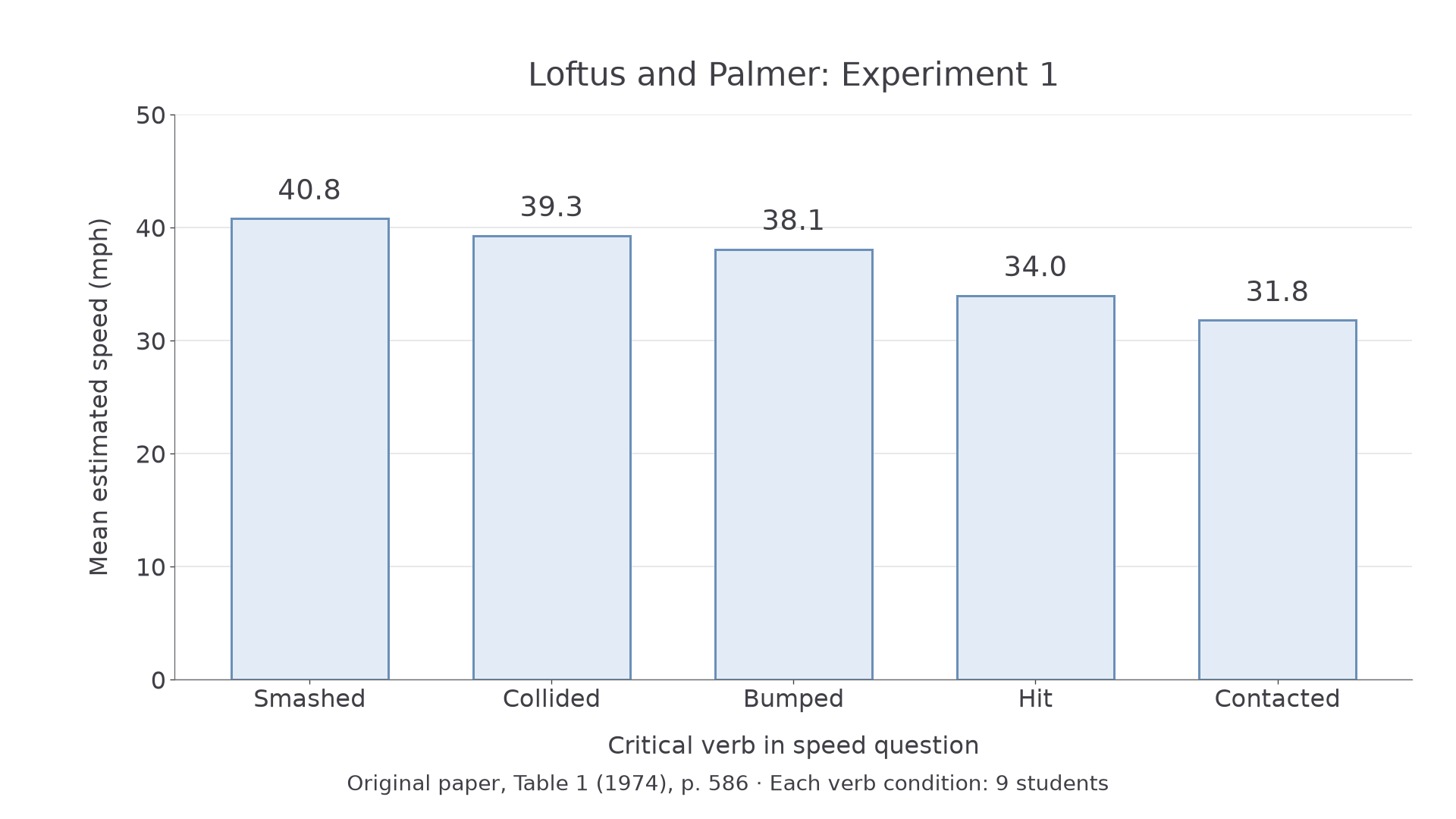
Diagram description: Each bar represents a separate wording group; the vertical axis is mean estimated speed, not the actual speed of a vehicle.
For four staged crashes with known speeds of 20, 30, 40 and 40 mph, average estimates were 37.7, 36.2, 39.7 and 36.1 mph respectively. Participants were imperfect judges of speed. The verb effect was statistically significant, but Experiment 1 alone could not distinguish response bias from memory reconstruction.
Experiment 2: reporting broken glass
The second experiment tested a later report about a detail that had not appeared. A new sample of 150 students viewed one film lasting less than a minute, with a four-second multiple-car crash. Fifty received a “smashed” speed question, fifty a “hit” question and fifty no speed question. This was again an independent measures laboratory experiment; the no-speed group supplied a control condition.
One week later participants returned without seeing the film again. A ten-question questionnaire included a yes/no question about seeing broken glass, placed at a random position. The film contained no broken glass. The main dependent variable was the later glass response. Immediate mean speed estimates in this experiment were 10.46 mph for “smashed” and 8.00 mph for “hit”; these must not be replaced with Experiment 1's means.
| Later response | Smashed | Hit | No-speed control |
|---|---|---|---|
| Yes | 16 | 7 | 6 |
| No | 34 | 43 | 44 |
The false “yes” rates were 32%, 14% and 12% respectively. The difference between “smashed” and “hit” was 18 percentage points. Most participants in every condition answered “no”, so the result is a difference in susceptibility, not universal memory failure. The groups differed significantly in their glass reports.
Continue this lesson.
You’re previewing NovaLearn without an account. Create a free account to read the rest.
Create free account