H567/03 Section B Option 1 - Gibson and Walk (1960) and developing perception
Gibson and Walk used a simulated cliff to investigate depth discrimination in infants and other species. Their evidence shows how vision guides action, while the differences between species and rearing conditions complicate a simple nature–nurture conclusion.
The question and visual-cliff apparatus
The researchers asked when an animal can use visual information to discriminate depth and avoid an apparent drop. Does this ability require learning through falling, or does it become available through maturation? They also investigated which visual cues guide discrimination and how previous visual experience affects responses.
The apparatus used a large continuous sheet of heavy glass supported a foot or more above the floor, with a centre board across its surface. Patterned material directly beneath the glass on one side gave the appearance of a shallow solid surface. The same pattern placed on the floor beneath the other side gave the appearance of a drop. Both sides physically supported the participant. This separated apparent visual depth from the danger of an actual fall.
[DIAGRAM: asset_slug: ch06_visual_cliff; file: ch06_visual_cliff.png; description: Continuous glass supports both sides; the pattern is directly beneath the shallow side and lower on the floor beneath the deep side, with a centre board above the glass.]
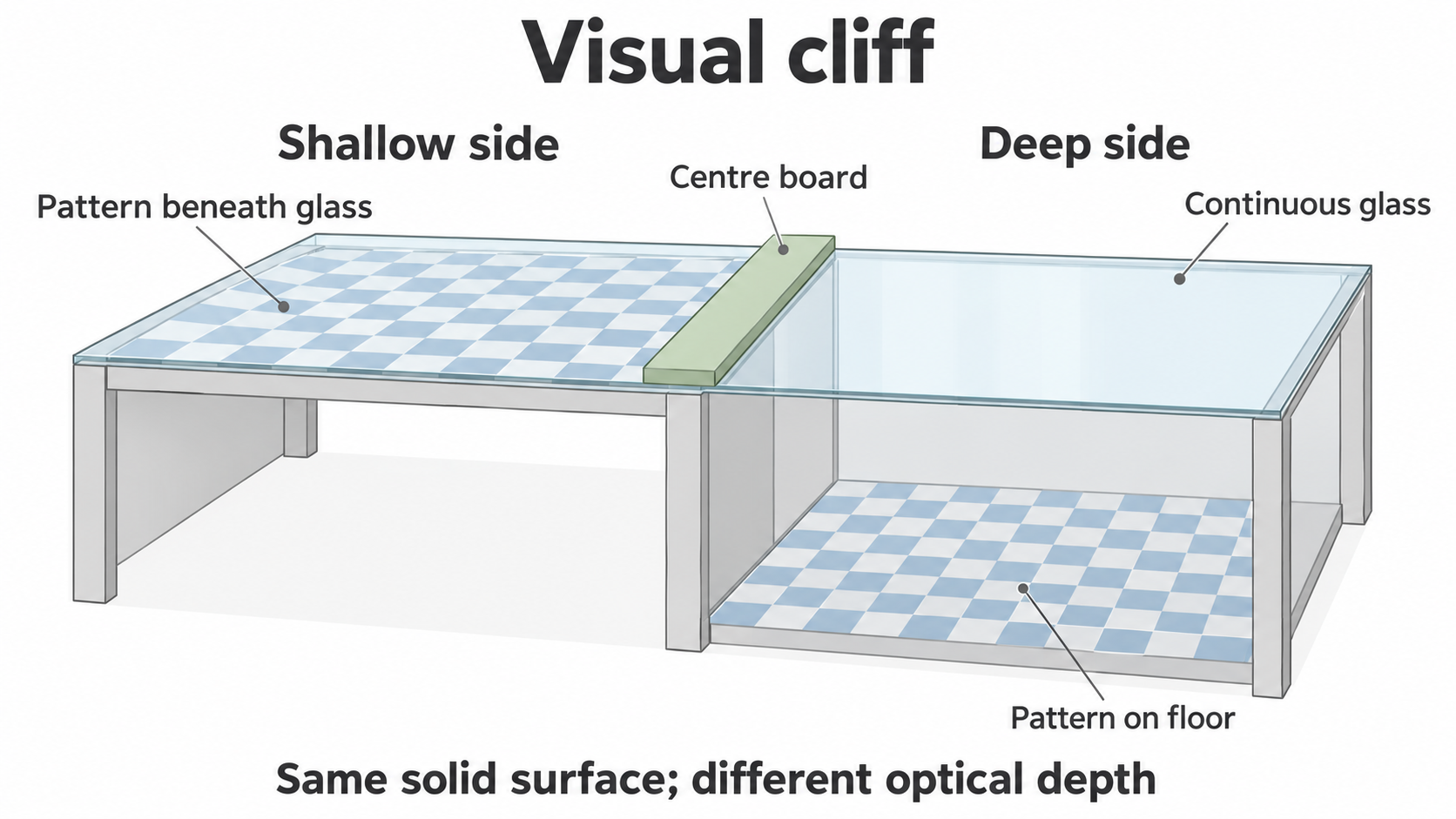
Diagram description: The glass surface is level and continuous. Pattern distance changes the optical depth, while physical support remains available on both sides. The illustration is a schematic of the apparatus rather than a scale reconstruction.
Depth cues include texture density and motion parallax. Pattern elements farther away project as smaller and more closely spaced; as the observer moves, nearer elements appear to move more across the visual field. A preference for one side can therefore be tested while particular cues are controlled.
The human procedure is a laboratory experiment comparing responses to shallow and deep conditions within the same infant. The manipulated condition is the apparent depth from which the mother calls; the measured response is whether the infant crosses toward her. Species and rearing comparisons involve naturally occurring species differences or experimentally varied experience and should be distinguished from this within-infant design.
The human infant procedure and findings
Thirty-six infants aged six to 14 months were tested with their mothers. Each infant was placed on the centre board and its mother called from the deep and shallow sides successively. Thus the same infant provided responses under both apparent-depth conditions, reducing between-child differences in the comparison. The report does not provide a detailed randomisation or modern consent/withdrawal account, so those procedures should not be invented.
Twenty-seven infants moved off the board. All 27 crossed the shallow side at least once; only three crossed onto the glass above the deep pattern. The proportion crossing the deep side among infants who moved was , approximately 11%. Nine of the original 36 did not move off. Using 36 as the denominator answers a different question, and those nine cannot simply be classified as unable to perceive depth.
Some infants peered down and backed away; some crawled away from their mother when called from the deep side, and some cried. Others patted the glass but still refused to cross, indicating that tactile support did not always override visual information. Several supported themselves or backed onto the deep glass awkwardly, showing that discrimination does not guarantee safe coordinated movement.
The findings support depth discrimination and avoidance in most tested infants who moved. They do not prove that human depth perception is innate: these babies already had visual and movement experience. The authors explicitly acknowledged this limit. Nor is the result a direct measurement of a subjective fear experience; crossing combines perception, motor ability, motivation and response to the mother.
Species differences and cue controls
The report described observations of chicks, turtles, rats, lambs, kids, pigs, kittens and dogs, with detailed findings for selected species. It did not provide a separate sample size for every animal group. Species differ in independent locomotion, ecological needs and sensory reliance, so equal ages in days would not constitute an equal developmental comparison.
Chicks less than 24 hours old consistently left on the shallow side. Kids and lambs also avoided the deep side at about one day, as soon as they could stand. When placed on deep glass they showed a defensive posture. Lowering the optical floor more than a foot could produce freezing despite continuing glass support; when the field of vision reached a solid-looking surface, movement resumed. These findings support early visually guided responses without learning through dangerous falls.
Rats showed little shallow preference when their whiskers could touch the glass, but raising the centre board beyond whisker reach produced 95–100% shallow-side descents. Four-week-old kittens, when able to move about easily, strongly preferred the shallow side. Aquatic turtles crossed shallow in 76% of observations; their different response could reflect the ecological meaning of a drop as well as discrimination. The study cannot directly identify a turtle's subjective fear.
Animal controls tested alternative explanations. Lighting patterned surfaces from below reduced glass reflections, yet rats still chose shallow. Grey patternless surfaces removed the preference. Putting patterns directly below both sides removed the optical difference and produced no side preference; lowering patterns on both sides could lead rats to remain on the board.
To isolate motion parallax, the researchers enlarged and spaced the deep-side pattern so projected texture density was comparable. Young rats and day-old chicks still strongly preferred shallow, supporting discrimination from differential motion. To remove differential motion, patterns were placed at the same physical level but one was smaller and denser. Normal rats preferred the larger pattern, whereas day-old chicks showed no preference. The cues can therefore make different contributions depending on species and experience.
Continue this lesson.
You’re previewing NovaLearn without an account. Create a free account to read the rest.
Create free account