H567/02 Section A - Bandura et al. (1961): transmission of aggression
Bandura, Ross and Ross investigated whether children would reproduce an adult's aggressive behaviour later, in a different room without that adult present. This is the 1961 live-model study.
Observational learning and the design
Previous research had shown imitation while a model was present. The stronger question was whether a child could learn a pattern through observation and reproduce it elsewhere. Observational learning means acquiring behaviour by watching another person; imitation is reproducing that person's behaviour. The researchers predicted more imitative aggression after an aggressive model than after a nonaggressive model or no model. They also predicted inhibition after a calm model and investigated whether the child's and model's sex affected imitation.
The laboratory experiment used different children in the conditions, with matched participants based on initial aggression. There were 72 children from Stanford University Nursery School: 36 boys and 36 girls, aged 37–69 months, with a mean of 52 months. An experimenter and a familiar nursery teacher rated aggression on four five-point scales: physical, verbal, towards objects, and inhibition of aggression. Composite scores were used to form matched triplets; children within each triplet were randomly allocated to aggressive-model, nonaggressive-model or control conditions. Each main condition had 24 children. The two model conditions were further divided by child sex and model sex, making eight experimental groups of six, alongside the 24-child control.
Model behaviour and model sex were manipulated. Child sex was a naturally occurring variable, not randomly assigned. The dependent measures were coded behaviours during the later test. Matching reduced the possibility that a more aggressive group simply started that way; it did not equalise every characteristic, such as familiarity with the toys. Random allocation within triplets concerns condition assignment, not random selection of all children from a population.
Materials and the three phases
In the 10-minute exposure phase, each child in a model condition worked with potato prints and picture stickers while an adult occupied another corner with construction toys, a mallet and a five-foot inflatable Bobo doll. The calm adult assembled construction toys and ignored Bobo. The aggressive adult initially used the construction toys, then performed a standard sequence including punching, mallet strikes, kicking and distinctive aggressive phrases. These unusual actions helped distinguish imitation from ordinary rough play. The control group had no model-exposure session.
Next, all groups experienced mild frustration. Children began playing with attractive toys, which the experimenter withdrew when they became involved, usually after about two minutes, saying these were reserved for other children. This was intended to create an opportunity for aggression across groups rather than testing calm behaviour immediately after exposure.
Finally, the child entered a different test room for 20 minutes, with the model absent. Aggressive toys included a three-foot Bobo doll, a mallet and dart guns; nonaggressive materials included crayons, a tea set, dolls and toy animals. Their positions were standardised. An experimenter remained unobtrusively in the room because some children would not stay alone. Observers behind a one-way mirror coded behaviour every five seconds, giving 240 observation units per child. They distinguished imitative physical and verbal aggression, partial imitation, nonimitative aggression and nonaggressive behaviour. For example, reproducing the model's distinctive mallet attack on Bobo counted differently from using the mallet against another object.
[DIAGRAM: asset_slug: cs13_observation_sequence; file: cs13_observation_sequence.png; description: A three-phase sequence shows ten-minute exposure for the two adult-model groups, no exposure session for the control, common toy withdrawal, and twenty-minute new-room testing without the model, coded every five seconds.]
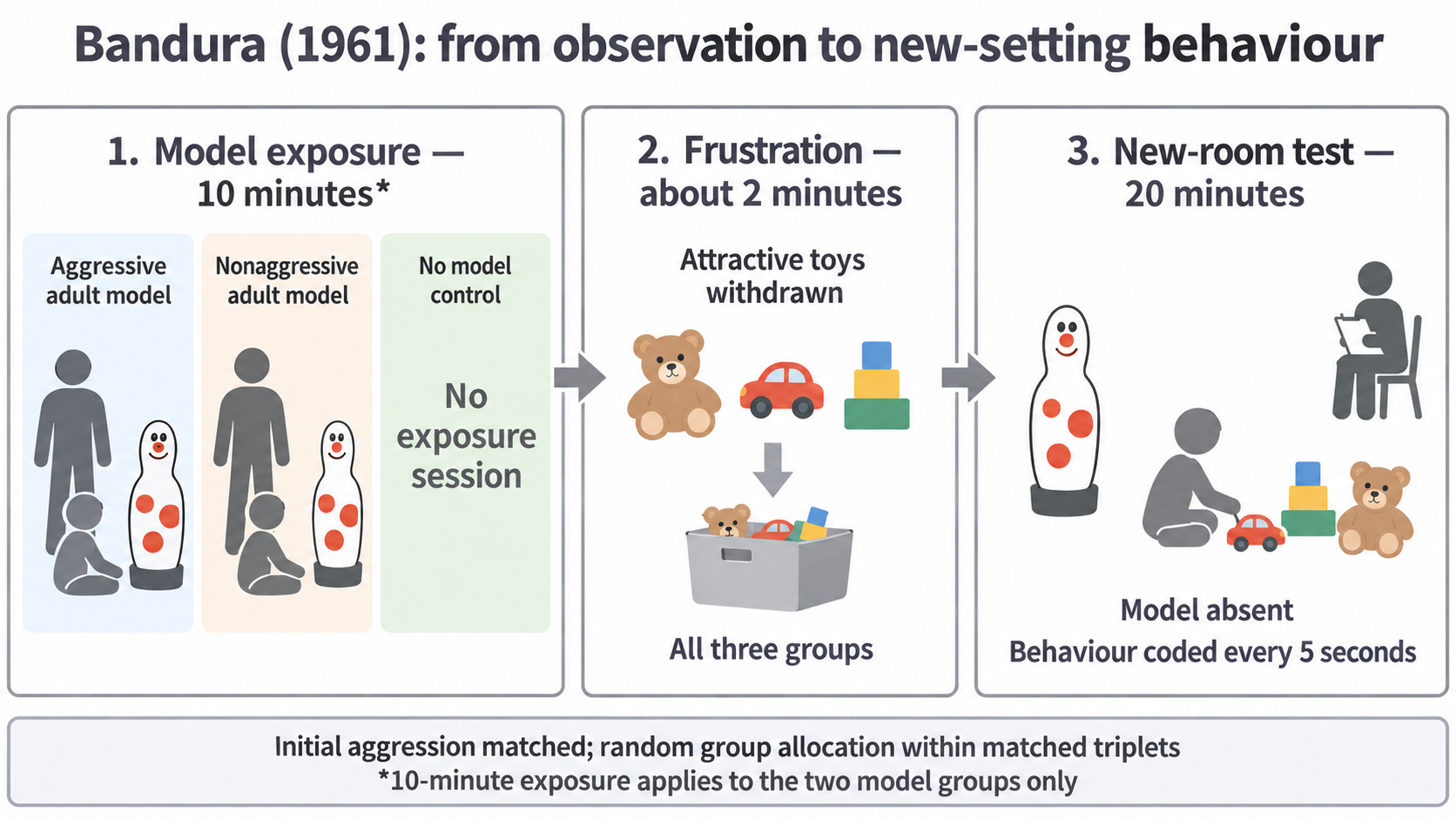
Diagram description: The control bypassed model exposure. All groups then experienced toy withdrawal and the same new-room test; the model was absent from that test.
Findings and what they mean
Children exposed to aggressive models produced substantially more imitative physical and verbal aggression than those in either other condition. Nonaggressive and control children displayed very little of these distinctive imitations. This supported the central prediction: behaviour observed from a model could be reproduced when that model was absent. It was not simply a count of all possible aggression; the distinction between imitative and nonimitative acts mattered.
Boys showed more imitative physical aggression than girls. Effects of model sex depended on the kind of behaviour: physical aggression showed stronger influence of the male model, whereas verbal imitation showed a tendency towards same-sex models. The findings do not support a blanket statement that every child copied only a same-sex adult. Some measures suggested inhibition after a nonaggressive model, particularly the male model, but nonaggressive and control groups did not differ significantly on every measure, including the main imitative aggression measures.
Continue this lesson.
You’re previewing NovaLearn without an account. Create a free account to read the rest.
Create free account