H567/03 Section A - Biochemical, genetic and brain explanations
Learn three biological explanations of mental illness and how to evaluate their evidence. Major depressive disorder is the worked example; biological vulnerability need not have a single cause or determine an individual's future.
Biochemical explanations and synaptic signalling
A biochemical explanation links symptoms to processes involving chemicals in the body, such as neurotransmission or stress hormones.
At a chemical synapse, a nerve terminal releases a neurotransmitter into the gap between neurons. The chemical binds to receptors and influences the receiving neuron. Reuptake transporters return some neurotransmitter to the releasing neuron; other processes also remove or break it down. The amount released, receptor responsiveness and removal all affect signalling. A meaningful explanation therefore concerns a process, rather than merely naming a chemical.
The monoamine hypothesis of depression proposes that altered signalling involving monoamines such as serotonin and noradrenaline contributes to depressed mood and related symptoms. A simple early version attributes depression to insufficient monoamine activity. This offers a testable biological mechanism, but treating every case of MDD as a proven serotonin shortage goes beyond the evidence. Depression is heterogeneous, and a single chemical measure does not provide a routine definitive diagnostic test.
[DIAGRAM: asset_slug: mh04_serotonin_synapse; file: mh04_serotonin_synapse.png; description: Conceptual synapse with serotonin release, postsynaptic receptor binding and a presynaptic reuptake transporter inhibited by an SSRI.]
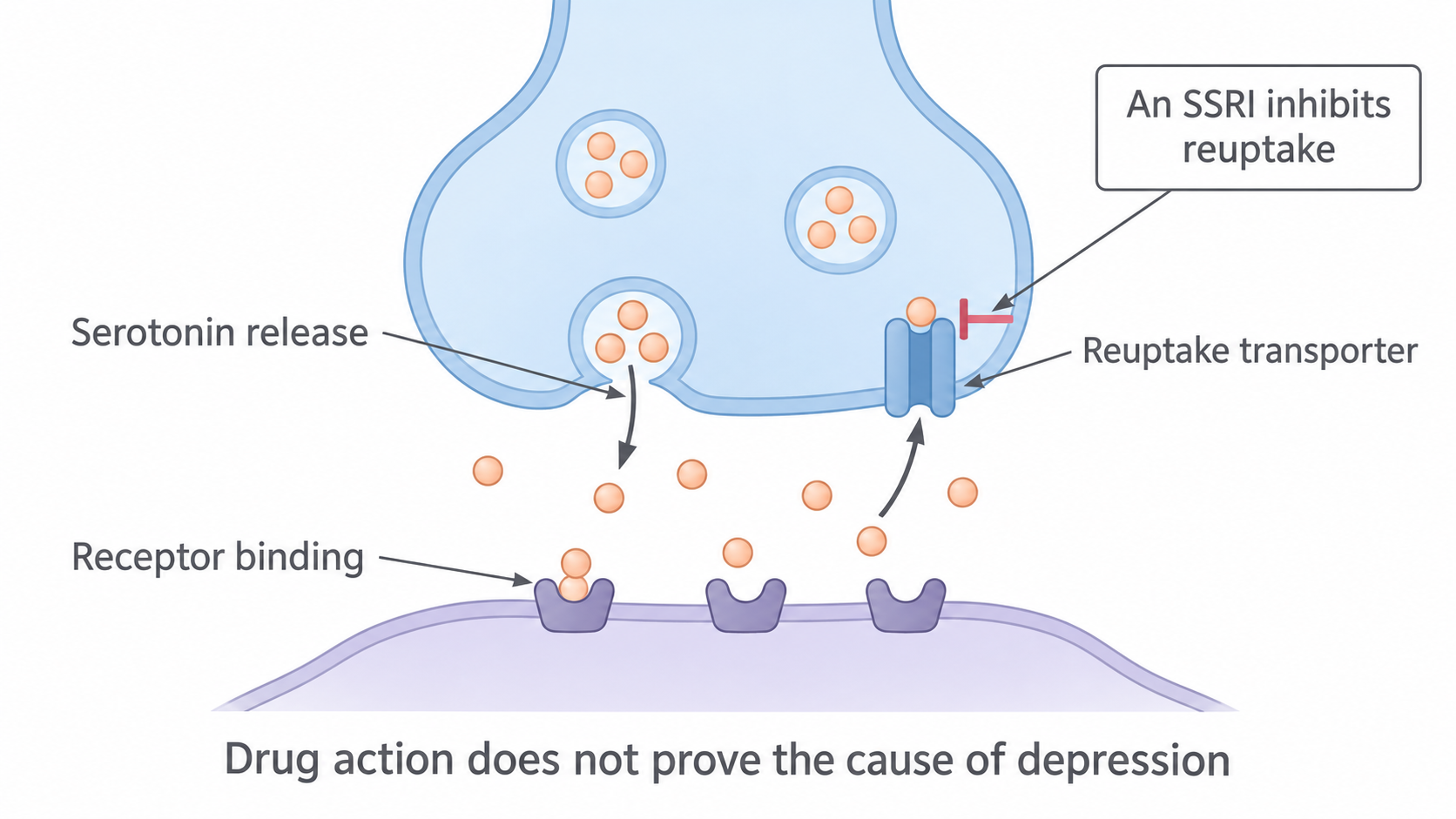
Diagram description: Serotonin is released from the upper nerve terminal into the gap, can bind receptors on the lower membrane, and can return through the upper reuptake transporter. Blocking that transporter changes synaptic availability. The diagram illustrates drug action, rather than evidence that depressed people all begin with too little serotonin.
Selective serotonin reuptake inhibitors (SSRIs) inhibit serotonin reuptake. This can increase its availability in the synaptic gap and alter signalling. Their action makes serotonin relevant to treatment research, but a drug's effect does not logically establish the original cause of a disorder. Pain relief by a medicine does not prove that the pain began with a deficiency of that medicine. Likewise, treatment response is different from demonstrating low serotonin caused MDD. The time course of clinical improvement also involves processes beyond immediate transporter inhibition.
Moncrieff and colleagues' umbrella review, published online in 2022, found no consistent support across the reviewed evidence for a simple reduced-serotonin account. The interpretation has been debated. The defensible conclusion here is that the simple shortage claim is not established; this does not mean neurotransmission has no role, or that the review alone settles whether an antidepressant benefits a particular patient. Treatment efficacy requires its own evidence.
Genetic vulnerability and environment
A genetic explanation proposes that inherited variation contributes to susceptibility to a disorder.
Genes are DNA sequences involved in the production or regulation of biological processes. Variation can affect proteins, development and signalling. MDD and many other common mental disorders are polygenic: many genetic variants contribute small effects, rather than a single gene inevitably producing the condition. A genetic association is evidence of a statistical relationship; it is not an individual destiny.
Family studies compare risk across relatives. Greater risk among closer biological relatives is consistent with inherited susceptibility, but relatives often share living conditions, stressors and social experiences. A family association alone cannot separate these explanations. Twin studies compare monozygotic and dizygotic twins, while adoption designs examine biological and rearing relationships; each has assumptions and limitations. Converging evidence across designs is stronger than one family comparison.
Concordance is the extent to which both members of a pair have the condition. Heritability describes variation associated with genetic differences in a particular studied population under its conditions. Neither tells us what percentage of one individual's depression was caused by genes. An estimate can change with the environment and measurement.
The diathesis–stress model combines vulnerability with environmental stress. A biological predisposition may increase susceptibility, while experiences such as prolonged adversity can contribute to whether symptoms develop. Protective relationships and resources may change outcomes. It does not require every person to have the same predisposition or the same triggering event, and it does not make people responsible for having their symptoms.
For a fictional application, two people share a family history of MDD but experience different stressors and support. One develops an episode and the other does not. The difference is compatible with susceptibility interacting with life circumstances. It neither proves a specific gene nor refutes all genetic contribution. The next research lesson examines actual family risk for schizophrenia and bipolar disorder; those figures must not be presented as MDD-specific estimates.
Continue this lesson.
You’re previewing NovaLearn without an account. Create a free account to read the rest.
Create free account