1.2 - Experimental designs
Learn how repeated measures, independent measures and matched participants designs arrange people across experimental conditions, and how to choose between them for a particular investigation.
Repeated measures and order effects
An experimental design describes who takes part in each condition; it is different from the research method or the place where the experiment happens. A laboratory experiment can use any of the three designs in this lesson.
Repeated measures design
The same participants take part in every condition of an experiment.
Imagine comparing recall after studying words in silence and after studying with background speech. In a repeated measures design, each person completes both conditions. Comparing their two recall scores reduces the influence of stable participant variables, such as their usual memory ability: each person acts as their own control. For the same number of scores per condition, fewer people need recruiting than in an independent measures design.
However, completing one condition can change performance in another. Order effects include practice, which may improve a later score, and fatigue or boredom, which may reduce it. If everyone does silence first, a difference could reflect task order as well as sound. A learner might also work out the aim by seeing both conditions and change their behaviour; these cues are demand characteristics.
Counterbalancing spreads order across conditions. Half complete silence then speech (AB); half complete speech then silence (BA). This prevents one condition always benefiting from going second. Use equivalent word lists, assigning the lists across conditions as well, so participants do not simply recall the same words again. Counterbalancing does not erase every carry-over effect: a task that teaches a lasting skill cannot be made unlearned by changing order. A rest interval may reduce fatigue but cannot reverse permanent learning.
Independent measures and participant differences
In an independent measures design, different people take part in the different conditions. Each person completes only one condition, so doing an earlier experimental condition cannot create practice or fatigue in a later one. Participants also do not directly compare both conditions, which can make the aim less obvious, although demand characteristics can still occur.
For the recall investigation, one group studies in silence and another with speech. A problem is that one group may have stronger memory ability before the manipulation. A score difference could then reflect individual differences, not background sound. With small groups, even allocation by chance may produce imbalance.
Random allocation assigns already recruited participants to conditions by a chance procedure, such as shuffled condition cards. It reduces systematic allocation bias and makes groups more likely to be comparable; it does not guarantee identical groups. Random allocation is not random sampling: sampling selects people from a population, whereas allocation puts selected people into conditions. Standardising instructions or task length controls procedural differences but does not itself equalise memory ability.
This design requires more participants to obtain the same number of scores in each condition. For example, 12 scores in each of two conditions require 24 different people; a repeated measures design would require 12 people completing both.
Matched participants and relevant characteristics
A matched participants design uses different people in the conditions but matches them in pairs on characteristics likely to affect the dependent variable. One member of each pair enters one condition; the other enters the other condition. Randomly allocating the members within each pair avoids consistently assigning one kind of person to a condition.
In the recall investigation, a researcher could give an initial equivalent memory task, pair people with similar scores, and place one from each pair in silence and the other with speech. Matching on memory ability is more directly relevant than matching only on an unrelated feature such as shoe size. Age might also matter if there is a reason it affects the task, but the choice should follow the research problem.
Matching reduces differences on the selected characteristics while avoiding cross-condition order effects, because no person completes both experimental conditions. It does not make the participants identical. A pair matched for initial memory could still differ in motivation, familiarity with the words or hearing. Recruiting, measuring and pairing people takes time; suitable partners may be hard to find. If one person withdraws, the matched comparison for their partner may be lost. A pre-test can also give practice, so both members should receive the same pre-test procedure and a different experimental list.
Choosing and controlling a design
The best design depends on what would threaten the interpretation of this particular experiment. Repeated measures is useful when stable individual differences are substantial and carry-over can be limited. Independent measures is useful when exposure to one condition produces lasting learning or reveals information that cannot be forgotten. Matched participants can combine separate groups with some control of relevant differences, if reliable matching measures and recruitment time are available.
[DIAGRAM: asset_slug: rm07_participation_designs; file: rm07_participation_designs.png; description: Three participant-allocation schematics distinguish the same people in both conditions, separate groups, and different people matched in pairs. Arrows indicate participation, not the order of conditions.]
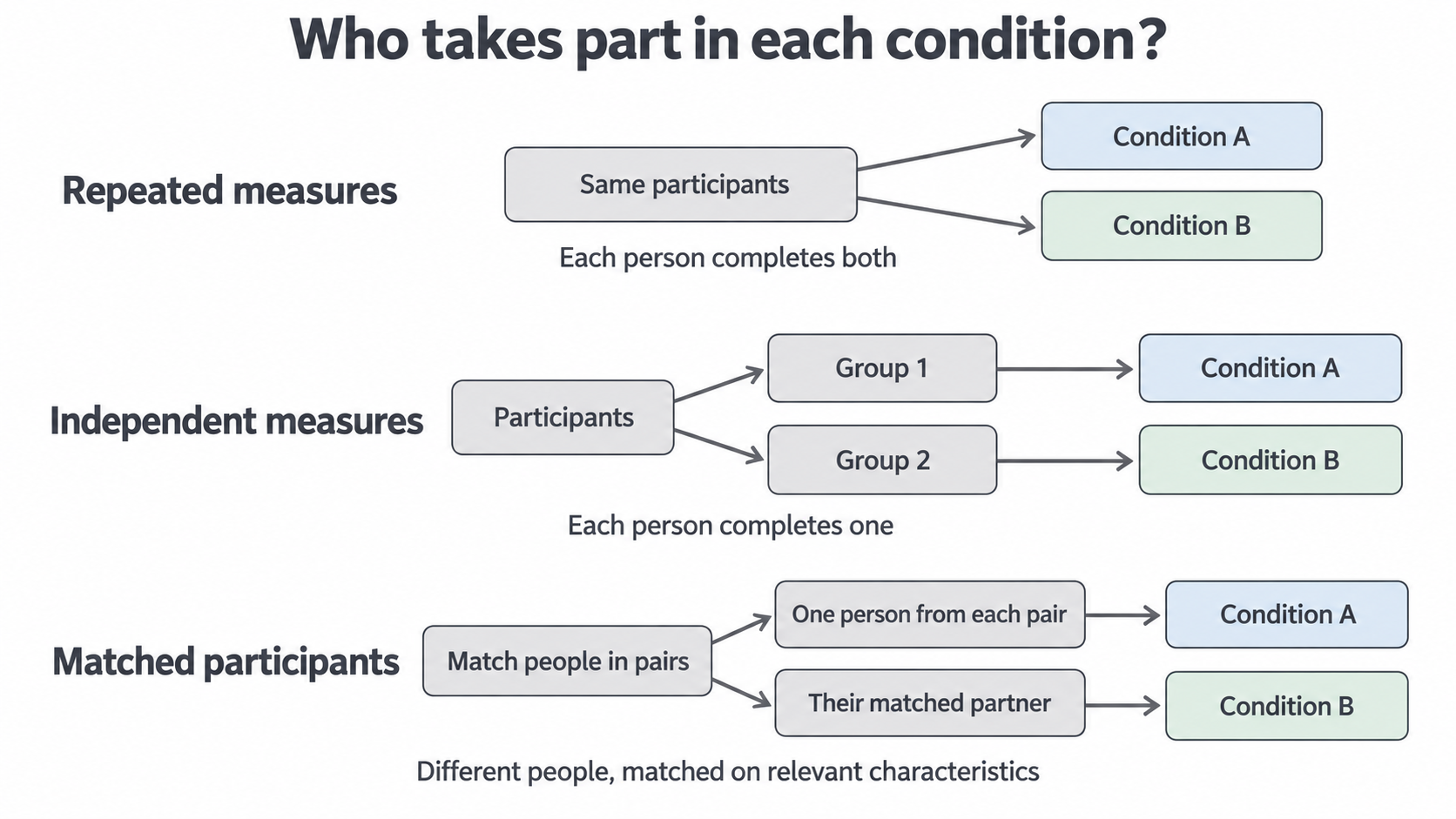
Diagram description: Repeated measures uses the same people twice; independent measures uses separate groups; matched participants separates the members of relevant matched pairs across conditions.
| Design | Main protection | Remaining problem | Contextual response |
|---|---|---|---|
| Repeated measures | Stable participant differences are controlled within a person | Practice, fatigue or carry-over | Counterbalance reversible order effects; use equivalent materials and suitable rest |
| Independent measures | No cross-condition order effects | Groups may differ before the manipulation | Randomly allocate; keep the procedure otherwise consistent |
| Matched participants | No cross-condition order effects; selected differences reduced | Unmatched characteristics and difficult pairing | Match on relevant measured characteristics; randomly allocate within pairs |
These controls strengthen internal validity, the confidence that the manipulation rather than another difference caused the observed effect. They do not establish that the sample represents everyone or that the task resembles everyday life. A carefully matched laboratory experiment can still have limited generalisability. Evaluate a design by naming a feature, explaining its consequence, and relating that consequence to the actual task.