1.5 - Conducting an experiment practical
Learn to turn a causal question into a controlled small experiment, collect and analyse recall scores, and reflect on the real procedure. The example data are fictional; written success does not certify practical conduct.
A testable manipulation
An experiment deliberately changes an independent variable and measures a dependent variable while trying to rule out other explanations.
Our original project asks whether organising a word list by category affects immediate recall. The independent variable is list order: category-grouped or mixed. The dependent variable is the number of different list words correctly written during a 60-second free-recall period after 30 seconds of studying. It ranges from 0 to 12. It is a measure of recall on this task, not a measure of overall intelligence or all memory abilities.
Both lists contain exactly the same words. The grouped order is apple, pear, plum, peach, shirt, coat, socks, dress, bus, train, boat, car. The mixed order is apple, shirt, bus, pear, coat, train, plum, socks, boat, peach, dress, car. Grouping could offer retrieval cues through shared meaning, but changing order also changes serial positions. A result therefore concerns the whole ordering manipulation; it does not isolate every possible cognitive mechanism.
A non-directional alternative hypothesis states that the number of different words recalled in 60 seconds after studying the 12-word list for 30 seconds will differ between adults given grouped and mixed orders. The null states no population difference between those conditions. A directional prediction of greater recall for grouped order would need to be decided and justified before seeing the results, not chosen because one sample mean is higher. This small classroom practical can use the non-directional hypothesis without pretending to establish a new universal theory.
Allocation and a replicable procedure
Random allocation and standardised procedures reduce alternative explanations but address different sources of variation.
With supervisor approval, invite 20 available consenting adults from the local learning centre. This is an opportunity sample. After consent, draw from 20 shuffled slips, ten marked Grouped and ten Mixed, without replacement. This randomly allocates the recruited people to independent groups; it does not turn recruitment into random sampling. Each person sees only one list, avoiding practice or carryover from seeing the same words twice. Random allocation reduces systematic participant differences in expectation, but a small sample may still be unbalanced in reading fluency or prior familiarity.
Prepare the two printed lists in the same font, size and single-column layout; blank recall sheets; a scoring key; an approved timer; and a standard instruction script. Test people individually in the same quiet room. Explain that they will see 12 words for 30 seconds and should then write as many as they can remember during 60 seconds, in any order, without aids. Present the allocated list, time exposure, remove it completely, begin recall and stop after 60 seconds. Use identical timing and instructions. Avoid hints or praise during recall. Record interruptions or timing errors rather than quietly changing scores.
Score each correct listed word once, ignore duplicates, and use an agreed rule for recognisable spelling errors that do not produce another word. The scorer can use coded sheets without knowing the condition where feasible, reducing expectation bias. A second scorer checks a subset against the key. Pilot the script, timing and scoring with volunteers excluded from the main sample; revise before collection. Do not change the key after seeing which condition benefits.
Repeated measures would control stable individual differences by using each person in both conditions, but this exact pair of lists repeats the same words. Counterbalancing order cannot remove learning those words; equivalent alternative lists and a revised protocol would be needed. A design change is therefore more than adding “counterbalance” to the report.
Participant welfare and reliable records
A memory task needs safeguards against pressure, distress and accidental disclosure even without physical treatment.
Complete the institution's risk assessment with the supervisor before conduct. Identify who may be affected, the likelihood and severity of harm, controls and what would trigger a stop. Participation must be voluntary and unrelated to teaching grades or access to services. Provide accessible information about the task, duration and use of scores; obtain the institutionally required consent, allow withdrawal without penalty and avoid recruiting someone who cannot understand that information. State that this is a short task, not an intelligence assessment. Stop and respond appropriately if someone becomes distressed; do not require them to finish for the sake of balanced groups.
Use participant codes and private recall sheets. Do not announce scores to classmates. A code and a withdrawal deadline allow removal before anonymous aggregation; explain that removal is no longer possible once records are irreversibly anonymised. Debrief about the ordering comparison and why incomplete recall is normal on this particular task. Keep consent records separately from task data, with restricted access and approved deletion arrangements. An unobstructed seated room and safely placed timer/equipment address physical hazards. Check whether any access adaptation changes the operationalised task; record it and interpret honestly rather than silently excluding a person.
Enter data into an institution-approved spreadsheet with participant code, assigned condition, score, usable/excluded status and a non-identifying deviation note. Restrict score entries to integers from 0 to 12, but check against paper sheets because an allowed value can still be mistyped. Preserve a read-only raw copy. Use formulas to calculate condition summaries and manually verify a small subset; a formula including an empty or wrong row can create a plausible but false mean. Save the final materials, timer plan and scoring rules so ICT supports reproducibility rather than becoming an undocumented black box.
Summarising and testing the difference
Descriptive results show the observed sample difference, while an appropriate inferential test assesses evidence against the stated null hypothesis.
This smaller fictional illustration contains six usable scores per condition, not the planned 20-person practical:
| Condition | Recall scores out of 12 | Sum | Number of scores |
|---|---|---|---|
| Grouped | 7, 8, 9, 6, 8, 10 | 48 | 6 |
| Mixed | 4, 6, 5, 7, 5, 3 | 30 | 6 |
Grouped mean recall is words; Mixed mean recall is words. The observed difference is words. These are sample summaries; the means do not show every individual's score, and a three-word difference does not by itself establish statistical significance or causation.
A frequency table preserves the score distribution. List the distinct Grouped scores in order, tally each person's score once and check that the frequencies sum to the sample size:
| Grouped score | Frequency |
|---|---|
| 6 | 1 |
| 7 | 1 |
| 8 | 2 |
| 9 | 1 |
| 10 | 1 |
These sum to six people. A bar chart of these separate score categories would have frequency on its vertical axis, unlike the mean chart below. A histogram instead groups a continuous measure: in a different fictional timing practical, durations 14.2, 18.5, 21.0, 27.8, 33.3 and 36.0 seconds give frequencies 2, 4 and 0 for , , . In a notebook use a continuous seconds axis, equal 20-second bins, a zero-based frequency axis and touching bars at 2, 4 and 0. State that these are separate illustrative timings, not durations measured in our recall dataset. Equal widths permit frequency heights; unequal widths need density. Choose between a frequency table, category bars, a histogram and a mean chart according to the variable and summary being displayed.
Construct a notebook bar chart with separated equal-width Grouped and Mixed bars. Label the vertical axis “Mean words recalled out of 12”, use an evenly spaced scale from 0 to 12, and draw heights 8 and 5. State that the chart represents six fictional adults per condition. Translate back from the picture: the Grouped bar being three units taller means three more words on average, not three more participants. The same information is expressed algebraically as .
[DIAGRAM: asset_slug: rm31_recall_means; file: rm31_recall_means.png; description: Two separated bars showing illustrative mean recall of 8 words for Grouped and 5 for Mixed, six participants per condition.]
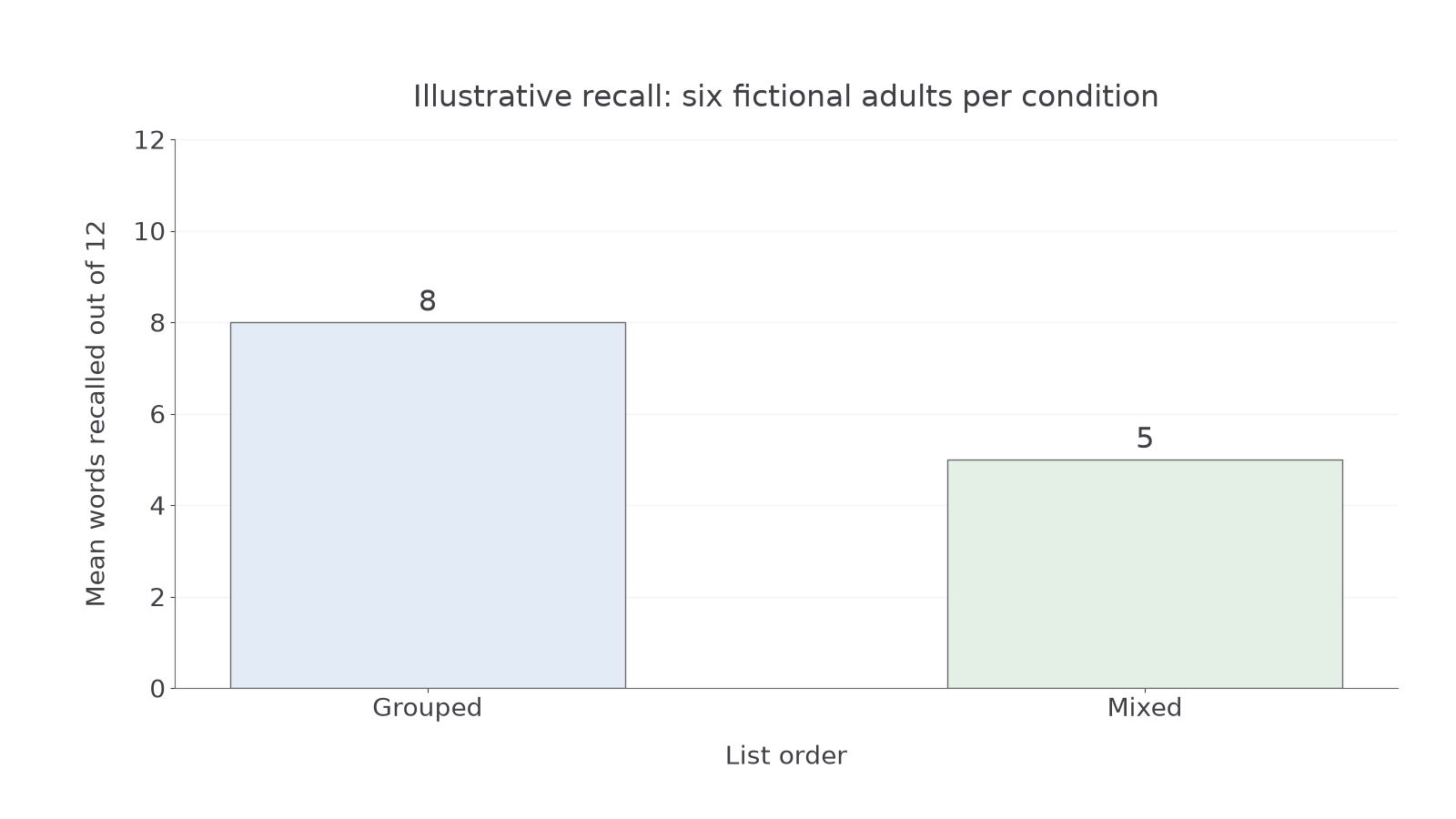
Diagram description: The vertical scale is recall score, not frequency; the chart summarises the supplied fictional dataset.
For a non-parametric analysis of a difference between these two independent groups, with scores that can be ranked and no established normality assumption, choose Mann–Whitney U. Selection depends on difference, independent groups and rankable data; it is not chosen merely because there are two columns. For a revised repeated-measures design with rankable paired differences, Wilcoxon signed-rank could be appropriate instead. A correlation test would answer a different question about association.
Use the taught calculation and a table matching the selected test, effective sample sizes and preselected tail/significance level if inference is undertaken. This lesson does not claim a significance decision from the means alone. A significant result would provide evidence against the null under the test assumptions; it would not prove a 95% probability that grouping caused recall, nor guarantee useful improvement in everyday studying.
Reporting causal limits and improvements
A good report judges whether the procedure supports the intended causal comparison and what could improve it.
Report aim and hypotheses, sample/recruitment, design/allocation, apparatus/materials, standardised procedure and ethics. Results contain labelled condition summaries, displays and any inferential decision with its relevant support. Appendices retain anonymised raw scores, actual lists, consent/instructions and calculation workings. Discussion interprets the pattern, relates it to the proposed grouping mechanism and examines alternatives. Do not write the planned sample as though all 20 actually completed it; record actual numbers, omissions and reasons that can safely be shared.
Control strengthens internal validity: identical words and timings reduce vocabulary and exposure-time explanations. Nevertheless, word order also changes serial positions and volunteers may guess the aim. A different recall strategy, uneven group composition or unnoticed hints could affect scores. Small local opportunity recruitment and a brief artificial task limit generalisation to other learners, materials and delayed memory. These are reasons to qualify a conclusion, not reasons to discard all experimental evidence.
Reflect on your actual role and observed deviations. If a timer failed, explain which exposure was affected, apply the pre-agreed handling rule, propose a checked backup timer and pilot it. If scoring disagreements occurred, specify the ambiguous rule and revise it before a future study. A fictional log can be used to practise such adaptation only when described as fictional. Completion of the real required experiment needs approved practical conduct and genuine records, not a model paragraph claiming experience.