H567/02 Section A - Moral development: comparing the pair
Kohlberg (1968) and Lee et al. (1997) investigated children's moral thinking. Compare the questions they asked before deciding whether the contemporary study changes the classic account.
A shared theme with different questions
Both studies belong to the developmental area and the theme moral development. They considered age-related patterns in children's moral judgements and used hypothetical situations, rather than asking participants to carry out harmful acts. Both also examined more than one cultural setting, making the reach of a moral explanation a central issue.
Kohlberg focused on why a choice was justified. He proposed movement from personal consequences, through social approval and order, towards rights and universal principles. Two people could choose the same action yet express different stages of reasoning. Lee focused on how good or naughty a statement was judged, varying whether it admitted or denied a good or bad deed. A child could approve helping while rating admission of helping less favourably because of modesty.
The shared theme does not make the outcomes identical. A stage classification concerns the structure of a justification; a truth/lie rating concerns the evaluation of a particular statement. Neither directly measures actual moral conduct, and a disagreement between ratings cannot be translated automatically into a difference in Kohlberg stage.
[DIAGRAM: asset_slug: cs18_moral_questions; file: cs18_moral_questions.png; description: Kohlberg's proposed levels of reasons are contrasted with Lee's four deed-statement combinations. The diagram distinguishes why an action is justified from how a statement is evaluated, under the shared moral-development theme.]
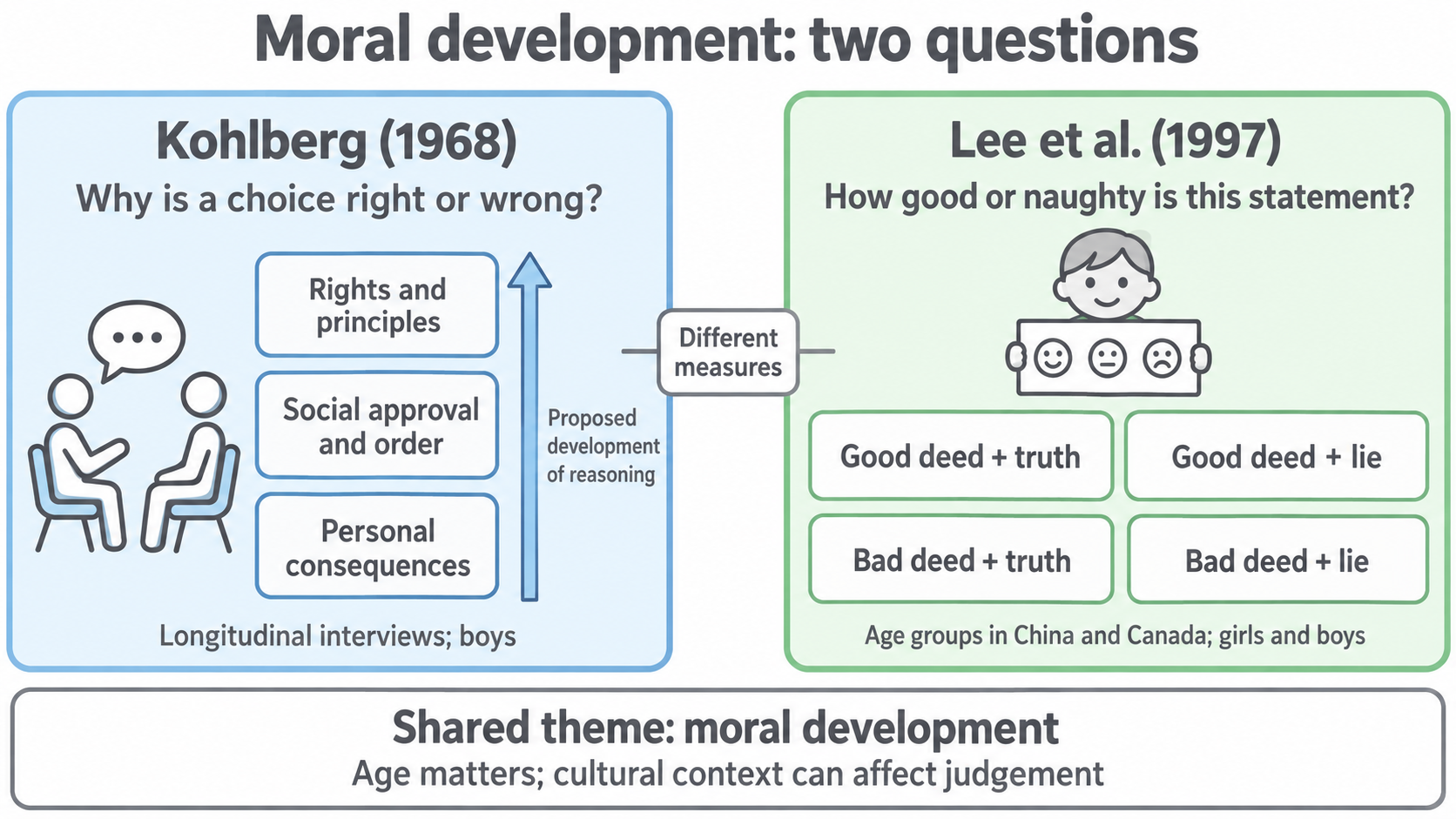
Diagram description: The left sequence represents Kohlberg's proposed development of reasoning, not fixed age steps. The right combinations represent Lee's contextual judgement task; the two studies measured different aspects of morality.
Comparing design, samples and evidence
Kohlberg's American sample of 75 boys, initially aged 10–16, was followed with interviews at three-year intervals over the period discussed in the account. Lee tested different seven-, nine- and eleven-year-olds at one time: 120 Chinese and 108 Canadian children, including girls and boys. Thus Kohlberg's longitudinal evidence could demonstrate change within a person, while Lee's cross-sectional evidence efficiently compared age groups but could not track an individual child's development. A long follow-up risks attrition and effects of repeated interviewing; separate age groups leave participant and cohort differences as alternative explanations.
Kohlberg's open reasons provided rich qualitative material, later coded into ordered stages. This revealed grounds that a yes-or-no answer would hide, but classification could depend on language skill and the coder's interpretation. Lee used a common seven-point rating chart, story structure and order controls, giving more directly comparable quantitative judgements. Those ratings compressed children's reasons, although post-task discussion added qualitative information. Both frameworks standardised comparison; neither standardisation alone established a universal moral construct.
Both methods involved responding to hypothetical material with an adult present. Kohlberg's abstract dilemmas may place greater demands on verbal reasoning; Lee's illustrated school situations were more familiar to children, but still did not measure their real-life truth-telling. Social desirability and differing interpretations of questions could affect either. An ethical similarity is that participants judged acts rather than performing them; a shared concern is the need to protect children from discomfort and pressure to give an approved answer.
Continue this lesson.
You’re previewing NovaLearn without an account. Create a free account to read the rest.
Create free account