H567/03 Section B Option 1 - Attachment development and its disruption
Attachment is a developing relationship with a particular caregiver. Its formation, its quality and the behaviours used to express it must be distinguished before explaining what disruption might mean.
Attachment and attachment behaviour
Attachment is an enduring emotional relationship in which a particular person becomes a source of security. Attachment behaviours are observable actions that promote proximity or contact, such as calling, approaching, clinging or seeking reassurance. The relationship can persist while none of these actions is occurring.
A child confidently playing while occasionally checking a familiar caregiver may be using a secure base. When alarmed, the same child may stop exploring and seek comfort. Constant clinging is therefore not a simple measure of a stronger attachment, and independent exploration is not necessarily evidence of a weak one. Behaviour depends on what the situation activates.
[DIAGRAM: asset_slug: ch09_secure_base; file: ch09_secure_base.png; description: A familiar caregiver's availability can support exploration; when the child is alarmed, the same relationship can support proximity seeking. Neither panel measures attachment strength.]
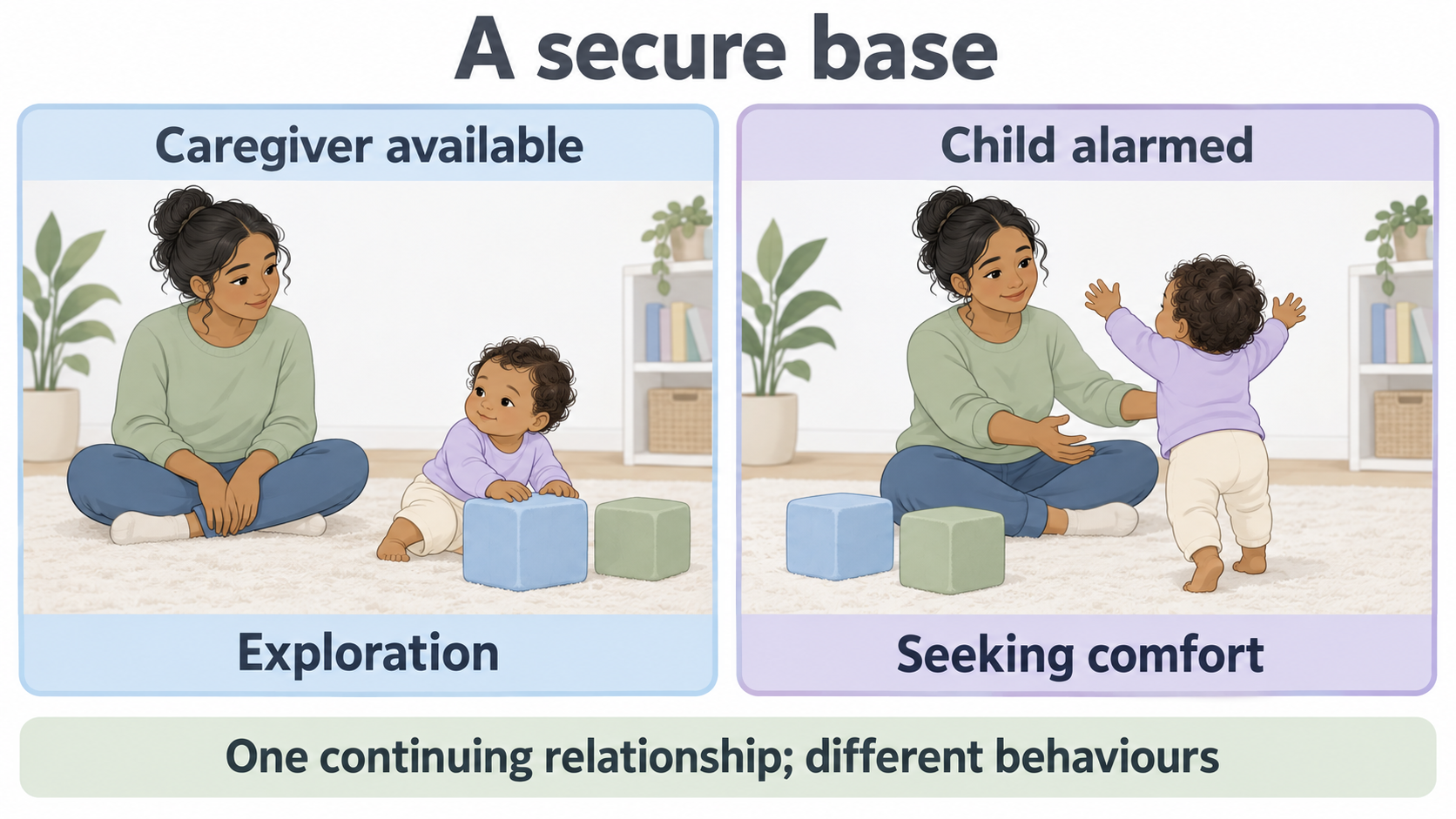
Diagram description: The two panels show possible behaviours within one continuing relationship. Context changes the balance between exploration and seeking comfort; a single behaviour does not establish the quality of attachment.
An evolutionary explanation links proximity seeking to protection during a dependent infancy, while exploration supports learning about the environment. Ainsworth and Bell investigated the changing balance between these systems. This account concerns a predisposition and its interaction with experience, not proof that every child responds identically.
How selective relationships develop
Early infants produce signals such as crying and smiling before these are consistently directed towards one particular person. Repeated interaction allows recognition, expectations and increasingly selective responses to familiar caregivers. As reaching and movement develop, an infant can actively approach or follow a preferred person.
Reliable, appropriately responsive care can connect the infant's signals with comfort and help. Over time the child develops expectations about a caregiver's availability. A caregiver need not prevent every difficulty: responding sensitively to the child's actual need differs from intruding on all independent activity.
Social interaction is central, but sensory recognition, memory, movement and biological needs also contribute. Feeding provides opportunities for closeness, yet attachment should not be equated with whoever supplies food. Protection and responsive interaction are broader than hunger reduction.
Children can develop relationships with more than one familiar caregiver, and quality may differ across those relationships. Caregiving arrangements vary across families and cultures. The prescribed Ainsworth–Bell sample involved mothers, which does not establish that only mothers can provide security. Developmental timing and expressed behaviour vary; one brief observation cannot certify a child's whole relationship history.
Continue this lesson.
You’re previewing NovaLearn without an account. Create a free account to read the rest.
Create free account