H567/02 Section A - Blakemore and Cooper (1970): early visual experience
Blakemore and Cooper investigated whether an unusually restricted early visual environment could shape visual behaviour and the response preferences of neurons in kittens' visual cortex. The study connects experience to brain development, while raising substantial ethical and generalisation questions.
Background, design and animal sample
In a normally developed visual cortex, many neurons respond most strongly to a line or edge at a particular orientation. Across the population, different orientations are represented. Earlier work had exposed different eyes to different orientations. Blakemore and Cooper instead restricted the animal's visual environment as a whole, while allowing normal binocular vision during exposure, to ask how experience shaped the developing system.
Brain plasticity
The capacity of the nervous system to change its organisation or functioning in relation to experience or other influences. Plasticity is not a claim that every change is beneficial or unlimited.
The research was a laboratory experiment: visual exposure was deliberately restricted to horizontal or vertical stripes. Stripe orientation was the independent variable; observed visual behaviour and neural response preferences were dependent measures. Separate animals experienced the different orientations, so this was an independent-groups comparison. The report does not document random allocation; do not invent it merely because the environment was manipulated.
The sample consisted of kittens raised under the restricted conditions. The preliminary paper does not give a precise total number for all kittens observed behaviourally. It explicitly reports recording from two cats, one raised with each orientation, at the later neural stage. That is a justified neural sample size, not permission to claim that exactly two animals comprised every stage.
Cats offered a visual system whose orientation-sensitive cortical cells could be investigated directly. Using a developing animal system allowed control of experience that would be unacceptable with human infants. Similarity to human visual processing makes the work relevant to biological explanations, but does not guarantee identical developmental timing or consequences in humans.
Restricted environments and testing procedure
Kittens were housed in darkness from birth. From about two weeks old, they spent roughly five hours daily on a clear glass platform inside a tall cylinder whose interior contained only one stripe orientation. One condition had vertical stripes and the other horizontal stripes. The rest of the time they remained in darkness.
The cylinder had no corners; the upper and lower edges were outside the relevant view. A wide black collar prevented the kitten seeing its own body. Those features were controls: an ordinary corner, floor edge or visible limb could supply orientations other than the intended stripes. The animals could turn their heads and move, so the manipulation was restricted patterned experience rather than holding the eyes fixed in one direction.
[DIAGRAM: asset_slug: cs22_restricted_visual_environments; file: cs22_restricted_visual_environments.png; description: Two cylinders provide vertical-only or horizontal-only patterned exposure, with a glass platform and collar to remove other visible contours. Darkness surrounds the daily exposure period.]
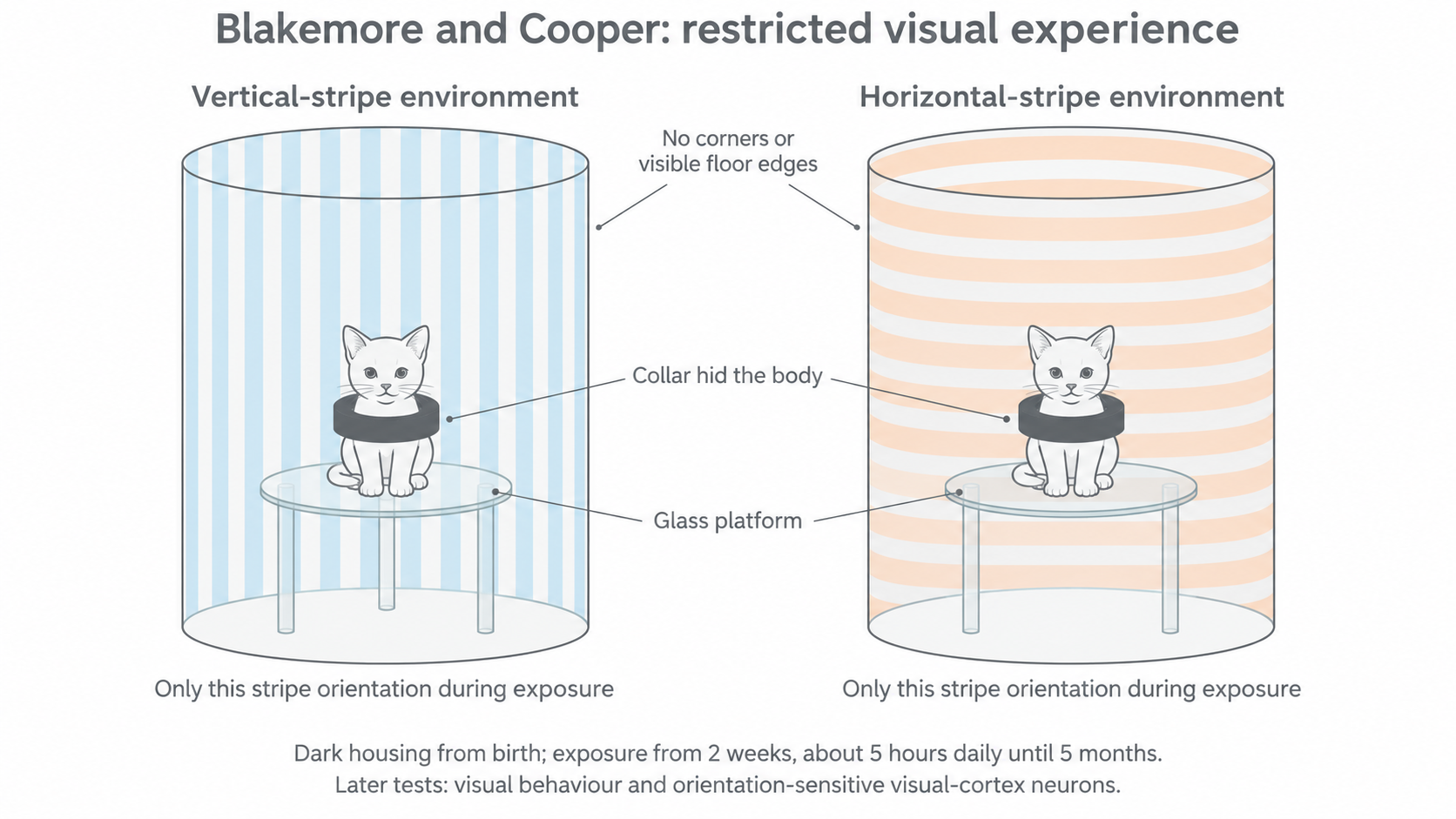
Diagram description: This is an external schematic of the apparatus, not the kitten's visual view. The outlines of the platform supports and body explain the setup; they were not intended sources of visible contours for the kitten. The collar hid the body and the cylinder's boundaries were outside the relevant view.
At about five months, the restricted routine ended. Researchers observed the animals for several hours each week in a well-lit room containing tables and chairs, examining visual guidance, tracking, reactions to surfaces and response to rods at different orientations.
At about 7.5 months, the two cats used for neural recording were anaesthetised and immobilised. Microelectrodes recorded individual neurons in visual cortex while bright slits or edges were displayed on a screen. Optical correction and checks on the eyes helped exclude an eye-optics explanation, such as severe astigmatism. The researchers examined which orientation produced a cell's strongest response, linking behaviour to cortical physiology rather than judging vision only from movement.
Behavioural and neural findings
Initially in ordinary light, the animals had normal pupillary responses but serious difficulties using vision. They did not initially show normal visual placing or startle responses, relied heavily on touch and were reluctant at edges. After about ten hours of total ordinary visual experience, many behaviours improved: startle and placing responses appeared and the kittens could jump to the floor. Improvement did not mean complete recovery. Tracking remained jerky, they could reach towards objects beyond reach and they bumped into table legs.
Their strongest persistent difficulty concerned contours at right angles to the experienced orientation. A vertically raised kitten responded to a vertical rod but largely ignored a horizontal one; the reverse pattern appeared for horizontal exposure. They were not wholly blind to all stimuli, and the normal pupillary reflex did not show that higher visual processing was normal.
The neural stage recorded 125 neurons from the two cats. The report's orientation plots included 52 cells from the horizontally raised cat and 72 from the vertically raised cat; the remaining recorded cell was a non-orientation-selective projection fibre. Cells responded mainly to orientations close to those experienced during rearing. No recorded cell had its preferred orientation within 20 degrees of the axis perpendicular to the experienced stripes. Most cells still responded through both eyes, so the effect was not simply loss of binocular response.
The neural findings converged with the behavioural findings: a restricted visual history was accompanied by a restricted range of cortical orientation preferences and difficulty with the unexperienced orientation. But 125 cells do not equal 125 independently reared cats. Many recordings from only two animals improve detail about those animals; they do not create a large animal sample.
Conclusions, theme and biological area
The authors concluded that development of visual-cortex organisation depends on early visual experience. The environment appeared to influence which orientations neurons preferred, rather than merely revealing an entirely fixed, experience-independent arrangement. They suggested that cells might adapt their preferred orientation towards commonly experienced features; the experiment did not directly film that adjustment occurring in each cell.
Continue this lesson.
You’re previewing NovaLearn without an account. Create a free account to read the rest.
Create free account