1.5 - Conducting an observation practical
Learn how to collect observable behaviour systematically, protect participants, display the data and improve the method. The example records are fictional; the written activities prepare you for a supervised practical and do not certify that it has occurred.
Behaviour that observers can record
An observation records behaviour using agreed rules rather than asking people to explain what they did.
Our original practical asks: How is visible activity distributed during a voluntary quiet reading session? Invite ten available consenting adults from an approved library session. This is opportunity sampling of a restricted local population; it cannot establish how every adult reads. Record the number recruited and actual characteristics relevant to generalisation without collecting unnecessary identifiers. No condition is manipulated, so this observation does not test whether devices cause poor reading.
Prepare a coding sheet with participant codes and three mutually exclusive categories at each sampling instant:
| Category | Visible recording rule |
|---|---|
| Text | Eyes directed at the chosen printed reading material |
| Device | Eyes directed at a phone, tablet or computer screen |
| Other | Participant is visible, but eye direction is elsewhere or cannot be classified as Text or Device |
Device use may involve reading rather than distraction. Eye direction is an imperfect indicator of attention; never label these counts “concentration scores” without validating that interpretation. “Other” catches uncertain direction for a visible participant instead of forcing a guess; an out-of-view participant or missed scan is missing. A brief separate field note, such as “participant moved behind shelf”, preserves qualitative context; counts of codes are quantitative. Do not record screen content, conversations or names.
Two observers pilot the same permitted brief session independently, then compare codes for the same participant at the same instants. If one codes a glance as Text and the other as Other, refine the duration/visibility rule. Train with the final rules and check agreement again. Agreement is inter-observer reliability, showing consistency of coding; two observers can agree on a poor proxy, so it does not establish validity.
Sampling behaviour in time
A replicable observation states where, when and how behaviour is sampled, as well as who is observed.
Use an agreed quiet room for one 15-minute voluntary reading session. The observer sits at the same unobtrusive, permitted position, remains a non-participant and does not join the reading activity. Set a silent timer to signal every 30 seconds, beginning at 30 seconds and ending at 15 minutes. This gives 30 time-sampling instants per person. At each instant, record the category for each visible participant using a fixed scanning order; pilot whether all ten can be scanned quickly enough to represent that instant, and reduce the group size if necessary. Record missed observations as missing, not Other. Note the actual schedule and deviations.
Time sampling can make a sustained session manageable, but misses behaviour between instants. Event sampling instead records every occurrence of a predefined event, such as every switch from printed text to a device, during a stated interval. It captures brief switches but requires a clear definition of when a new switch starts, and frequent events may overwhelm an observer. A switch count and a sampled-state count answer different questions; do not compare them as though they are the same measure.
The setting is arranged for the practical and participants know they are observed: it is a controlled, overt observation. A naturalistic study would observe an everyday reading session without rearranging it. An overt approach allows explicit consent but may change behaviour; covert observation is not an automatic cure because it creates privacy and consent concerns. This practical uses overt observation. The same person contributes repeated scans, so 300 scans from ten people are not a sample of 300 independent people. Report participant and scan totals separately.
Consent, risk and recording tools
Observation needs ethical and physical controls even when no treatment is given.
Before recruiting, gain the supervisor's and institution's approval and complete the required risk assessment. The form identifies possible obstruction of exits, discomfort at being watched and disclosure of private activity; it records who is affected, controls, residual risk and a stop procedure. Use a seated observer location away from doors and equipment cables. Tell adults what visible behaviour will be recorded and for how long, obtain informed consent, state that participation has no effect on library access and allow stopping without penalty. Follow the institution's consent requirements for the chosen participants.
Observe only the agreed consenting group. If a bystander enters, stop recording them and use the agreed pause or missing-data rule. Never secretly record conversations or screens. Video can improve later coding but also creates an identifiable record; it needs separate explicit consent, secure storage and an approved deletion/withdrawal plan. This protocol uses live coding without photographs or audio/video. Debrief participants about the aim and the limits of interpreting eye direction. Give a withdrawal code and deadline before anonymous aggregation and explain when individual removal ceases to be possible.
Use an approved spreadsheet with one row per participant per scan and columns for code, scan time, category, missing flag and a brief non-identifying note. A drop-down list reduces inconsistent spellings; it does not prevent an observer choosing the wrong category. Preserve a read-only raw file, check row totals against the coding sheets and restrict access. A silent timer prevents audible cues that could prompt device checking. Prepare paper sheets in case a device fails; document switching tools rather than silently filling gaps. Do not use public cloud storage for identifiable records.
From observations to useful displays
Choose a display that matches the kind of recorded variable and clearly distinguishes a person from a scan.
In one fictional participant's 30 usable scans, Text occurs 18 times, Device 8 and Other 4. Their ratio is , and Text occupies of sampled instants. Device and Other occupy and , rounded to one decimal place. These estimate sampled states rather than continuously measured durations; brief changes between scans are unknown. If scans are missing, state the usable denominator.
| Category | Frequency of sampled state |
|---|---|
| Text | 18 |
| Device | 8 |
| Other | 4 |
To construct the bar chart in a notebook, label the horizontal axis with these three separate categories and the vertical axis “Frequency of sampled state”. Use a zero baseline, equal-width separated bars and a uniform scale reaching at least 18. Draw bars at 18, 8 and 4; give a title that identifies one fictional reader and 30 scans. The gaps show categories rather than adjacent intervals of a continuous measurement.
[DIAGRAM: asset_slug: rm30_sampled_states; file: rm30_sampled_states.png; description: Separated category bars for 30 illustrative scans: Text 18, Device 8, Other 4.]
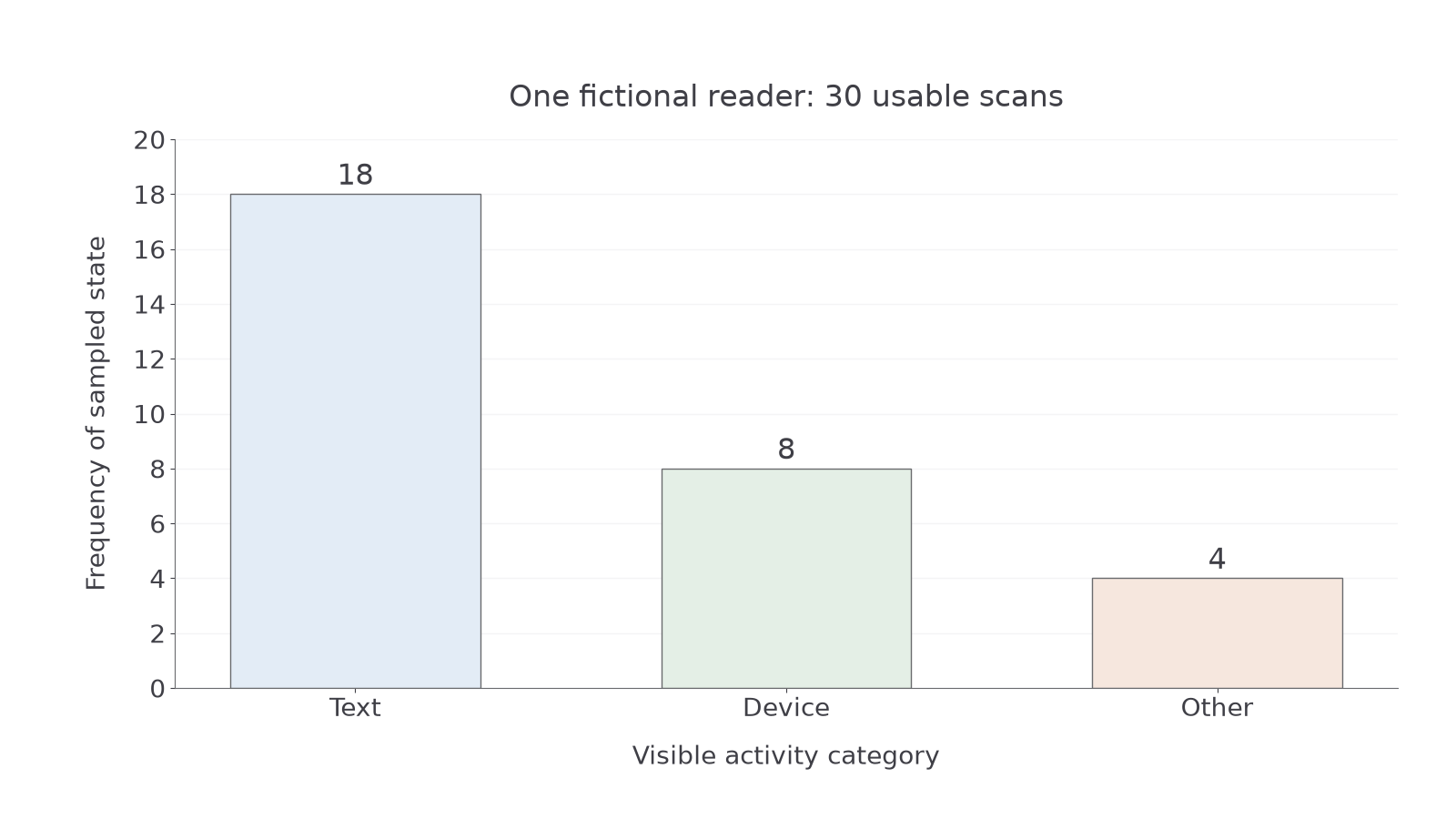
Diagram description: The chart shows visible sampled states for one fictional reader, not measured attention or an independent sample of 30 people.
A histogram instead suits continuous measurements grouped into intervals. A separate fictional observational timing example records the time, in minutes, from beginning to finishing a brief leaflet for ten consenting readers: 1.0, 1.5, 2.0, 2.4, 2.8, 3.1, 3.6, 3.8, 4.2, 4.7. Use intervals , , : their frequencies are 2, 6 and 2. The value 2.0 belongs in the second interval, not both. In a notebook draw a continuous minute axis from 0 to 6, a frequency axis from zero and touching bars with heights 2, 6 and 2. All bins have equal width, so frequency heights represent the relative counts; unequal widths require frequency density instead. Do not use a histogram for Text/Device/Other.
[DIAGRAM: asset_slug: rm30_leaflet_times; file: rm30_leaflet_times.png; description: Equal two-minute histogram intervals with frequencies 2, 6 and 2 for ten illustrative leaflet-reading durations.]
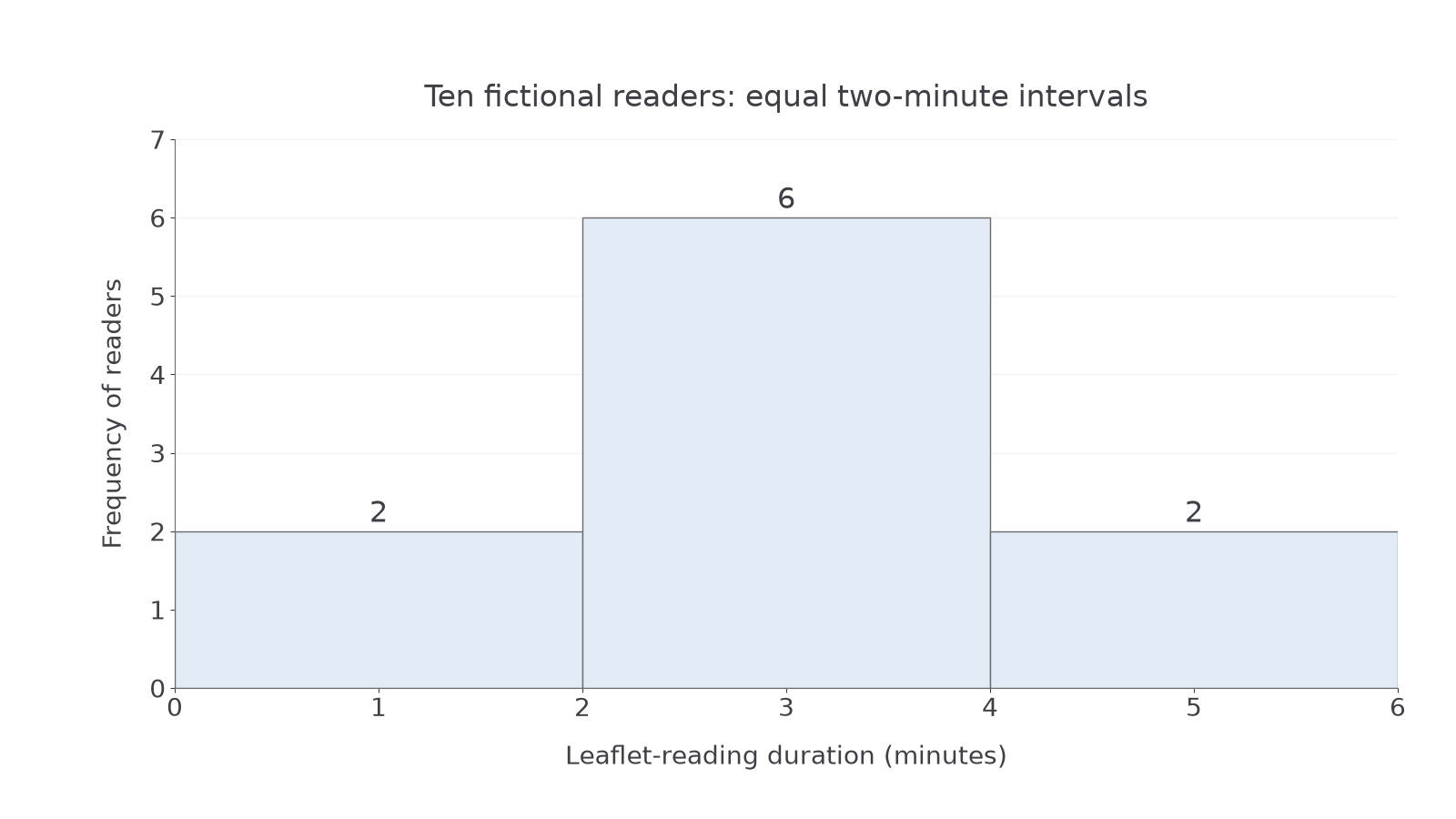
Diagram description: The touching bars group continuous durations; intervals include their lower boundary and exclude their upper boundary.
Report each reader's counts or proportions before combining them. Pooling scans can overweight a reader with more usable observations. Qualitative notes help explain missing visibility, but cannot justify inventing a code for it.
Reporting observation and improving it
Reflection uses evidence about the conduct to improve an observation without claiming more than the measures reveal.
Write the method so another observer could reproduce participant recruitment, consent, category rules, location, duration, scan schedule and treatment of missing records. Results give usable participants/scans, frequency tables, clearly labelled displays and any agreement check; appendices keep the blank coding sheet, anonymised records and final rules. The discussion distinguishes observed states from inferred mental processes. A single controlled library session cannot justify a national claim about attention or a causal claim about devices.
For actual experience, record a concrete incident such as the fixed scan order taking too long. Explain how later participants' records then came from later moments, propose a smaller group or fewer simultaneous codes and pilot the revised timing. If disagreement was high, report it and refine the definitions; do not erase disagreements to make the project look successful. A controlled setup aids standardisation but overt observation may make readers avoid their usual device checks. A follow-up in a more ordinary approved setting could test generalisability while still respecting consent.
Record your own role when work is shared: creating categories, recruiting, timing, coding or checking data are different experiences. A supplied fictional log can support a written adaptation, but should be described as simulated evidence. Actual required observation needs real approved conduct and an honest record of what happened.