1.2 - Designing observations
Learn to turn observable behaviour into clear categories and a coding record, choose time or event sampling, and evaluate what the resulting record includes and misses.
Defining observable behavioural categories
A structured observation needs rules that tell an observer what counts as each behaviour. Behavioural categories are operational definitions of the actions to be recorded, rather than guesses about people's intentions or feelings.
For a study of helping during a group task, the label helpful is too vague. One observer might count smiling; another might count sharing a pen. A category such as offering materials can be defined as moving a needed task object towards another participant without that participant first requesting it. Asking for help can be defined as a spoken request addressed to another participant for information or assistance with the task. These describe observable actions, not an assumed helpful personality.
Categories should fit the research aim and be clear enough for different trained observers to apply consistently. They should be mutually exclusive where one event must receive one code, so a single action is not counted twice. They should cover the intended domain adequately; a category labelled other can preserve relevant actions missed by the initial list. Exhaustive coverage means covering the behaviours relevant to the study, not cataloguing everything a person could do. If simultaneous actions can receive more than one code, that rule must be explicit rather than accidental overlap.
Set boundaries for events. For example, count one request from the start of a spoken request to the end of that utterance; a later new request counts separately. Decide how to code an ambiguous action or one that starts outside the observation window. Pilot the definitions using the same practice sequence before collecting the main data, then revise unclear rules.
Building and using a coding frame
A coding frame is the organised set of categories, codes and recording rules used to turn observations into a consistent record. It may produce frequency counts, timed durations or systematically coded notes; a coding frame does not have to be just a tally sheet.
Here is an original frame for a ten-minute cooperative task. It illustrates event counts, so every new target event in the defined observation period receives one tally. Codes identify behaviours; they are not numerical ratings of good or bad behaviour.
| Code | Behavioural definition | Event boundary |
|---|---|---|
| OM | Offers a task object without a prior request | One transfer attempt counts once, even if refused |
| RH | Makes a spoken request for task information or assistance | One request utterance counts once |
| GH | Gives task information in response to a request | One response utterance counts once |
The observer records participant codes, the date, session start and finish, and a tally under the relevant behaviour for each participant. Write a note for an ambiguous event instead of silently assigning a guess. Offering a pencil after a request is outside OM as defined; either add a suitable category if it matters to the aim, or state that it is outside the current target domain. Otherwise the record could falsely suggest there was no helping.
Keep the frame stable during the main study. Changing the definition halfway through makes early and later frequencies incomparable. Two observers can independently code the same pilot sequence and compare disagreements to improve inter-observer reliability. Agreement supports consistent measurement; it does not prove the categories capture all cooperation or that the observers' shared interpretation is valid.
Time sampling and event sampling
Time sampling selects when behaviour is recorded, whereas event sampling selects the target events to record throughout a defined period. Neither term describes how participants were recruited.
In time sampling, observers record at specified moments or during specified intervals, using the same rule across the session. For example, they observe the first ten seconds of every minute in a ten-minute group task, recording the target behaviours during those ten-second windows. An alternative protocol might record the behaviour occurring at each one-minute instant. These protocols are different: state whether the rule is a momentary snapshot, an interval count, or presence at any point in the interval. Time sampling does not necessarily mean recording every action continuously.
This can reduce workload and distribute observations across a long session. However, a brief or rare helping event could happen entirely between sampled windows and be missed. If a regularly repeating activity always falls outside the selected windows, the sample could systematically underrepresent it. Choose sampling times to fit the aim and report the gaps; do not interpret a zero in sampled windows as proof that the behaviour never happened.
In event sampling, observers monitor throughout the defined period and record every occurrence of specified target behaviours, such as every request for help during the whole ten-minute task. This is useful for infrequent, discrete events and captures their frequency within that period. It ignores non-target behaviour unless it is separately recorded. Many simultaneous events can overwhelm an observer, and deciding where one event ends and another begins still needs a clear rule. Frequency comparisons also need comparable observation duration and opportunities; a longer session can produce more events without a greater underlying tendency.
[DIAGRAM: asset_slug: rm09_sampling_rules; file: rm09_sampling_rules.png; description: An illustrative six-interval sequence highlights selected intervals for time sampling and every target event across the full period for event sampling. It is a schematic of recording rules, not empirical data.]
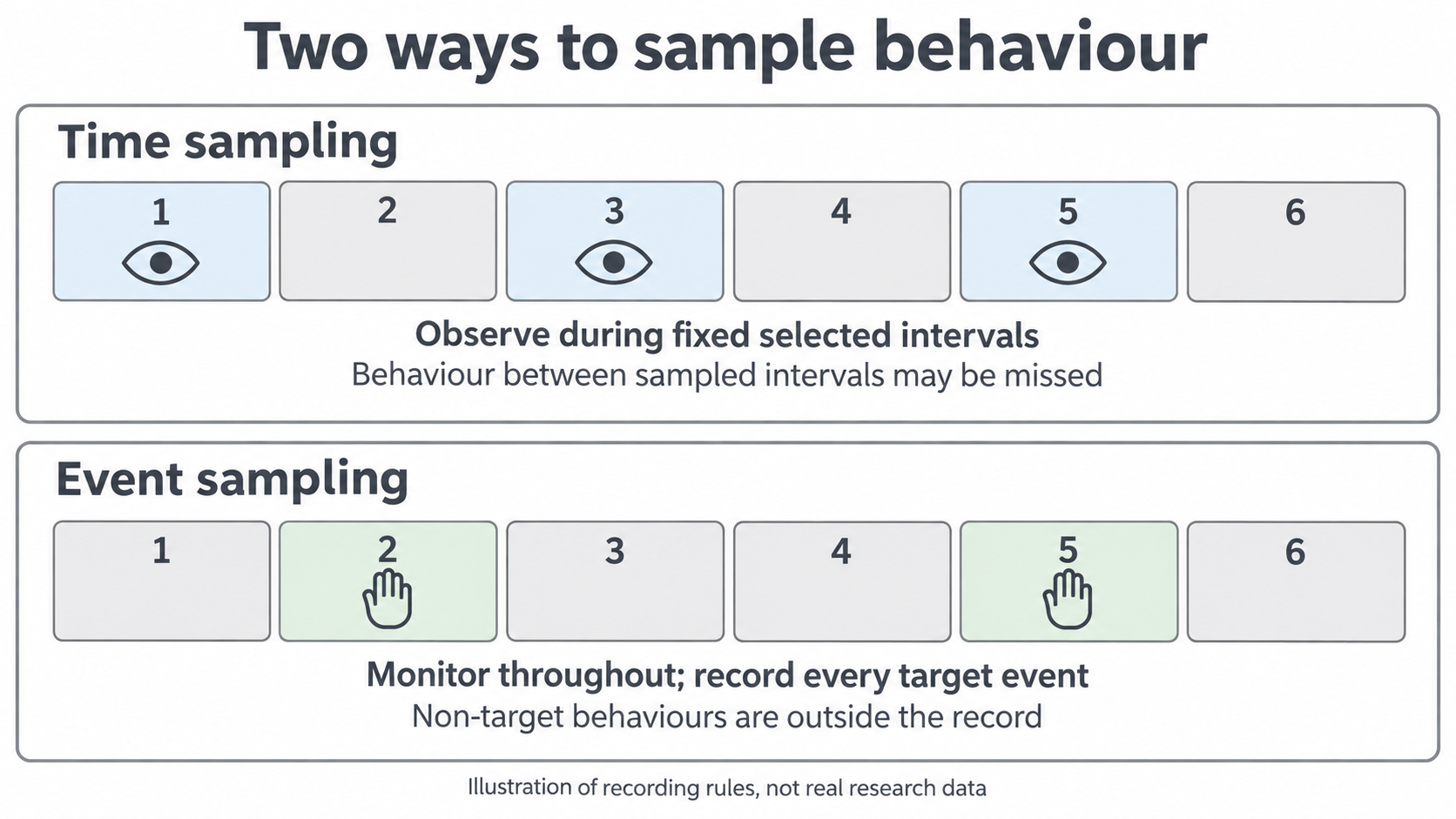
Diagram description: Time sampling leaves gaps between selected observation windows; event sampling monitors throughout but records only the defined target behaviour.
Evaluating what the record can show
Observation design balances manageable recording with an adequate representation of the behaviour of interest. A narrow coding frame can make observers more consistent, but it can also miss important behaviour. Counts of requests and offers do not tell us why someone helped or how the recipient experienced it. Structured counts can support comparisons; detailed notes can preserve context, but may be harder to compare consistently.
A useful design states the setting, target people, observation duration, behavioural definitions and sampling rule. Pilot whether the observer can keep up, train observers using the same definitions, and use equivalent observation periods if comparing groups. In a task with rapid events, use fewer clearly defined categories or more appropriately positioned observers rather than assume that a single observer saw everything. If recording is proposed, obtain the necessary permission and protect privacy; a video is not automatically an ethical substitute for live observation.
An observer's expectations may bias an ambiguous classification. Clear definitions and, where feasible, coding without knowing the prediction reduce this risk. People aware of observation may change their behaviour; gaining consent and respecting withdrawal still matter. Where categories represent culturally specific actions, explain that the same action may have different meanings across settings. A coding frame developed for one task should not be assumed valid for every culture or age group.
The resulting record describes what was observed under the rules. It does not establish that an unrecorded action never occurred, reveal internal motives directly, or show that one observed behaviour caused another.