3.8.2 - Competitive positioning and advantage
Competitive positioning concerns why customers should choose a business's offer and how the business can provide it profitably. This lesson compares Porter's low-cost, differentiation and focus strategies, links positioning to functional decisions and explains both the value and the difficulty of maintaining competitive advantage.
Low cost and differentiation
A business competes through the benefits customers perceive and the price they pay, supported by its ability to deliver the offer at a viable cost.
Competitive advantage is an advantage over rivals that helps the business attract customers or achieve superior performance. A low-cost strategy, also described as cost leadership, seeks lower unit costs than competitors across a broad market. Efficient processes, waste reduction, purchasing terms, scale and a simplified offer can help. The strategy is about the cost position, not merely advertising a low selling price.
Compare a producer whose all-in unit cost is £6 at the relevant output with a rival whose unit cost is £8. At the same £10 selling price, the difference between price and unit cost is £4 versus £2. The lower-cost firm can retain more at that price or charge £8 and still retain £2 per unit, whereas the rival's £8 price only covers its stated unit cost. Low costs create pricing flexibility; they do not require the lowest possible price in every circumstance.
Worked example 1 - cost advantage at a common price
With all-in costs measured at the stated output, the producer retains £2 more per unit. If the figures were variable costs instead, these differences would be contribution rather than profit.
Worked example 2 - a premium must cover extra cost
A differentiated product sells for £28 with an all-in unit cost £21. A standard alternative sells for £20 with an all-in cost £15.
The £8 price premium exceeds the £6 extra cost, leaving £2 extra per unit. The strategy still depends on enough customers valuing the feature to buy at £28.
Cost leadership must retain an acceptable product. Cutting essential quality or reliability can lose demand and generate rework, complaints or reputational damage. A low price without low costs may simply sacrifice profit. Similarly, a large factory only creates an advantage if it is used effectively enough to lower relevant unit costs.
A differentiation strategy offers benefits customers regard as distinctive and valuable, such as reliability, design, expertise, convenience or service. It may support a premium price, greater loyalty or reduced direct price comparison. The difference must matter to customers: a costly feature they ignore is not a competitive advantage.
Illustrative case: a repair service differentiates its offer through dependable collection and a clear warranty. Some customers may pay more for the reduced inconvenience and perceived assurance. The firm incurs extra collection and support costs, so the additional price or retained demand must be sufficient for the chosen financial objective. Differentiation can involve a service benefit, rather than only a visibly unusual physical product.
The comparison is between delivering value at lower cost and delivering a valued distinctive benefit. A differentiator still needs cost control, and a low-cost firm still needs customers to value its offer. Trying to promise extensive premium features at a very low price without the capabilities to support both can create an incoherent position. Some businesses can combine efficiency and distinctive benefits successfully; whether this works must be explained through actual capabilities and customer evidence.
Ryanair's results published on 19 May 2025 reported 200 million passengers, 7% lower average fares and profit after tax of €1.61 billion for the year. This shows that low fares can coexist with profit when the operating model supports them, while lower fares do not automatically mean higher profit: its reported profit fell from €1.92 billion. Cost leadership needs evidence about cost capability, not the fare headline alone. Ryanair, 2025.
Focus strategies and customer segments
A focus strategy serves a narrower market segment rather than attempting to compete across the whole broad market.
[DIAGRAM: asset_name: Porter's generic competitive strategies; asset_slug: porter-generic-strategies; caption: Competitive scope combines with lower cost or differentiation to identify four positions; description: A two-by-two matrix places broad-market cost leadership and differentiation in the upper row, and narrow-segment cost focus and differentiation focus in the lower row. Columns distinguish the source of advantage, lower cost or differentiation. The matrix shows that focus concerns market scope rather than necessarily a premium price.]
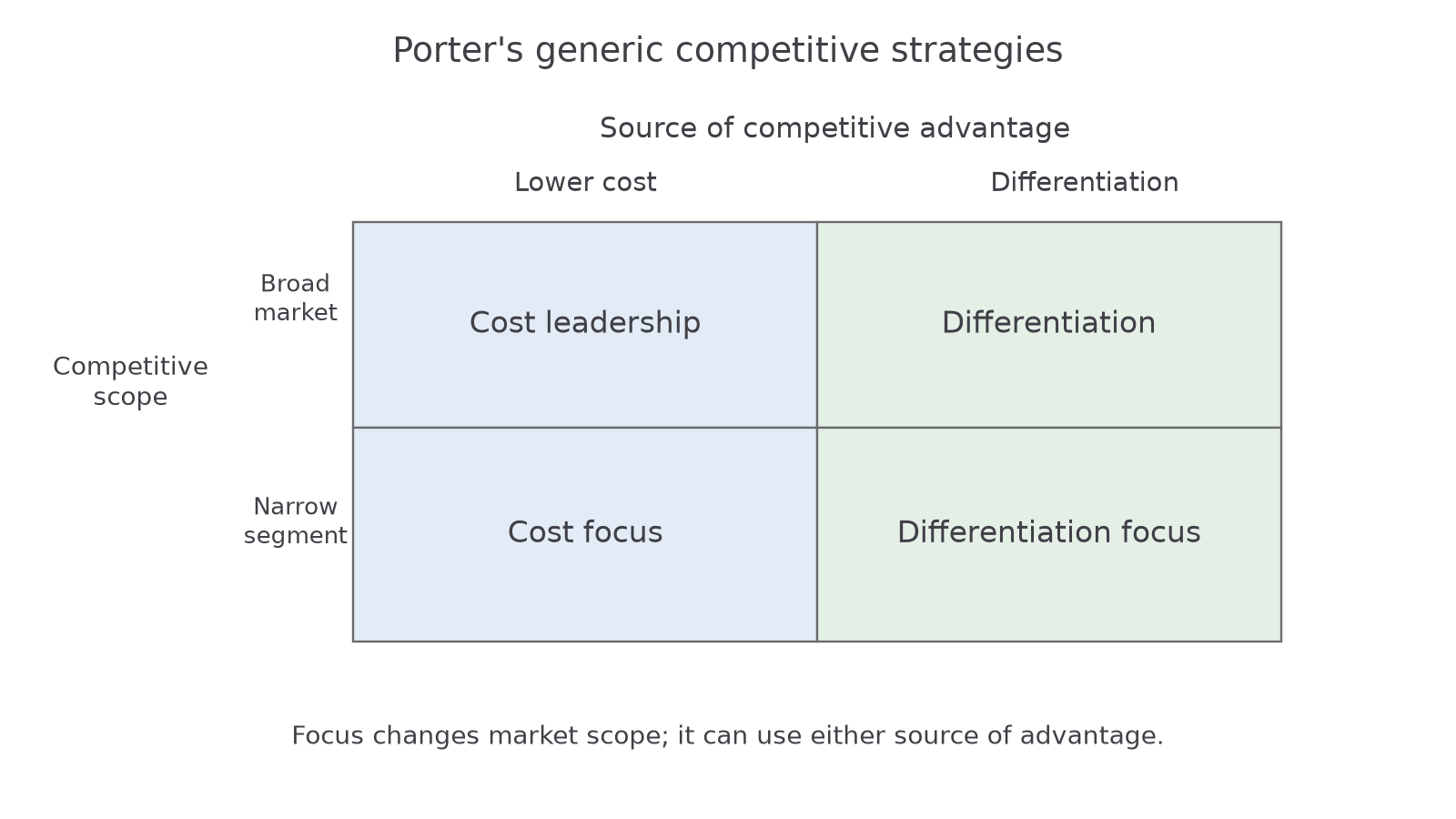
The segment may have specific needs, such as a specialist use, location or customer preference. Concentrating resources can improve understanding of those needs and avoid spreading effort across customers the firm cannot serve well. Focus is a choice of market scope; within that scope the business can pursue low cost or differentiation.
Cost focus aims to provide the chosen segment's required offer at lower cost than rivals serving it. Illustrative case: a distributor serves workshops in one compact area with a limited range of frequently used parts. A simple range and concentrated delivery routes may lower relevant costs for that segment. The strategy does not necessarily make the firm the lowest-cost supplier for every type of customer or geography.
Differentiation focus offers distinctive benefits suited to the narrow segment. Illustrative case: a software provider designs scheduling tools specifically for one type of laboratory. Detailed understanding of its workflows may make the product more valuable than a general scheduling service. Customers may pay a premium or be reluctant to switch because the fit matters to their work.
Focus can suit a business with specialist knowledge or limited resources that cannot confront broad-market leaders directly. It can also support stronger relationships and a more coherent offer. However, a narrow segment may be too small to sustain development costs, may contract or may attract competitors once it proves attractive. A broad rival could adapt its offer, while a customer group's needs may change.
Continue this lesson.
You’re previewing NovaLearn without an account. Create a free account to read the rest.
Create free account