3.4.5 - Inventory control and lead times
Inventory protects a business against shortages but ties up resources and can create waste. This lesson explains how managers choose inventory levels, interpret an inventory control chart, and adjust re-order decisions when demand or supplier lead times change.
Why businesses hold inventory
Inventory consists of materials, work in progress or finished goods held for future use or sale.
A manufacturer may hold raw materials so production can continue between deliveries, partially completed items between stages, and finished goods ready for customers. A retailer holds goods for resale. The inventory needed depends on the product and process: a tailor producing only confirmed bespoke orders faces a different problem from a supermarket promising immediate availability across many items.
Inventory supports reliability. Customers need not wait for every item to be made or delivered after ordering, and production can continue through a short supply delay. A business can prepare for seasonal demand or purchase larger quantities to obtain a discount. Some reserve may be valuable when suppliers are distant, lead times are long or demand varies unexpectedly.
However, bought inventory uses cash before it earns sales revenue, tying up working capital. Storage, handling, insurance and security add costs. Goods may deteriorate, be damaged or become obsolete; perishable foods and rapidly changing technology are particularly exposed. A purchasing discount can be outweighed by these costs. Inventory is an asset rather than automatically an expense of the entire purchase in a profit calculation, but its cash and opportunity costs remain important to decisions.
Too little inventory can cause a stockout, when the business cannot meet demand for an item. A customer may switch to a competitor, or missing components may stop a production line and leave other resources idle. Emergency purchases or faster transport can then be expensive. Too much stock risks waste and liquidity pressure; a firm can be profitable on paper while lacking cash to pay bills because money remains in unsold goods.
Managers therefore consider demand volume and variability, replenishment time, supplier reliability, product life, storage capacity, financing cost, order costs and the consequences of a shortage. The lowest possible inventory level is not universally the best one.
At 28 September 2024, Apple reported inventories of $7.286 billion on its balance sheet. This was an asset held at a date rather than that year's entire cost of sales. Holding inventory can support product availability, but the figure alone does not establish whether each item is saleable or how much reserve is suitable. Apple's September 2024 balance sheet.
Re-order levels, lead time and buffer inventory
An inventory control chart plots the quantity of an item held against time, showing when replenishment orders are placed and deliveries arrive.
In a simple chart, a downward line means stock is being used or sold; a vertical rise represents a delivery. The re-order level is the stock level that triggers a new order, not the quantity ordered. Lead time is the interval between placing an order and receiving it. Buffer inventory is a reserve intended to absorb unexpected demand or supply delay. Re-order quantity is the amount in each replenishment delivery.
A warehouse holds 700 units initially and uses 100 per day. Each order is for 500 units with a 3-day delivery lead time, and the warehouse retains a 200-unit buffer.
[DIAGRAM: asset_name: Inventory replenishment with a three-day lead time; asset_slug: inventory-reorder-leadtime; caption: Re-ordering at 500 units allows three days of use before delivery at the 200-unit buffer level; description: Inventory begins at 700 units on day zero and falls by 100 units daily. It reaches the re-order level of 500 on day two. After a three-day lead time, it reaches the buffer level of 200 on day five, when delivery of 500 units raises stock back to 700. The cycle repeats with an order on day seven and delivery on day ten. The 500-unit vertical replenishment is the re-order quantity.]
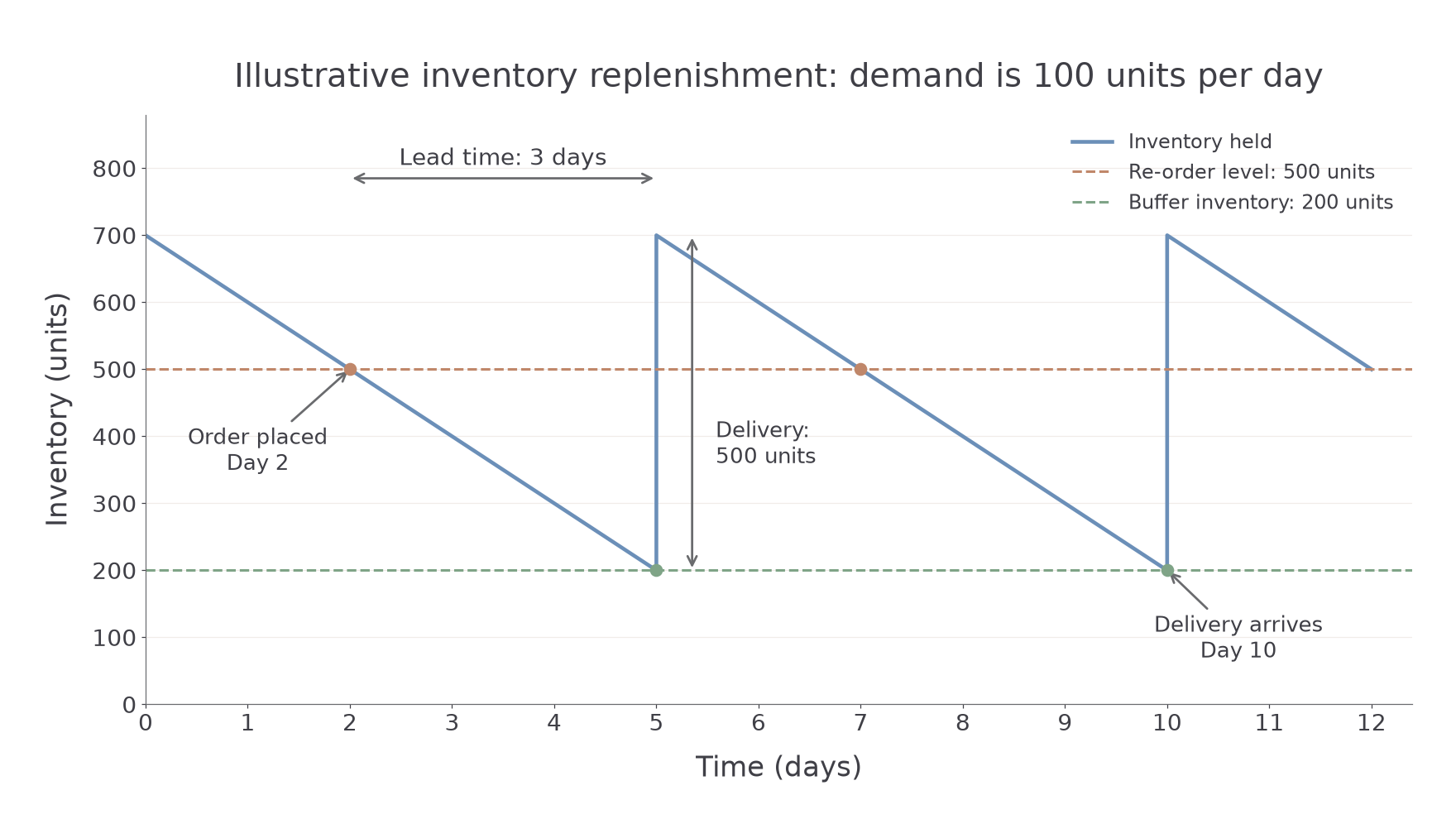
An order placed with 500 units remaining allows 300 units to be used during delivery time, leaving the 200-unit buffer. The supplier then delivers 500 units, raising inventory from 200 to 700. The 700 units are stock held after replenishment, including the reserve; the delivery itself is 500 units.
These relationships assume steady demand, the stated delivery timing and no losses or outstanding orders that change the calculation. They help read this model, not predict every real inventory pattern. If demand fluctuates, managers need a reserve based on the risk they are prepared to accept. In a more complete digital system, outstanding orders and committed customer demand also affect whether another order is needed.
Continue this lesson.
You’re previewing NovaLearn without an account. Create a free account to read the rest.
Create free account