3.10.3 - Network analysis and critical paths
Network analysis shows how the timing of interdependent activities affects a project's completion. This lesson teaches activity-on-arrow diagrams, earliest start times (EST), latest finish times (LFT), critical paths and float, then explains how to amend a network when the plan changes.
Activities, events and dependencies
A network diagram represents the activities needed for a project and the order in which they can occur.
In an activity-on-arrow network, each arrow represents an activity and carries its name and duration. Nodes represent events, such as the point at which prerequisite activities are complete. A node is not an extra task consuming time.
AQA's node places the event number in the left half. The right half is divided horizontally: EST is above and LFT is below. The EST at the node is the earliest time activities leaving it can start; its LFT is the latest time incoming activities can finish without delaying the planned project completion. The same origin and unit apply to all node times.
An equipment installation consists of the following activities, with durations given in days:
| Activity | From event | To event | Duration | Meaning |
|---|---|---|---|---|
| A | 1 | 2 | 3 | Prepare the site |
| B | 1 | 3 | 2 | Train the operating team |
| C | 2 | 4 | 4 | Install the equipment after site preparation |
| D | 3 | 4 | 3 | Complete team checks after training |
| E | 4 | 5 | 2 | Commission after installation and team checks |
A and B can start together. C cannot start until A finishes; D cannot start until B finishes. E must wait for both C and D. Joining two incoming arrows at event 4 captures that requirement: the event occurs only when both routes are complete.
To construct this network, draw start event 1, split arrows to events 2 and 3, join their following activities at event 4, then draw E to finish event 5. Keep arrows pointing in the direction of progress and check each dependency against the plan. An arrow's drawn length need not be proportional to its duration.
Network structure matters as much as arithmetic. Drawing E directly after C but ignoring D would incorrectly allow commissioning before the operating team is ready. Durations should also use the same unit; days and weeks cannot be added without conversion.
The Elizabeth line's central section opened on 24 May 2022. TfL's opening arrangements involved the railway, stations, staff and systems being ready together, demonstrating why a real project needs dependencies as well as a list of activities. A railway cannot safely open merely because civil construction is complete. Network analysis supports the timing discussion; it does not replace operational assurance. TfL, May 2022.
EST, LFT and the critical path
The critical path is the route determining the minimum project duration under the stated activity durations and dependencies.
A forward pass calculates EST. Start at time zero. Add each activity's duration to the EST at its starting node; at a join use the maximum incoming completion time because all prerequisites must finish.
Worked example 1 - the installation forward pass
The A–C–E route totals nine days. The shorter B–D–E route totals seven, but commissioning must wait for both.
A backward pass calculates LFT. Set the final LFT to the planned completion time, then subtract each activity duration going backwards. At a split use the minimum permitted time, so every outgoing route remains feasible.
Choosing the maximum during the backward pass could give permission for a late start that misses one of the required routes.
[DIAGRAM: asset_name: Installation network and event times; asset_slug: 7132_b59_network; caption: A–C–E determines the nine-day project; EST is above LFT in the right half of each AQA node; description: Activity-on-arrow network A from 1 to 2 takes 3 days, B from 1 to 3 takes 2, C from 2 to 4 takes 4, D from 3 to 4 takes 3 and E from 4 to 5 takes 2. Event numbers occupy left node halves. Right halves contain EST above LFT, respectively 0 and 0, 3 and 3, 2 and 4, 7 and 7, 9 and 9. A, C and E are critical.]
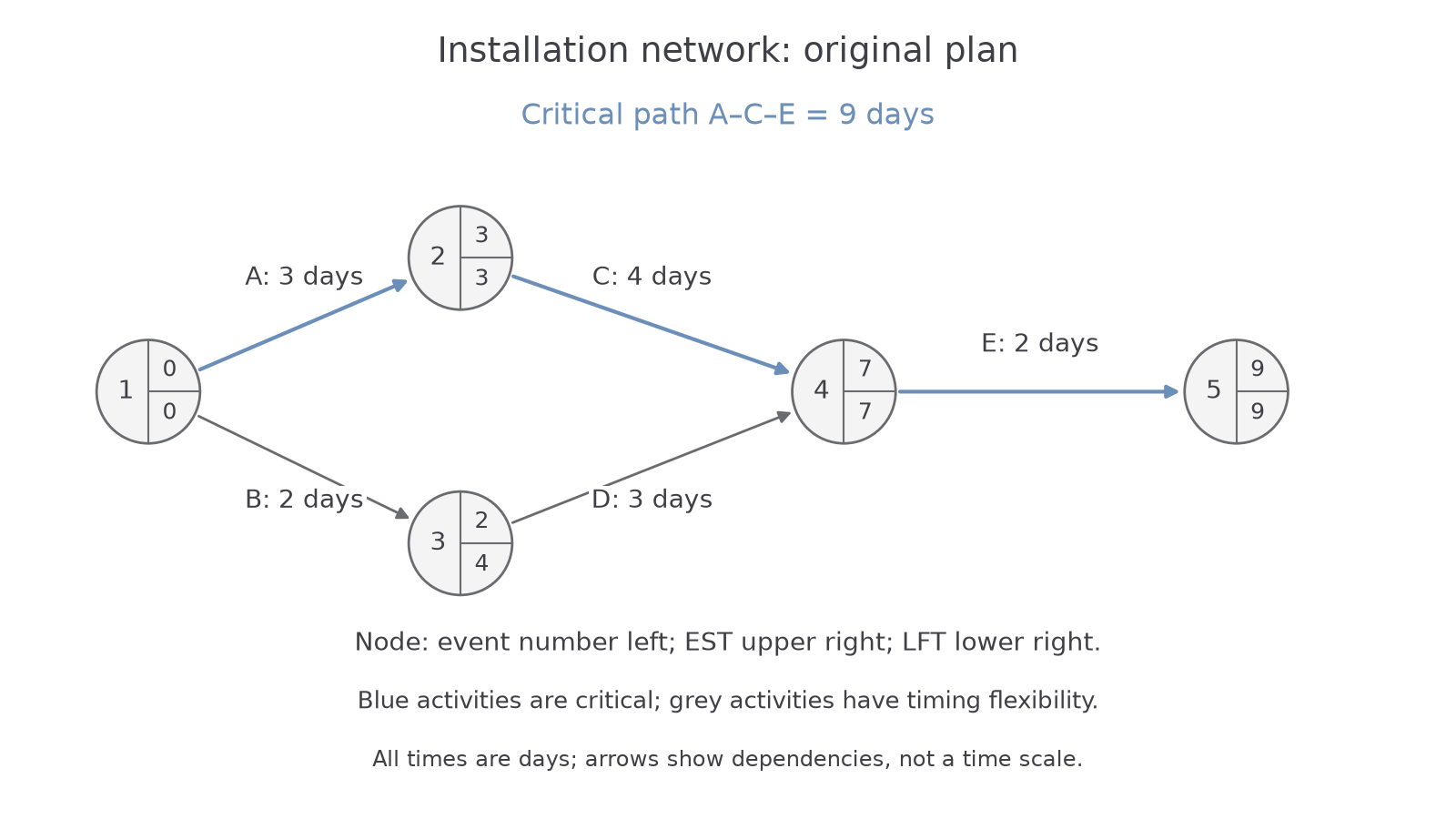
The A–C–E route totals nine days and is critical. If one of these activities is delayed without a compensating change elsewhere, the finish is delayed. A network can have more than one critical path if multiple routes tie for the longest duration.
Worked example 2 - a different route is critical
A product exhibition uses the same five-event dependency pattern, with A taking two days, B four, C three, D five and E one. There are sufficient resources for concurrent activities.
B–D–E is critical at ten days; A–C–E totals six. The critical path is the longest required route, not the route containing the individually longest activity alone.
Continue this lesson.
You’re previewing NovaLearn without an account. Create a free account to read the rest.
Create free account