3.3.3 - Segmentation, targeting and positioning
Customers do not all want the same product or experience. This lesson explains how businesses divide a market into useful groups, choose which groups to serve and establish a position that customers can distinguish from competing offers.
Identifying meaningful customer groups
Segmentation divides a market into groups whose relevant needs or buying behaviour are similar enough to inform a marketing decision.
Market segment
A group within a market whose members share relevant characteristics, needs or behaviours that distinguish them from other groups.
Demographic segmentation uses characteristics such as age, household composition or occupation. A business providing meals might distinguish single-person households from families, because portion needs differ. Geographic segmentation uses location, such as region, country, urban or rural area. A delivery service can face very different access and distance requirements across those areas. Geography can influence needs and supply costs; it is not merely a postcode list.
Income segmentation groups customers by income or purchasing power. A producer might develop a basic appliance for tighter budgets and a premium version for customers able and willing to pay for convenience. Income does not perfectly predict willingness to pay: a wealthy buyer may prefer a basic product, while a lower-income enthusiast may save for a premium one.
Behavioural segmentation uses how or why people buy, such as frequency of use, loyalty, purchase occasion or benefits sought. Illustrative case: a sports-equipment supplier separates occasional walkers seeking comfort from regular mountaineers seeking durability. Both groups could have the same age and income but need different products. Segmenting business customers by usage or buying requirements can also be useful; industrial buyers may prioritise reliability and support rather than lifestyle imagery.
A business can combine methods. For example, a meal service could target working households in a dense urban area who repeatedly order evening meals. The grouping links occupation, geography and behaviour to a plausible need. It is more useful than assuming that everybody in one age group wants the same meal.
Segmentation can improve product design, media selection and the relevance of a message. Rather than advertise delivery convenience to every household, a firm can focus on those likely to value it. However, more segments mean more research, products and campaigns to manage. Very narrow groups may be too small or costly to reach. A useful segment should be identifiable, reachable and substantial enough for the chosen business, with needs that justify a distinct offer. These are practical checks, not a guarantee of profitability.
Segmentation also requires care with personal data and stereotypes. Group averages do not describe every individual. Ethical choices about targeting vulnerable groups can affect trust and stakeholder relationships, even where a campaign appears commercially attractive.
Spotify's June 2024 US announcement listed separate Individual, Duo, Family and Student subscriptions. Student eligibility and household arrangements identify different customer groups, and the different plans translate those distinctions into offers. This is more meaningful than assuming all music listeners have the same budget and usage needs. Spotify's June 2024 plans.
Choosing a target market
Targeting selects the market or segments on which the business will concentrate its offer and resources.
Niche marketing focuses on a relatively narrow segment with particular needs. Illustrative case: a small manufacturer produces lightweight tools adapted for gardeners with limited grip. Specialisation may allow a better fit, a price premium and focused promotion. It can also limit total sales and expose the firm to a change in that group's needs or entry by a larger competitor. A niche is not automatically uncompetitive or profitable.
Mass marketing seeks a broad market with an offer appealing to many customers. A large consumer-goods producer may sell a standard cleaning product through widespread distribution and broad promotion. High volume can spread development and promotional costs over many units and support efficient production. However, the business must compete for attention and shelf space, and a standard offer can disappoint customers with more specialised needs. A broad target requires resources to reach and supply it.
Target choice depends on the segment's size, growth, expected profitability and competitive intensity, as well as the firm's capabilities. A fast-growing segment can attract rivals; its current size alone does not reveal its future returns. A business with technical expertise and limited capital may be better placed in a specialist industrial niche than in a heavily advertised consumer market. A national retailer with established distribution may have the resources to reach several segments or a mass market.
Research should establish willingness to buy at the intended price, not only interest in the general idea. Consider distribution access, switching barriers and buyer power. A niche industrial supplier serving only a few large customers can face strong bargaining pressure even if it has few direct competitors. Dependence on one customer may make the niche risky.
The target must also suit the business's objectives and values. A social enterprise aiming at affordability may reject a profitable premium niche if it weakens its purpose. A small firm seeking steady cash flow may prefer an established segment to an uncertain high-growth market. There is no universally best target: suitability depends on the connection between demand, competition and the firm's ability to serve it.
Positioning and market maps
Positioning concerns how customers perceive a product relative to alternatives on attributes that matter to them.
A business can seek a position through quality, price, convenience, reliability or another relevant benefit. The intended position and customers' actual perceptions may differ. Calling a service “premium” does not establish premium positioning if customers experience slow replies and unreliable delivery. Research into perceptions therefore matters as much as the business's preferred message.
A market map plots products or brands against two selected attributes. The positions describe the supplied perceptions and prices, not every characteristic of the services.
Plotting repair services
Compare four services using a perceived-convenience rating from 1 to 5 and a monthly price in pounds.
- Label convenience horizontally from 1 to 5 and price vertically from £0 to £55, using constant intervals.
- Plot the four supplied coordinates:
- Check that A and D align vertically because both have convenience 2, but D is higher because it costs £40 rather than £15.
- Label each service separately and leave the points unjoined. The map compares alternatives rather than changes through time.
[DIAGRAM: asset_name: Repair-service market map; asset_slug: aqa_b14_market_map; caption: A two-attribute map compares repair-service offers and identifies a candidate position that needs further investigation.; description: Convenience is rated from 1 to 5 horizontally and monthly price is displayed from £0 to £55 vertically. A is at 2 and £15, B at 4 and £25, C at 4.5 and £45, and D at 2 and £40. A hollow clay-coloured candidate point at 1.5 and £27 is labelled as requiring demand evidence rather than as an established opportunity.]
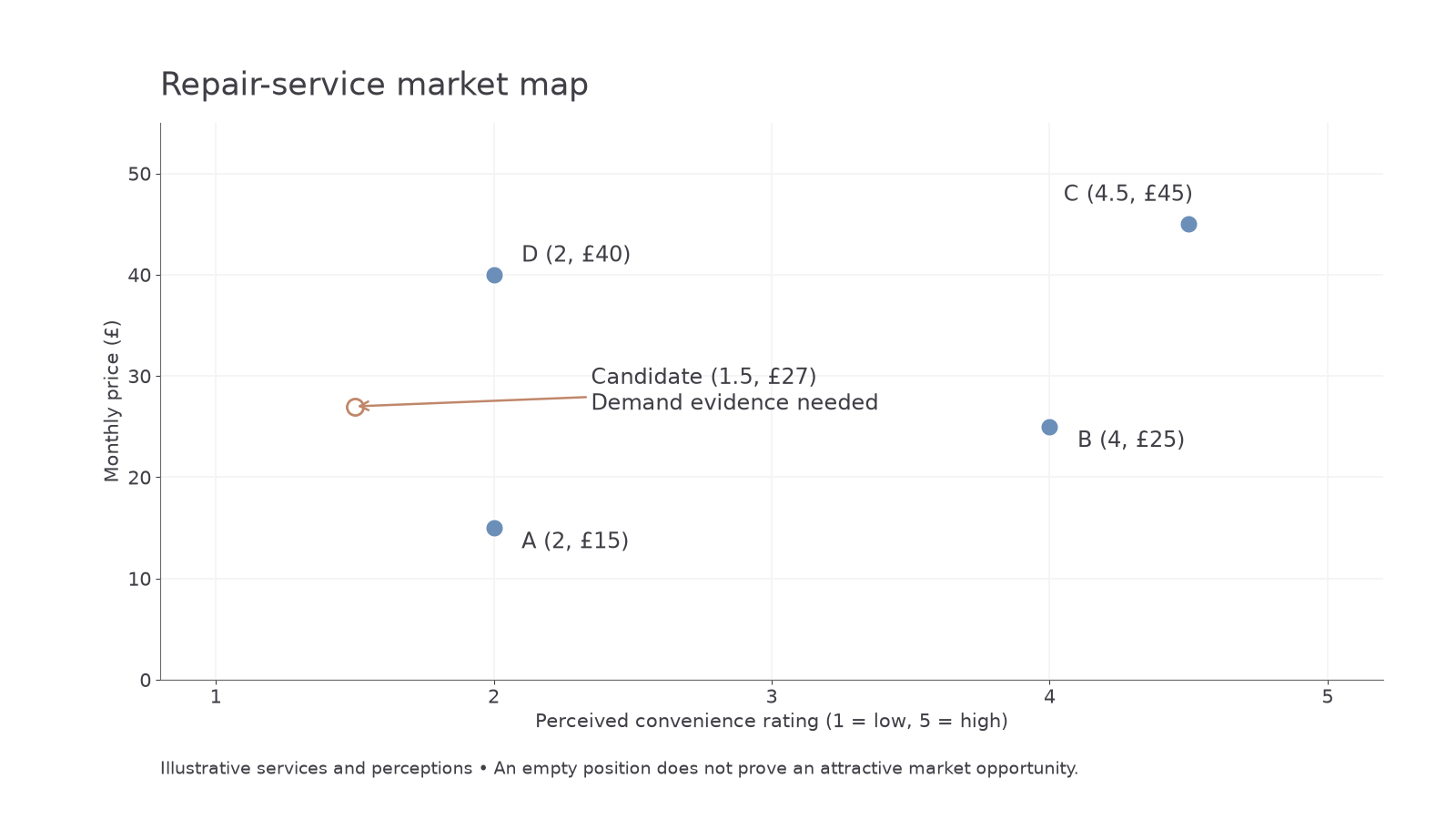
The map shows B offering relatively high convenience at a middle price, while C combines high convenience with a high price. An empty area may suggest room for a different offer, but it may instead reflect a lack of customer demand or an impossible cost structure. An inconvenient middle-price service is not necessarily an opportunity simply because no rival occupies that area. A favourable-looking low-price, high-quality gap may be hard to supply profitably.
Plotting an alternative market map
A bicycle shop compares three locks using durability rated 1–5 and price in pounds: E (2,18), F (4,35) and G (5,60).
- Label durability horizontally with equal intervals from 1 to 5 and price vertically from £0 to £70.
- Plot the supplied coordinate pairs:
- Check that G is both highest and furthest right. Unlike a time series, the products are separate observations, so do not join them.
- F is cheaper than G but has lower rated durability. Its position suggests a trade-off to investigate, rather than proving it offers better value to every buyer.
The map's value depends on the chosen axes and evidence. A map based on reliability and response time might tell a different story from one based on price and convenience. Ratings can be subjective, segment perceptions can differ and competitors can reposition. Two dimensions simplify a richer decision; they do not directly show sales volume, customer satisfaction or profitability.
Positioning choices should connect to a target's priorities and the firm's capabilities. A rapid-response position needs staff and systems that can deliver rapid responses. A low-price position needs costs compatible with the price. Without that alignment, promotion creates a promise the business cannot keep.
Aligning the offer with the chosen segment
Segmentation, targeting and positioning form a connected process because each decision changes what the next one needs to achieve.
Illustrative case: a small appliance-repair company identifies busy urban households that value predictable evening appointments. It selects this segment because customers are reachable within a compact area and the company can schedule technicians efficiently. It positions itself as a reliable booked-time service rather than the cheapest repair option. An online booking system, accurate arrival windows and trained staff are then needed to make that position credible.
The chain can fail at each stage. A segment defined only by age may miss the need for evening access. Targeting distant households could create uneconomic travel times. A convenience position would be undermined if the booking process required long telephone waits. Marketing research identifies the customer benefit, but operations, finance and human resources determine whether the promise can be delivered within resources.
Alignment also improves competitiveness. Focused promotion can explain the specific benefit rather than make a generic quality claim. A price reflecting the value of guaranteed slots may help cover scheduling costs. However, the business must check whether customers value that guarantee enough to pay. If a rival offers similar reliability more cheaply, a distinctive position may need to change.
Managers should reassess the process as markets evolve. Growing remote working could change which appointment times customers want; a new digital platform could make rival services easier to compare. A segment and position are choices supported by current evidence, not permanent labels attached to customers.