3.2.3 - Stakeholder needs and relationships
A business decision affects people who have different interests and different powers to influence it. This lesson explains stakeholder needs, overlapping and conflicting interests, stakeholder mapping, and how communication and consultation can improve relationships without guaranteeing agreement.
Stakeholders and their needs
Stakeholders have an interest in a business's actions or outcomes, even when they do not own part of the business.
Stakeholder
An individual or group that can affect, or is affected by, the decisions and activities of a business.
Shareholders own shares and may seek dividends, a rising share price or long-term survival. A shareholder is one kind of stakeholder; the terms are not interchangeable. Employees may want fair pay, safe conditions, job security, development and meaningful work. Managers also have employment interests, but may additionally seek resources and autonomy to meet departmental objectives.
External stakeholders include customers, who want suitable products, reliable service and value for money; suppliers, who want continuing orders, reasonable terms and prompt payment; and lenders, who want interest and repayment without excessive risk. Governments have interests in taxes, employment and compliance. Local communities may value jobs while seeking protection from traffic, noise or pollution. Pressure groups can represent environmental or social concerns that extend beyond one neighbourhood.
Needs differ within each group. A short-term shareholder may favour a dividend now, while another prefers investment for later growth. Some customers prioritise price; others prioritise durability or ethically sourced materials. Managers should identify the actual stakeholders and circumstances of a decision rather than assume every group has one fixed view.
Illustrative case: a bakery considers night production. Its decision should account for residents' sleep, workers' preferences and safety, customers' demand for fresh bread, and owners' desire for profitable growth. Ignoring these needs can undermine the decision: dissatisfied employees may leave, residents may object, and unreliable suppliers can interrupt production. Considering stakeholders helps the business identify constraints, predict responses and build support; it does not mean satisfying every request in full.
Overlapping and conflicting interests
Stakeholder interests can reinforce one another, but a scarce resource or a disputed consequence can produce conflict.
When a business improves product reliability, customers may face fewer failures, employees less stressful complaint handling, and owners fewer refunds and stronger repeat sales. These interests overlap. Training can improve workers' skills and job satisfaction while improving productivity and customer service. A stable, profitable business may offer suppliers dependable orders, lenders safer repayment and employees continued employment.
Conflict arises when meeting one need makes another harder to meet. Raising wages can benefit employees but reduce the profit available for dividends if productivity and revenue do not rise. Extending customer credit may help buyers but delay cash needed to pay suppliers. A new factory may create employment while increasing traffic and emissions for residents. Shareholders' desire for rapid cost reductions can conflict with employees' job security and customers' service expectations.
The consequences depend on responses. Cutting staffing costs may initially improve profit, but poorer service can drive customers to rivals and reduce later revenue. Holding back supplier payments preserves cash temporarily, but suppliers may withdraw credit or prioritise other buyers. A decision that seems to favour one group today can eventually damage that group's interests too.
Managers can search for compromises: a phased change, retraining, noise insulation or productivity improvements that help fund a pay rise. These have costs and may only partly resolve the conflict. Assess both the immediate distribution of gains and losses and the longer-term business consequences. Do not assume that all ethical choices reduce profit or that every profitable choice benefits all stakeholders.
Stakeholder power and interest
Stakeholder mapping helps managers judge how strongly a group is likely to engage with a decision and how much influence it can exert.
Power is the ability to affect the decision or its implementation. It may come from voting rights, control of finance, scarce skills, customer purchasing, legal authority or collective action. Interest is how concerned the stakeholder is about the particular issue. These are separate dimensions: a lender can have considerable contractual influence yet little interest in a routine packaging change.
[DIAGRAM: asset_name: Stakeholder power and interest matrix; asset_slug: stakeholder-power-interest; caption: Four approaches to relationships based on stakeholder power and interest; description: A two-by-two matrix with stakeholder interest increasing left to right and stakeholder power increasing bottom to top. Low power and low interest is monitor; low power and high interest is keep informed; high power and low interest is keep satisfied; high power and high interest is engage closely. The categories guide attention rather than determine stakeholders' rights.]
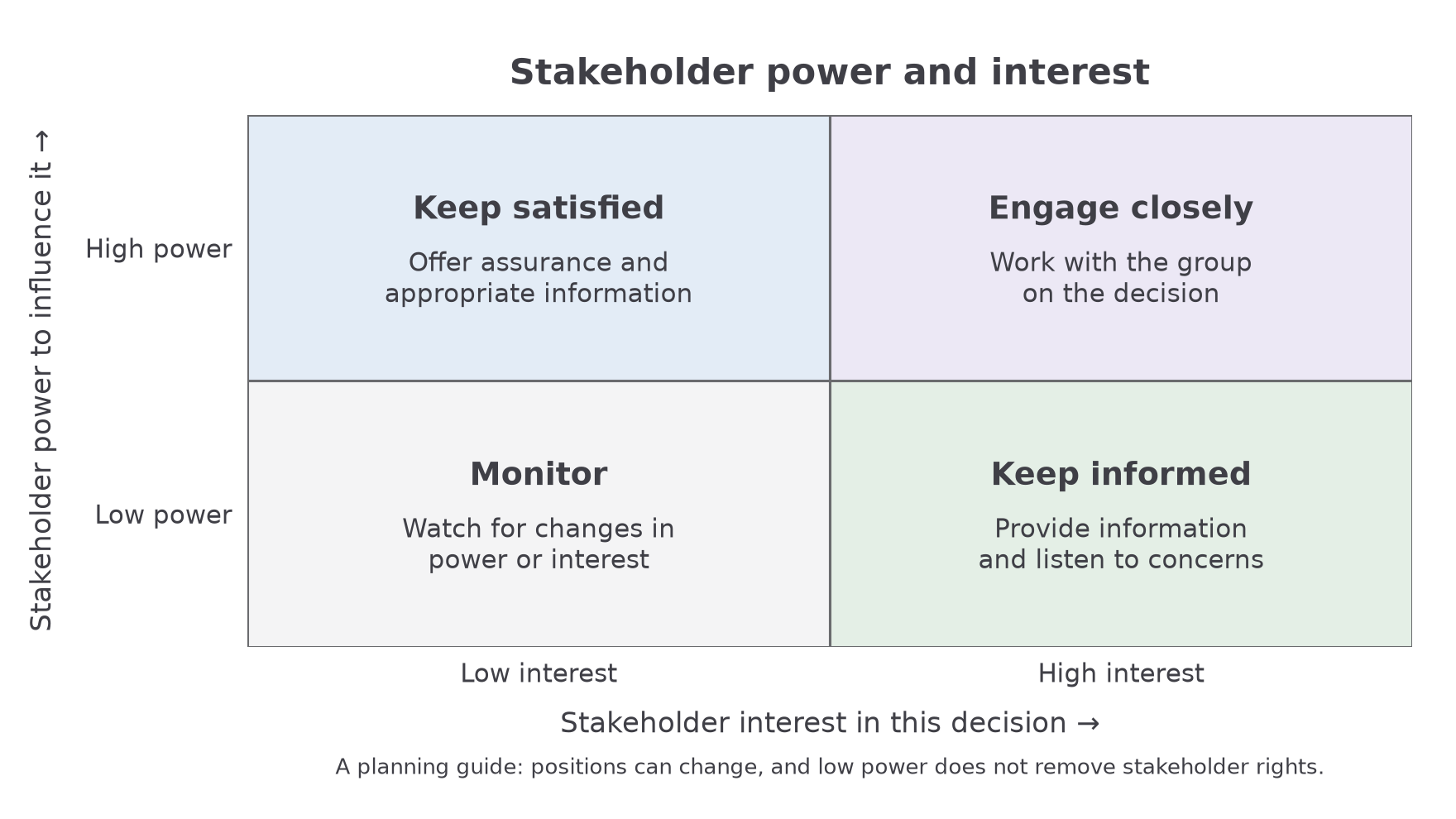
High-power, high-interest stakeholders need close engagement because they may support or block the change. Those with high power but lower interest should receive enough information and assurance to remain satisfied. Lower-power stakeholders with high interest should be kept informed and heard; lower interest and power usually justify monitoring for change. These approaches allocate attention, not moral worth: the business still has responsibilities to less powerful groups.
For the night-shift bakery, the local planning authority may have high power through approval conditions. Employees with rare baking skills may have substantial power if production depends on them. Residents can have high interest but individually limited influence; organising a residents' association or involving the authority can increase their collective power. A major supermarket customer may have more influence than one occasional shopper because losing its order would affect a large share of sales.
Positions change with the issue and over time. A normally passive shareholder may become active when a takeover is proposed. A supplier's power rises if alternative sources disappear. A map therefore needs updating and evidence; broad labels such as “employees always have low power” can lead to poor decisions.
In October 2023, the CMA approved Microsoft's revised acquisition of Activision Blizzard after cloud-streaming rights were placed outside Microsoft's control through Ubisoft. The regulator's legal authority gave it substantial power, while its concern was competition for gaming customers. Microsoft adapted the transaction to address that stakeholder's demands. This shows influence changing the decision itself rather than merely requiring better publicity. CMA's Microsoft–Activision decision.
Communication, consultation and trust
Managing stakeholder relationships requires both explaining decisions and finding out how people are likely to respond.
Communication shares information: managers might explain the reason for a change, its timing, its likely effects and the support available. Information must be accurate, timely and appropriate to the group. Employees may need a meeting about working arrangements, suppliers a forecast of orders, and residents clear details of noise controls. Good communication can reduce rumours and uncertainty, but simply announcing a decision does not give stakeholders influence over it.
Consultation seeks views before or during decision making. Listening can reveal constraints managers have missed: bakery staff may identify unsafe staffing levels on a night shift, while residents may suggest delivery times that avoid the worst disturbance. Managers can then revise the proposal. Consultation can also improve acceptance because stakeholders understand the trade-offs and see that their concerns were considered.
Consultation is not the same as giving every stakeholder a veto. Views may conflict, some stakeholders may be difficult to reach, and time or legal requirements can limit choices. The business should explain what is open to change, how views will be used and why it chooses a particular solution. Asking for opinions after an irreversible decision and implying that it remains open can damage trust.
The bakery could consult workers about voluntary night-shift arrangements and residents about delivery times, then publish a schedule with a complaints contact and review the actual disturbance. This creates a continuing relationship rather than a one-off announcement. Its value depends on follow-through: reliable payment, safe working and honoured commitments usually matter more than a polished message. Relationship management should therefore connect communication with practical decisions and accountability.