3.6.4 - Motivation and engagement theories
Motivation influences employees' effort and persistence, while engagement connects them with their work and organisation. This lesson explains the benefits of both and uses Taylor, Maslow and Herzberg to understand why different working arrangements may affect employees differently.
Why motivation and engagement matter
Motivation is the drive that influences behaviour, effort and persistence, while engagement involves connection with and commitment to work and the organisation.
An employee can work hard to earn a bonus without feeling strongly committed to the employer. Another may care about the organisation's purpose but struggle to maintain effort because the work is poorly organised. The concepts overlap, but they are not identical.
Motivated employees may persist with difficult tasks, use their time effectively and make fewer avoidable errors. Engaged employees may suggest improvements, help colleagues and identify problems before customers experience them. These behaviours can support productivity, quality, customer service and retention, improving competitiveness.
Benefits are conditional. Employees need suitable skills, equipment and achievable goals. Motivation alone cannot remove a faulty machine or an impossible workload. A reward tied solely to output volume may encourage rushing or hiding defects, so managers should consider what the system motivates people to do.
Measurement also needs care. Productivity reflects several influences, while an engagement survey depends on honest responses and the questions asked. Managers should combine suitable numerical measures with employee evidence and observe whether changes persist.
In its 2025 Annual Report Microsoft describes access to continuous learning through internal and external learning content. Such development can give employees an opportunity to progress and use their potential; the motivational mechanism is the opportunity to learn and achieve. The existence of a programme alone does not prove every participant becomes more engaged, so employee feedback and evidence of applied skills are still needed. Microsoft, 2025.
Taylor and scientific management
Taylor's approach links productivity to systematic analysis of work and financial incentives.
Managers examine tasks, identify efficient methods, select and train employees for them and establish performance expectations. Breaking work into standardised steps can reduce unnecessary movement and variation. Pay linked to output, such as piece rates, is intended to give employees a financial reason to increase production.
[DIAGRAM: asset_name: Taylor's scientific-management mechanism; asset_slug: taylor-management; caption: Work analysis and training combine with financial incentives in Taylor's approach; description: Three connected stages show analysis of tasks, selection and training for a defined method, and a reward linked to acceptable output. They feed an intended productivity improvement, subject to measurable work, feasible standards and quality safeguards. The flow is a model rather than a guaranteed effect.]
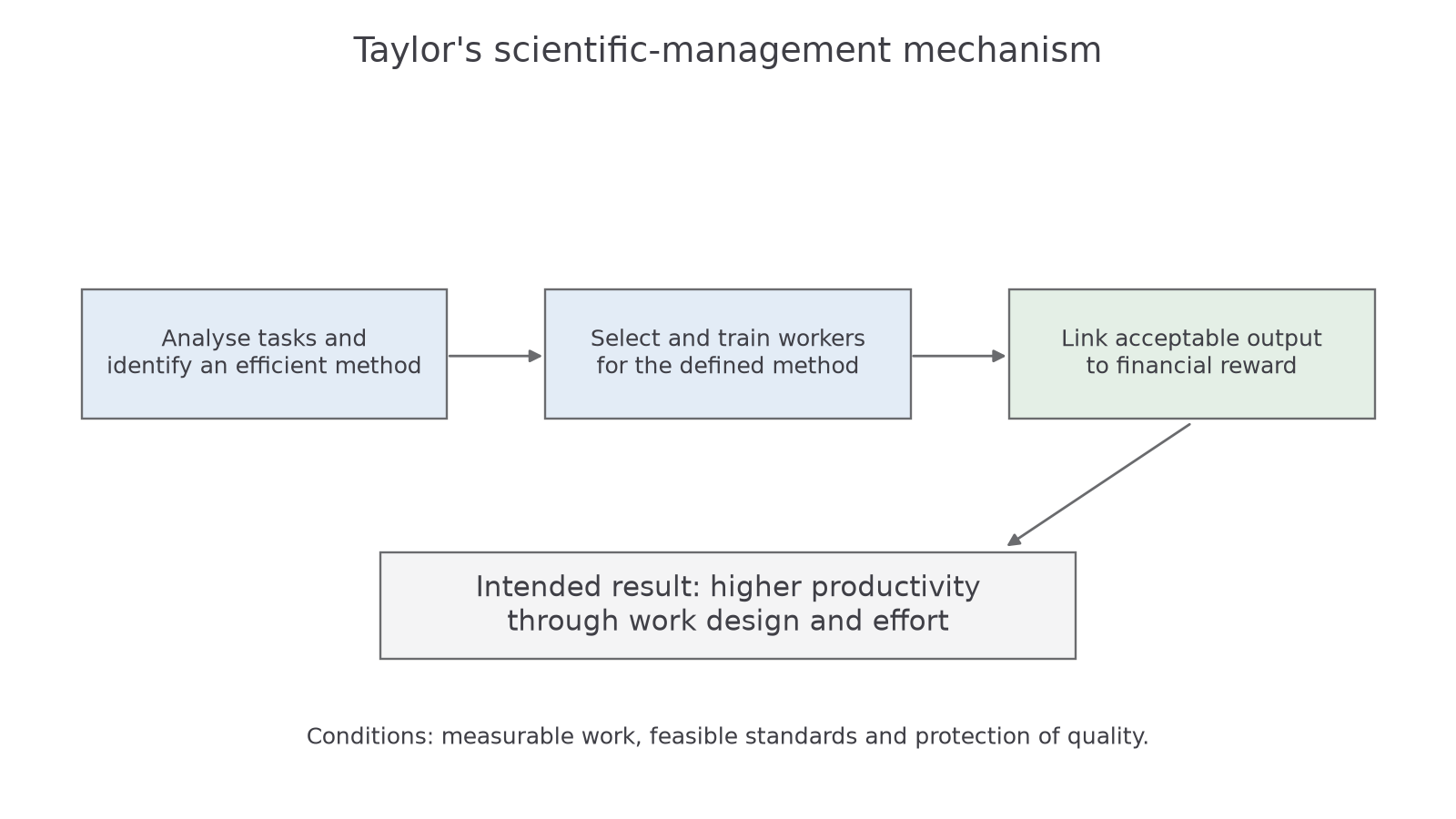
Illustrative case: packing managers compare workstation layouts, select a method and train employees in it. A payment for each acceptable package then links additional output with earnings. The method combines work design and training with an incentive; Taylor should not be reduced to the statement that “money matters”.
The approach can be useful where tasks are repetitive, output is measurable and the method is genuinely efficient. It can increase predictability and lower unit costs. However, employees may experience monotony or reduced autonomy, and a narrow output incentive may damage quality or cooperation. It is harder to apply where work requires creative judgement or output depends heavily on a team.
The assumption that a financial incentive will dominate all employees' behaviour is also limited. Security, recognition, relationships and meaningful work may matter. Managers should assess the nature of the work and unintended effects rather than assume a piece rate always increases useful output.
Maslow's hierarchy of needs
Maslow presents human needs in a hierarchy that helps explain why the same reward may have different value to different employees.
Continue this lesson.
You’re previewing NovaLearn without an account. Create a free account to read the rest.
Create free account