3.8.1 - Ansoff's matrix and strategic direction
Strategic direction concerns which products a business offers and which markets it serves. This lesson uses Ansoff's matrix to compare four directions, explains the benefits and risks of each and connects a choice to capabilities, market evidence, resources and stakeholders.
Products and markets in Ansoff's matrix
Ansoff's matrix classifies strategic direction using whether products and markets are existing or new to the business.
A product is the good or service offered. A market is the group of customers and the setting in which their needs are served, which can be defined by geography or customer segment. “New” is relative to the business: selling an established product in a country the firm has never served can be market development even though the product already exists there.
| Existing products | New products | |
|---|---|---|
| Existing markets | Market penetration | New product development |
| New markets | Market development | Diversification |
[DIAGRAM: asset_name: Ansoff's product-market matrix; asset_slug: aqa7132_b48_ansoff; caption: Ansoff's four directions combine existing or new products with existing or new markets, relative to the business.; description: A two-by-two matrix with columns Existing products and New products and rows Existing markets and New markets. The cells are Market penetration, New product development, Market development and Diversification in their corresponding positions. A footer states that direction describes products and markets, while method describes how the change is pursued.]
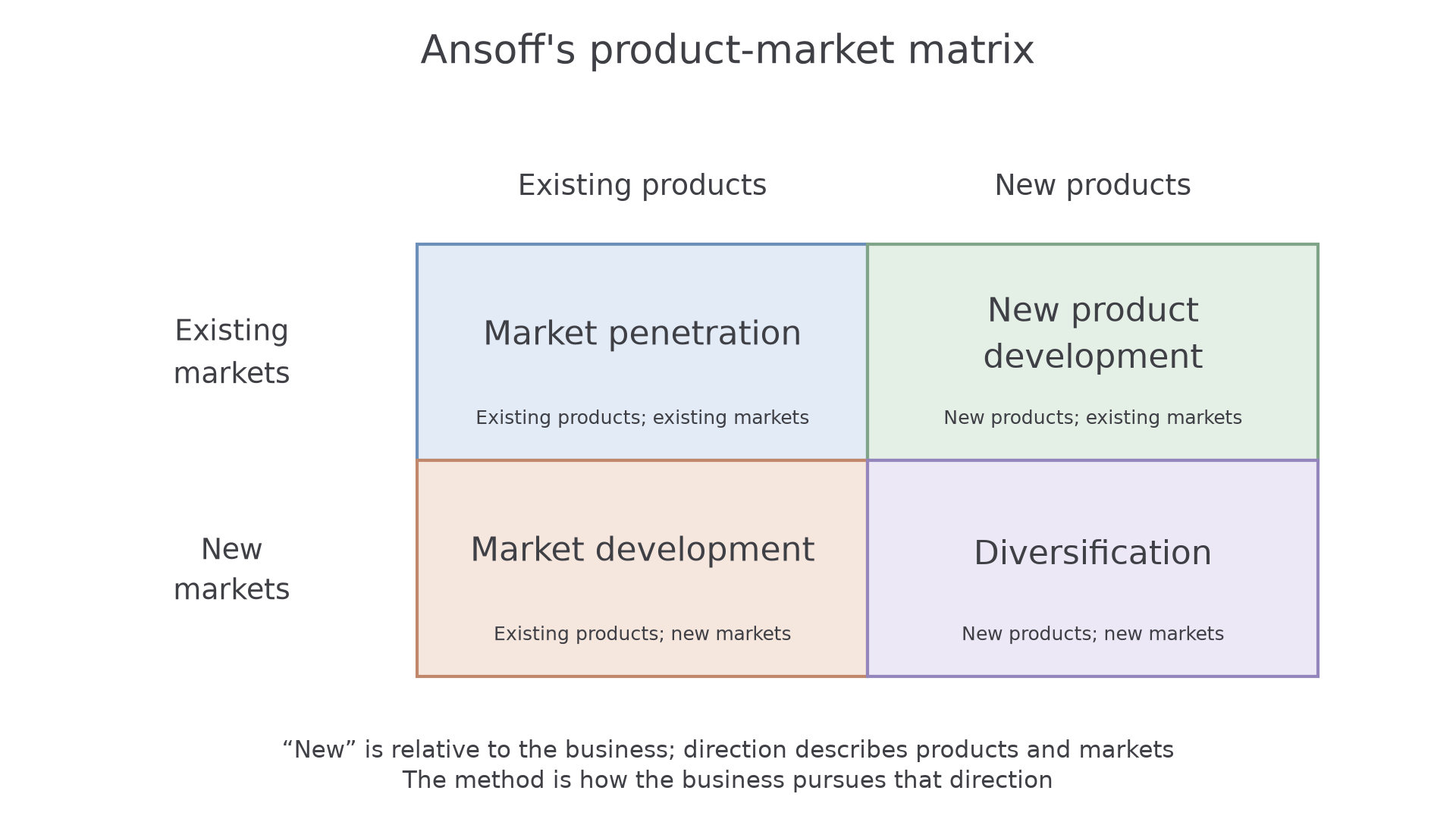
Illustrative case: a bakery pursues market penetration by selling more of its current bread range to existing local customers. Selling the same bread to a new geographic area is market development. Introducing a new meal service to existing local customers is new product development. Entering a new customer market with a new product is diversification. Define the market consistently rather than changing its boundary to force a label.
Direction differs from method. Market development might be pursued by opening an outlet with the firm's own resources or buying an existing business serving the new area. These are different methods of pursuing the same product-market direction. The matrix does not choose between them or specify the detailed implementation plan.
A channel change alone is not necessarily a new market. If the same customers buy the same products through a new website, the firm may still be increasing penetration of its existing market. If the website gives access to a genuinely new customer segment or region, market development may be the appropriate classification. Establish who is served and what is offered before deciding.
The matrix is useful because it makes the source of growth and unfamiliarity explicit. It does not calculate risk or prove the best option. A badly supported penetration campaign can fail, while a carefully researched new direction can succeed. Risk depends on capabilities, evidence and implementation as well as the cell selected.
The LEGO Group's results published on 11 March 2025 reported 13% revenue growth in 2024 and described demand for a broad portfolio serving different ages and interests. Existing sets sold more widely and new sets developed for established customer groups can contribute through different Ansoff directions. A revenue-growth figure alone cannot classify the whole strategy: identify which product and customer market changed. LEGO Group, 2025.
Market penetration and market development
The two directions using existing products differ in whether the business deepens its current market or seeks customers in a new one.
Market penetration aims to increase sales of existing products in existing markets. A business might win customers from rivals, encourage more frequent purchases or make its product more accessible to the current market. It can draw on established product knowledge, customer relationships and operating systems, reducing some unfamiliarity and allowing existing capacity to be used more fully.
Its value depends on room for growth. A saturated market may require aggressive price reductions or expensive promotion to win sales, while competitors can respond. Discounting gym memberships for existing local customers may increase membership numbers while sacrificing revenue from those willing to pay the original price. Capacity and service quality also matter: overcrowding can undermine retention. Penetration does not mean growth is costless or low-risk in every context.
Market development takes existing products into new markets, such as another region or a new customer segment. It can extend the product's sales potential, reduce dependence on one market and use spare capacity or established expertise. A product whose original market is mature may still meet needs elsewhere.
A new market adds unfamiliarity. Distribution, customer preferences, regulation, payment practices and competitor strength may differ. Serving smaller firms may require an equipment supplier used to large industrial buyers to change its support and payment arrangements. The product can remain broadly existing while the market requires changes to how it is sold and serviced.
Research should test whether there is genuine demand at a viable price and whether the firm can reach and serve it. Existing brand recognition may not transfer, and transport or support costs can absorb extra revenue. A pilot or an experienced distribution partner can provide evidence, but adds expense and may create dependence. The choice should compare the cost of further penetration with the opportunity and uncertainty of the new market.
Continue this lesson.
You’re previewing NovaLearn without an account. Create a free account to read the rest.
Create free account