3.7.8 - Payback and average rate of return
Investment appraisal compares a project's expected results with the resources it requires. This lesson calculates payback and average rate of return, distinguishes net cash flows from accounting profit and explains how financial criteria, non-financial considerations and uncertainty influence the final choice.
Calculating and interpreting payback
Payback is the time taken for a project's cumulative net cash inflows to recover its initial investment.
An initial investment is the cash outlay at the start, often labelled year 0. Future net cash inflows are the cash receipts from the project minus its cash payments in each period. Use net inflows, not sales revenue alone. Payback concerns the recovery of cash rather than the accounting profit reported in each year.
Payback
For unequal inflows, add them cumulatively until the investment is recovered. If inflows arise evenly during the recovery year:
A machine costs £30,000 and generates £12,000 net inflow each year, evenly through the year. The first example converts its payback into years and months. A 0.5-year fraction is six months, not five: multiply the fraction by 12.
Worked example 1 - equal annual inflows
For unequal inflows, consider a project costing £80,000 initially, with operating net inflows generated evenly during each year.
| Year | Annual net inflow | Cumulative inflow | Initial outlay still unrecovered at year end |
|---|---|---|---|
| 1 | £20,000 | £20,000 | £60,000 |
| 2 | £30,000 | £50,000 | £30,000 |
| 3 | £40,000 | £90,000 | £0; recovery has occurred |
| 4 | £50,000 | £140,000 | £0 |
The table identifies year 3 as the recovery year. Dividing the outlay by an average annual inflow would lose the actual timing and give a different result.
Worked example 2 - unequal inflows
The fraction uses the recovery year's inflow, not an average across the project's life.
[DIAGRAM: asset_name: Recovering an investment through cumulative cash inflows; asset_slug: aqa7132_b46_payback; caption: With inflows generated evenly within each year, cumulative net inflows reach the £80,000 initial outlay after 2.75 years; description: A piecewise-linear cumulative inflow graph joins year 0 £0, year 1 £20,000, year 2 £50,000, year 3 £90,000 and year 4 £140,000. A horizontal £80,000 investment line crosses the year 2–3 segment at 2.75 years, marked by a dashed vertical guide.]
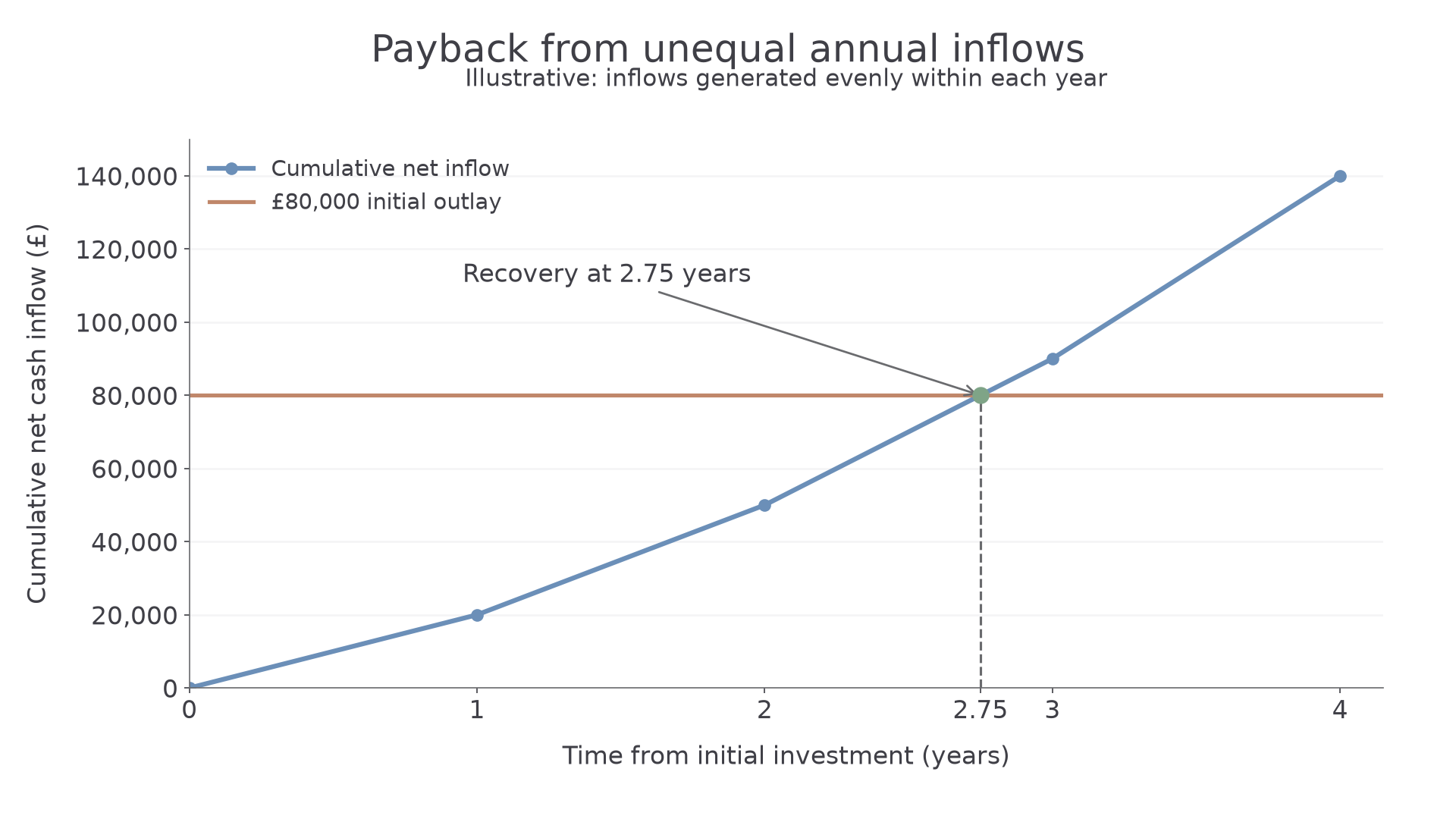
Timing assumptions matter. If the same annual receipts arrive only at each year end, the investment is not recovered until the end of year 3; a fractional interpolation would be inappropriate. If the project's total inflows never cover its outlay during its life, it does not pay back within that life. Read whether residual receipts are included and when they arrive rather than adding an unstated amount.
A short payback can reduce the time funds are committed and limit exposure to distant forecasts. It does not establish that the project creates the highest total return: cash received after payback is excluded from this measure's comparison.
Average rate of return from profit
Average rate of return, or ARR, expresses average annual accounting profit as a percentage of the initial investment.
Average rate of return
Use the initial-investment denominator unless a task explicitly supplies a different convention.
Net operating cash inflows are not automatically accounting profits. The cost of the investment must also be accounted for over its life. If a task gives operating net cash inflows before depreciation and the initial cost and residual value, derive the total profit as follows:
The residual value is the estimated value remaining at the end. Subtracting cost minus residual value accounts for the amount of the asset's value used up. This approach assumes the stated cash flows are appropriate for this conversion and no other accounting adjustments are required. If annual accounting profits are already supplied, average those profits without deducting the capital cost again.
A machine costs £100,000, lasts three years and has residual value £10,000. Net operating cash inflows before depreciation are £40,000, £45,000 and £50,000, excluding the residual receipt. The first example derives accounting profit before calculating ARR.
Worked example 1 - converting cash flows into profit
Continue this lesson.
You’re previewing NovaLearn without an account. Create a free account to read the rest.
Create free account