3.10.1 - Change, resistance and flexibility
Strategic change alters how a business pursues its objectives and can affect employees, customers and other stakeholders. This lesson explains pressures for change, Lewin's force field analysis, flexible organisations and the required reasons for resistance and ways to overcome it.
Causes, types and value of change
Change may originate within a business or arise from its external environment, and its scale affects how it needs to be managed.
Internal pressures include poor performance, growth, a new leader, a different mission or a need to improve processes. External pressures include competitors' moves, changing customers, technology, economic conditions and political or legal changes. A manufacturer could respond to its own costly defects, a rival's faster delivery, or both by changing its production method.
Incremental change develops existing arrangements in smaller steps. Gradually improving a shop's ordering process is one example. Disruptive change involves a substantial departure that can alter the business model, capabilities or working arrangements, such as replacing a mainly branch-based service with a digital model. Internal/external describes the source; incremental/disruptive describes the nature or scale. They are different classifications.
Change can improve competitiveness, service, efficiency or resilience and may be necessary for survival. However, “new” is not automatically better. Implementation consumes resources, interrupts established routines and may damage relationships. A business should identify the problem, the intended benefit and whether it has the capabilities to deliver it.
Stakeholders experience different effects. Customers may welcome faster service while employees fear role losses. Suppliers may need to adapt systems, and investors may face short-term costs before benefits arise. The value of change should therefore be assessed against objectives, feasibility and the consequences over a relevant period.
Nissan's November 2023 Sunderland EV36Zero announcement linked three electric vehicles with battery capacity and up to £3 billion of investment. Moving vehicle production towards electric technologies involves changed products, equipment and skills together. For employees and suppliers, the strategic opportunity therefore comes with training and coordination requirements; the headline commitment does not establish that every implementation problem has been solved. Nissan, 2023.
Lewin's force field analysis
Lewin's force field analysis examines driving forces encouraging a proposed change and restraining forces opposing it.
Illustrative case: a manufacturer weighs the forces supporting and opposing a proposed production system. Driving forces include lower expected defect costs, faster delivery and competitive pressure. Restraining forces include investment cost, employees' uncertainty about skills and disruption during installation. Identifying both sides encourages managers to look beyond the attractive headline benefit.
[DIAGRAM: asset_name: Force-field analysis of a production-system change; asset_slug: force-field-change; caption: Strength scores compare driving and restraining forces, from 1 for weak to 5 for strong; description: A central vertical line marks the current position with change progressing from left to right. Blue rightward arrows show competitive pressure scored 5, fewer defects scored 4 and faster delivery scored 3. Clay leftward arrows show investment cost scored 5, skills uncertainty scored 4 and installation disruption scored 3. Arrow widths reflect these strength scores on a scale from 1 for weak to 5 for strong. The scores express managerial judgement rather than probabilities or a measured forecast of success.]
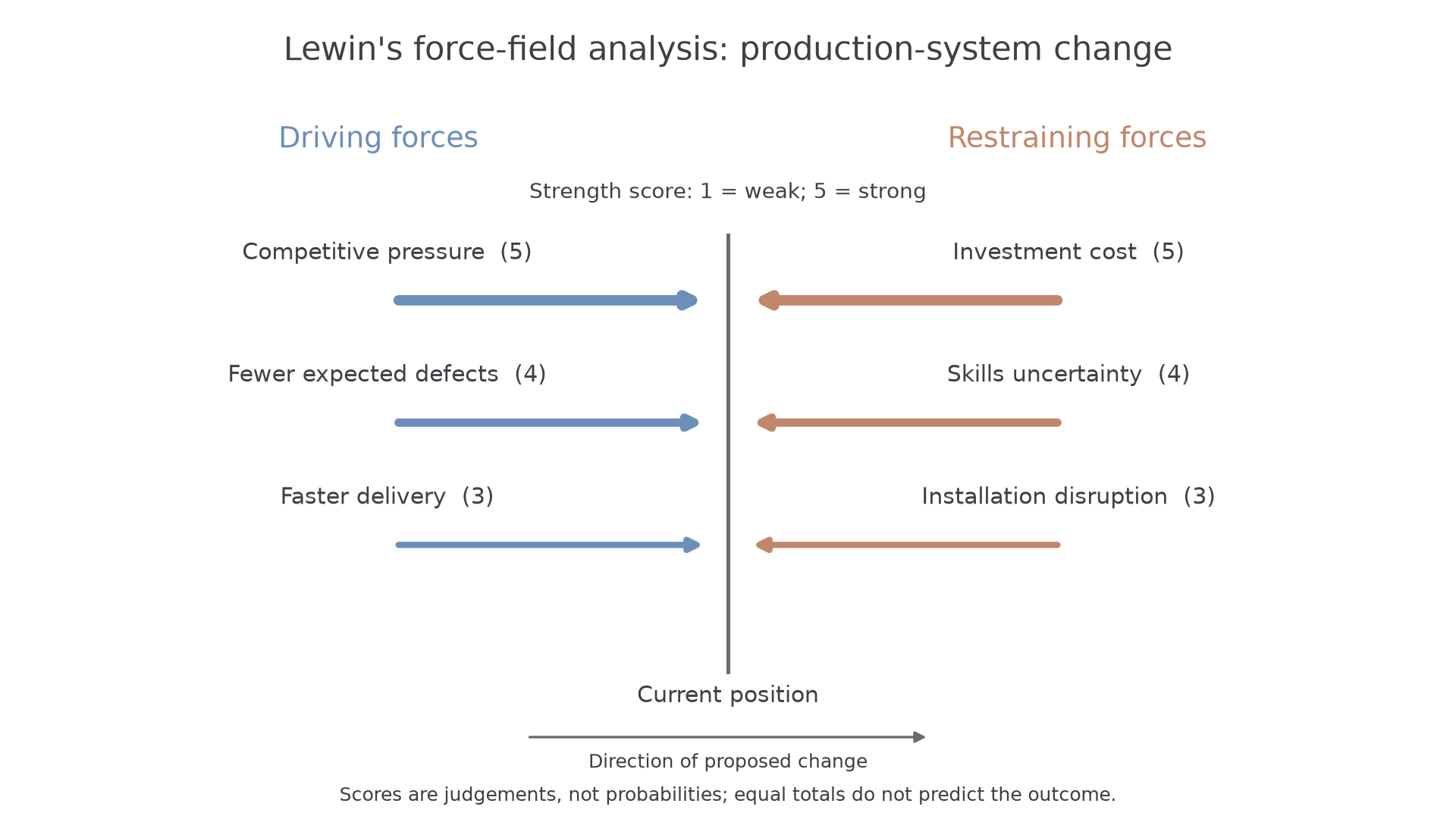
Managers may assign comparative strength scores to forces to structure discussion, but the scores are judgements rather than measured probabilities. Adding them does not prove that the change will succeed. A weakly estimated benefit or a small-looking but decisive safety problem can invalidate a simple total.
The analysis helps managers decide where to intervene. Training and a trial period may reduce the skill and disruption barriers. Evidence from a pilot may strengthen confidence in the quality benefit. Simply increasing pressure on employees might also increase resistance, so reducing a restraining force can be more effective than adding another demand.
Forces can change. A rival's investment can increase competitive pressure, while a cash shortage can make the funding barrier stronger. Stakeholder consultation can reveal a force managers initially missed. Use the analysis as an evidence-based discussion of feasibility and action, not as an automatic mathematical decision rule.
Continue this lesson.
You’re previewing NovaLearn without an account. Create a free account to read the rest.
Create free account