3.6.3 - Organisational structure and authority
Organisational design determines who is responsible for work and how decisions and information move through a business. This lesson compares the required structures and explains authority, hierarchy, delegation and the choice between centralised and decentralised decisions.
Functional, product, regional and matrix structures
An organisational structure arranges roles, reporting relationships and responsibilities so that work can be coordinated.
| Structure | Main grouping | Useful consequence | Possible difficulty |
|---|---|---|---|
| Functional | Marketing, operations, finance and HR departments | Specialist expertise and consistency within each function | Departmental priorities can obstruct coordination |
| Product-based | Divisions responsible for different products | Clear focus on each product's market and results | Resources or specialists may be duplicated |
| Regional | Divisions for geographical areas | Decisions can reflect local conditions | Regions may become inconsistent or duplicate work |
| Matrix | Employees report through two dimensions, commonly function and project | Combines specialist expertise with cross-functional work | Conflicting instructions or unclear priorities |
Illustrative case: a small firm with one main product uses a functional structure, allowing finance specialists to coordinate its financial controls. As the firm develops very different products, a product division may respond more quickly to each product's customers. If regional differences dominate, organising by area may be more appropriate.
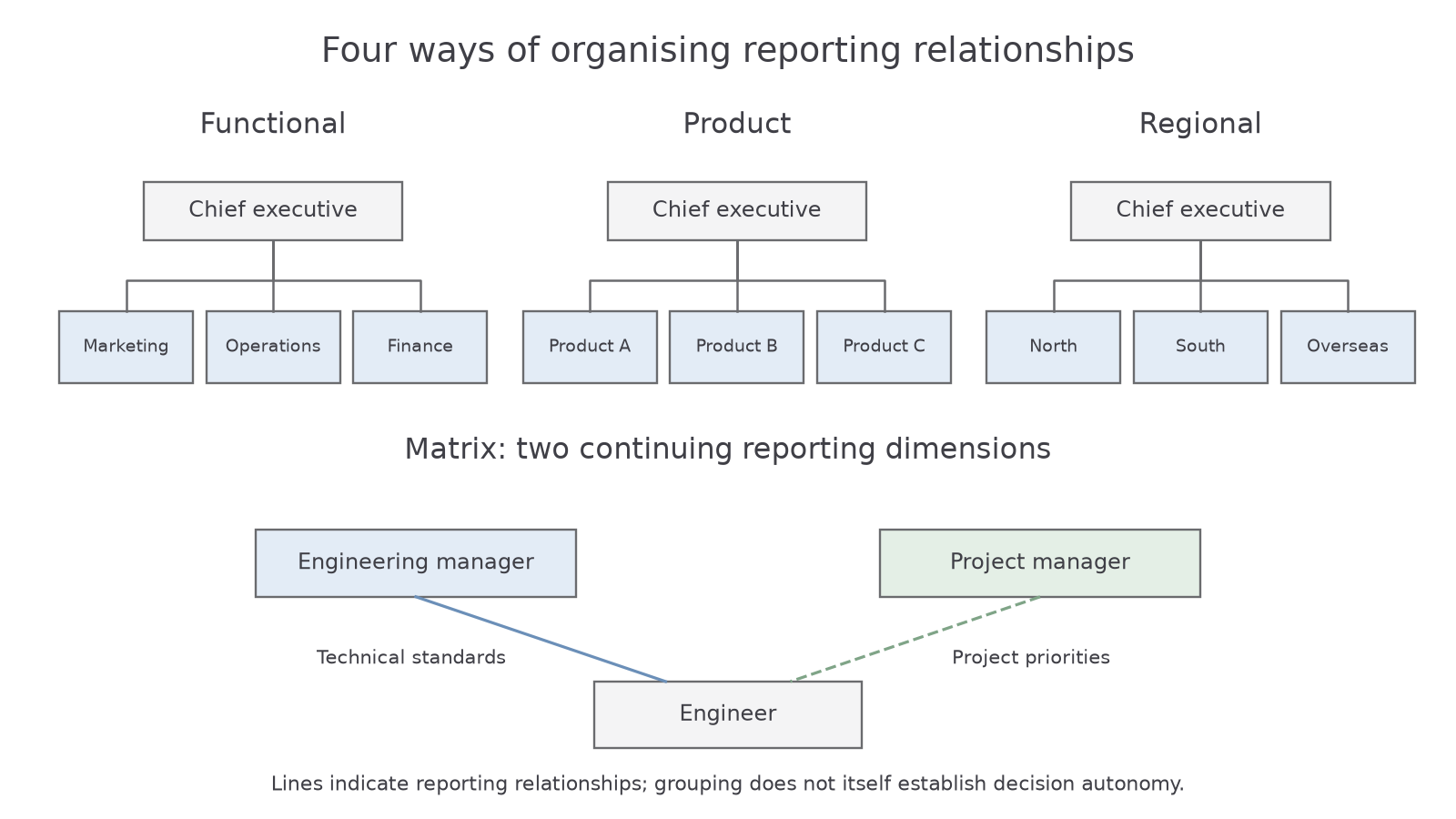
A matrix does not simply mean teamwork. Illustrative case: an engineer reports to one manager for engineering standards and another for the project delivery schedule. Both have an ongoing role. This can share expertise across projects, but the managers must resolve conflicts about time and priorities rather than leave the employee with incompatible demands.
No structure removes the need for cooperation. A product division still needs finance and HR capability; functional specialists still need to understand customer needs. Choosing a structure depends on scale, variety, location, strategy and the coordination problem the business is trying to solve.
Microsoft's 2025 Annual Report identifies three operating segments: Productivity and Business Processes, Intelligent Cloud, and More Personal Computing. This is a real example of grouping different product and service activities for management and reporting. A division's results can become clearer, but finance, security and technical specialists still need to coordinate across the groups; published segments alone do not establish each employee's reporting line. Microsoft, 2025.
[DIAGRAM: asset_name: Four organisational structures; asset_slug: organisational-structures; caption: Functional, product and regional grouping use one reporting dimension while a matrix combines two; description: Four panels show a chief executive above functions, product divisions or regions. In the matrix panel an engineer has a solid reporting line from the engineering manager and a dashed reporting line from the project manager. Lines represent reporting relationships rather than product or information flows.]
Authority, hierarchy, span and delegation
Authority is the legitimate power attached to a role to make decisions and direct work within an organisation.
Hierarchy arranges roles into levels of authority. A tall structure has relatively many levels; a flat structure has relatively few. The chain of command shows how authority and reporting relationships connect those levels. More levels can provide supervision and promotion steps, but communication may take longer and messages may change as they pass through.
Span of control is the number of employees reporting directly to a manager. It does not mean everyone below that manager in the whole organisation. A manager supervising six team leaders has a span of six, even if those leaders supervise another sixty people.
Delegation passes responsibility and appropriate authority for a task to another employee. The delegating manager remains accountable for the overall outcome within their own reporting relationship. Meaningful delegation needs a clear task, decision boundaries, resources and support; assigning work without the authority to act can frustrate the employee.
Experienced employees who can resolve routine issues themselves may work effectively under a manager with a wide span of control. A new team performing safety-sensitive work may need closer support and a narrower span. Communication technology can make coordination easier, but it does not remove a manager's limited time or the need for judgement.
Continue this lesson.
You’re previewing NovaLearn without an account. Create a free account to read the rest.
Create free account