3.7.7 - Porter's five forces
Competitive pressure comes from more than the firms already selling a similar product. This lesson uses Porter's five forces to analyse industry profit pressures, explains how the forces change and connects them to choices about positioning, suppliers, customers and investment.
Rivalry and the threat of entry
Porter's five forces describe pressures that affect an industry's ability to retain profits: rivalry, entry threat, buyer power, supplier power and substitute threat.
[DIAGRAM: asset_name: Porter's five forces; asset_slug: porter-five-forces; caption: Four external forces act on an industry in which existing firms compete; description: Existing rivalry occupies the centre, with threat of new entrants above, threat of substitutes below, supplier bargaining power on the left and buyer bargaining power on the right. Arrows lead from each external force towards the industry, showing pressure on its ability to retain profit rather than a sequence of events.]
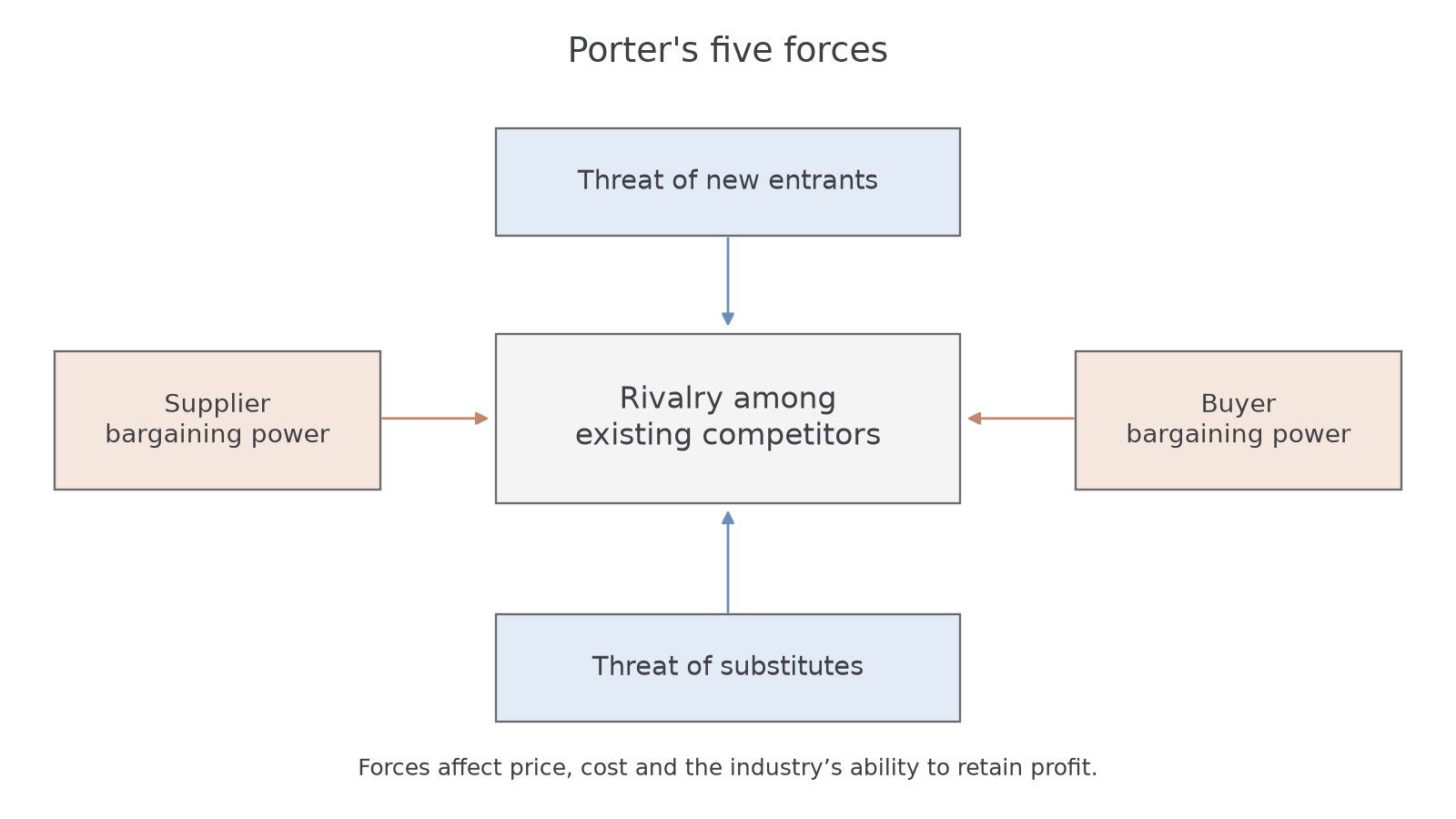
Rivalry is competition between existing businesses in the industry. Firms may compete through price, quality, service, promotion and innovation. Intense rivalry can force selling prices down or increase the costs needed to keep customers, reducing profit. Rivalry tends to be stronger where offers are similar, customers can switch easily and several firms compete for demand that is growing slowly.
High fixed costs and spare capacity can add pressure to win sales because a firm still has bills to pay when output is low. Hotels discounting empty rooms may prompt nearby rivals to cut their prices too. Sales volume can rise without recovering the original profit per room. The actual outcome depends on the extra costs, demand and rival responses; rivalry does not mean that every firm makes a loss.
Entry threat concerns the possibility that new competitors enter the industry. Even before entry occurs, incumbents may keep prices attractive or invest in service to discourage it. New capacity and new offers can intensify rivalry and reduce the existing firms' sales or pricing freedom.
Barriers to entry make successful entry difficult. Large start-up investment, established brands, economies of scale, access to distribution, specialist knowledge or regulatory requirements can all matter. An incumbent able to produce at low unit cost may withstand a price that a small entrant cannot sustain. Strong customer loyalty can make it expensive for an entrant to persuade buyers to switch. A barrier must have a mechanism: merely saying a business is “large” does not show why entry is difficult.
Technology and other external changes can alter barriers. Online distribution may let an entrant reach customers without an extensive shop network. New production methods may reduce the minimum initial investment. Alternatively, a new technical requirement could make specialist skills more important. Barriers reduce threat rather than guarantee that entry never occurs.
Analyse the industry, not just one competitor's intentions. A profitable niche might attract entry, but the required capabilities and resources determine whether that threat is credible. Firms can respond through stronger differentiation, lower costs or improved access to customers, with financial and operational implications.
Buyer and supplier bargaining power
Bargaining power concerns how strongly buyers or suppliers can influence the price and terms on which a business trades.
Buyer power is strong when customers can credibly demand lower prices or better terms. A large buyer accounting for much of a supplier's sales may threaten to switch, making the loss difficult for that supplier to absorb. Standardised products, good price information and low switching costs make alternatives more credible. Buyers can then capture more of the value through discounts, improved service or longer payment periods.
A large number of individually small customers often have less bargaining power than a few major customers, although comparison technology and easy switching can still create significant pressure. Buyer power is not simply the number of people who like the product. It depends on the alternatives and the business's dependence on their purchases.
Illustrative case: one manufacturer buys 60% of a component maker's output. If that manufacturer can obtain comparable parts elsewhere, it may demand a lower price. The maker risks losing a large portion of sales if it refuses. Winning a large contract therefore brings revenue but can also create dependence and squeezed margins.
Supplier power is strong when input providers can demand higher prices or restrictive terms. Few alternative suppliers, scarce specialist inputs, costly switching and a customer's dependence on the input can all strengthen it. A supplier whose component is essential and hard to replace may obtain a higher price, raising its customer's costs and reducing the customer's profit unless the increase is passed on or offset.
The customer's importance to the supplier matters too. A small firm buying a tiny share of a large supplier's output may have little influence. A large buyer able to switch among several suppliers can negotiate more effectively. The same business can be a powerful buyer in one relationship and a weak seller in another.
Power can change. A new alternative component can weaken an established supplier; losing a major customer can increase dependence on those remaining. Developing another source can improve bargaining position, but it may require qualification costs, time and quality checks. Avoid assuming that switching is costless merely because another firm's name exists.
Continue this lesson.
You’re previewing NovaLearn without an account. Create a free account to read the rest.
Create free account