3.7.2 - Financial statements, returns and gearing
Financial statements provide evidence about a business's performance and financial position, but different measures answer different questions. This lesson explains their main categories and calculates return on capital employed, the current ratio and gearing, showing how profitability, liquidity and financing risk can point in different directions.
Income statements and balance sheets
An income statement reports revenues, costs and profit over a period, while a balance sheet reports assets, liabilities and equity at a particular date.
Revenue less cost of sales gives gross profit; subtracting operating expenses gives operating profit. Finance costs and tax affect the later profit figure. Consider an engineering company with annual revenue of £400,000, cost of sales of £240,000 and operating expenses of £100,000. Finance costs are £12,000 and tax £10,000. Use the profit measure matching the ratio being calculated.
Worked example 1 - profit through the statement
Worked example 2 - a workshop
A workshop has revenue £275,000, cost of sales £155,000 and operating expenses £75,000.
Both figures refer to the year's trading. The operating figure includes running expenses but precedes finance costs and tax in this simplified statement.
Rolls-Royce's 2024 results, released on 27 February 2025, report underlying operating profit of about £2.5 billion and free cash flow of about £2.4 billion. These have different adjustments and purposes: the similarity of the amounts does not make profit and cash interchangeable. Rolls-Royce, 2025.
Assets are resources the business controls. Non-current assets, such as equipment, are intended for continuing use; current assets include inventory, receivables and cash. Liabilities are amounts owed: current liabilities are generally due within a year, while non-current liabilities are longer-term commitments. Equity represents owners' interest, including contributed funds and retained profits. The statement balances because total assets equal liabilities plus equity.
The engineering company's balance sheet has non-current assets £240,000 and current assets £100,000: total assets £340,000. Current liabilities are £40,000, non-current liabilities £120,000 and equity £180,000, also totalling £340,000. Net current assets, or working capital, are £60,000. They are not the same as the £100,000 current-assets total.
Capital employed is equity plus non-current liabilities: £300,000. Equivalently, subtract current liabilities from total assets, or add non-current assets to net current assets. These routes must agree when the figures use the same date and basis. Statements can reveal debt, asset commitments and profitability, but recorded assets are not necessarily immediately saleable at their stated value and profit is not the same as cash received.
Return on capital employed
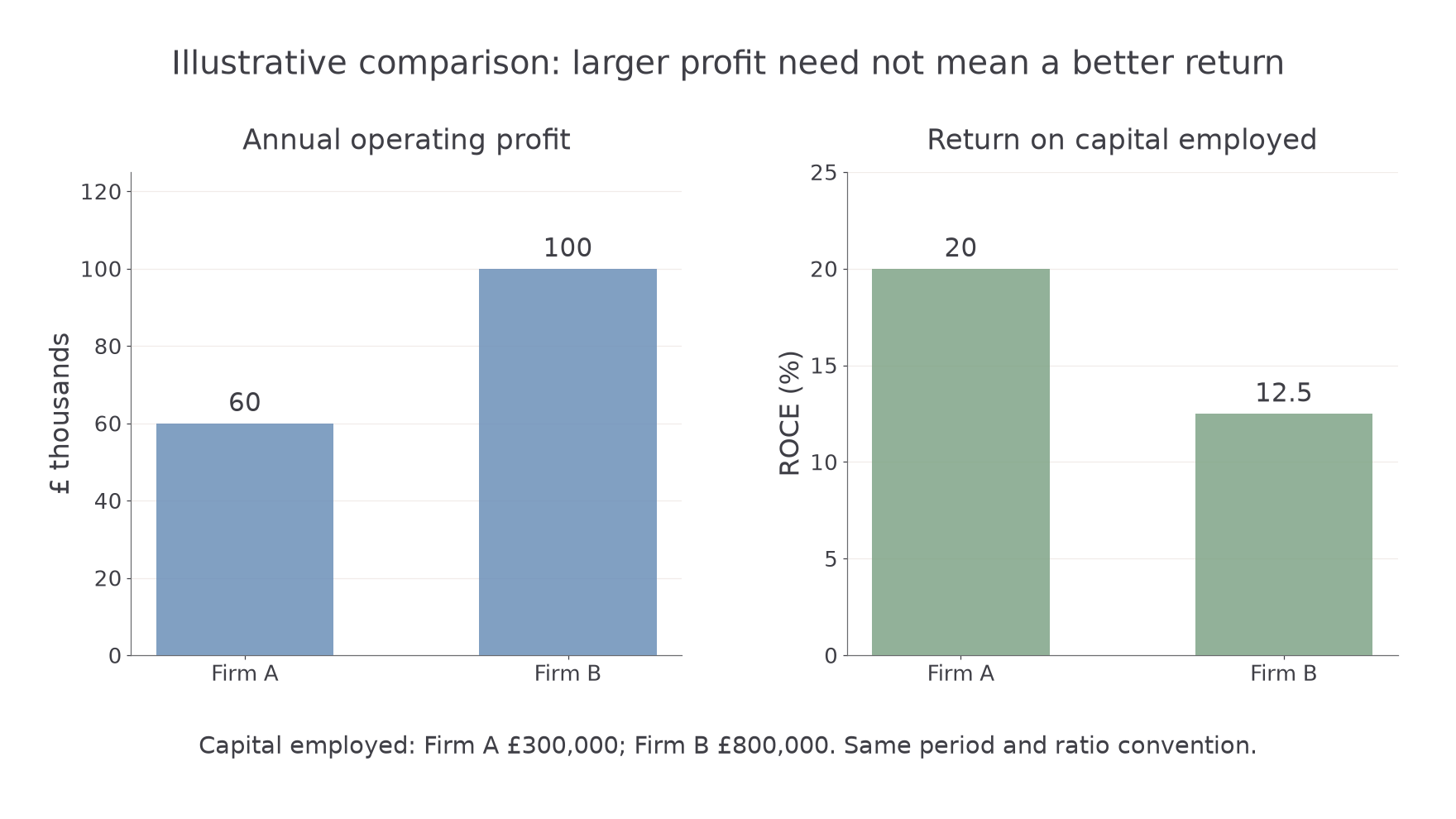
Return on capital employed compares operating profit with the funds committed to the business, so a larger profit does not automatically mean a better return.
For the engineering company, annual operating profit is equivalent to 20% of capital employed on the stated basis. This does not mean shareholders receive a 20% dividend or that 20% of sales is profit: the denominator is capital, not revenue.
Worked example 1 - deriving capital employed
Worked example 2 - a larger firm
A second business has equity £600,000, non-current liabilities £200,000 and operating profit £100,000.
Its larger profit uses much more capital, so its return on each pound employed is lower.
Comparing returns can identify how productively capital is used over time or against comparable firms. Rising ROCE may result from more operating profit, less capital employed, or both. Selling an asset can raise the ratio even if profit falls, so investigate the cause.
[DIAGRAM: asset_name: Operating profit compared with return on capital; asset_slug: profit-versus-roce; caption: The business with larger operating profit can have a lower ROCE because it uses more capital; description: Two panels compare Firm A with operating profit 60 thousand pounds and capital employed 300 thousand pounds, with Firm B at operating profit 100 thousand pounds and capital employed 800 thousand pounds. Operating profits are 60 and 100 on the left, while ROCE is 20 percent and 12.5 percent on the right.]
Working backwards from ROCE
A business has capital employed £750,000 and ROCE 16%. Rearrange the formula, then convert the percentage to a proportion.
As a check, . Multiplying by 16 rather than 0.16 would exaggerate the amount a hundredfold.
A different business has operating profit £84,000 and ROCE 14%. Its unknown capital employed can be found by rearranging in the other direction:
Both reverse routes preserve the relationship between profit, capital and a percentage return.
Interpretation needs context. Capital-intensive firms, firms using older assets and firms investing ahead of demand can have different ratios for sensible reasons. A new factory may initially lower ROCE while supporting later growth. Accounting values and one-off effects limit comparisons, and the ratio alone does not show cash availability, risk or non-financial outcomes.
Continue this lesson.
You’re previewing NovaLearn without an account. Create a free account to read the rest.
Create free account