3.10.2 - Organisational culture
Organisational culture shapes what employees regard as normal, valued and acceptable at work. This lesson explains Handy's four cultural types, the influences on culture and why changing it can support strategy but prove difficult.
Handy's four cultural types
Culture is the shared assumptions, values and ways of behaving that influence how work is done.
Culture appears in decisions and everyday behaviour, not just in a written mission. If a business claims to value quality but rewards output while ignoring defects, employees receive a practical message about what matters.
Handy's power culture centres influence on a person or small group. Decisions can be rapid because the centre directs action, but the organisation may depend heavily on that person's judgement and relationships. A founder-led business may have this culture when authority remains concentrated around its founder; size alone does not establish the pattern.
A role culture emphasises defined responsibilities, rules and procedures. It can support consistency and predictability, but rigid boundaries may slow a response to unfamiliar problems. An administration department organised around formal duties and approval procedures demonstrates this emphasis.
A task culture brings people together around solving problems or completing projects, with influence often linked to relevant expertise. It can support cross-functional cooperation and adaptability. It also needs coordination and resources, and project priorities can conflict.
A person culture places the individual professionals' interests at the centre, with the organisation serving those individuals. Independent professionals who share support facilities through an association may organise their work this way. It is not simply a workplace that treats people well; many other cultures do that while prioritising organisational objectives.
The types are models, not exhaustive boxes. A large business may contain different subcultures, and its actual behaviour may combine elements. Identify evidence of influence and expectations rather than label a culture solely from its structure.
[DIAGRAM: asset_name: Handy's four culture patterns; asset_slug: handy-culture-patterns; caption: The patterns distinguish where influence sits and what coordinates work; description: A power-culture web has a central decision maker, a role-culture temple has ordered specialist pillars, a task-culture net connects expertise around a project, and a person-culture cluster contains autonomous professionals sharing support. The shapes are conceptual models, not literal organisation charts or claims that every firm fits one pure type.]
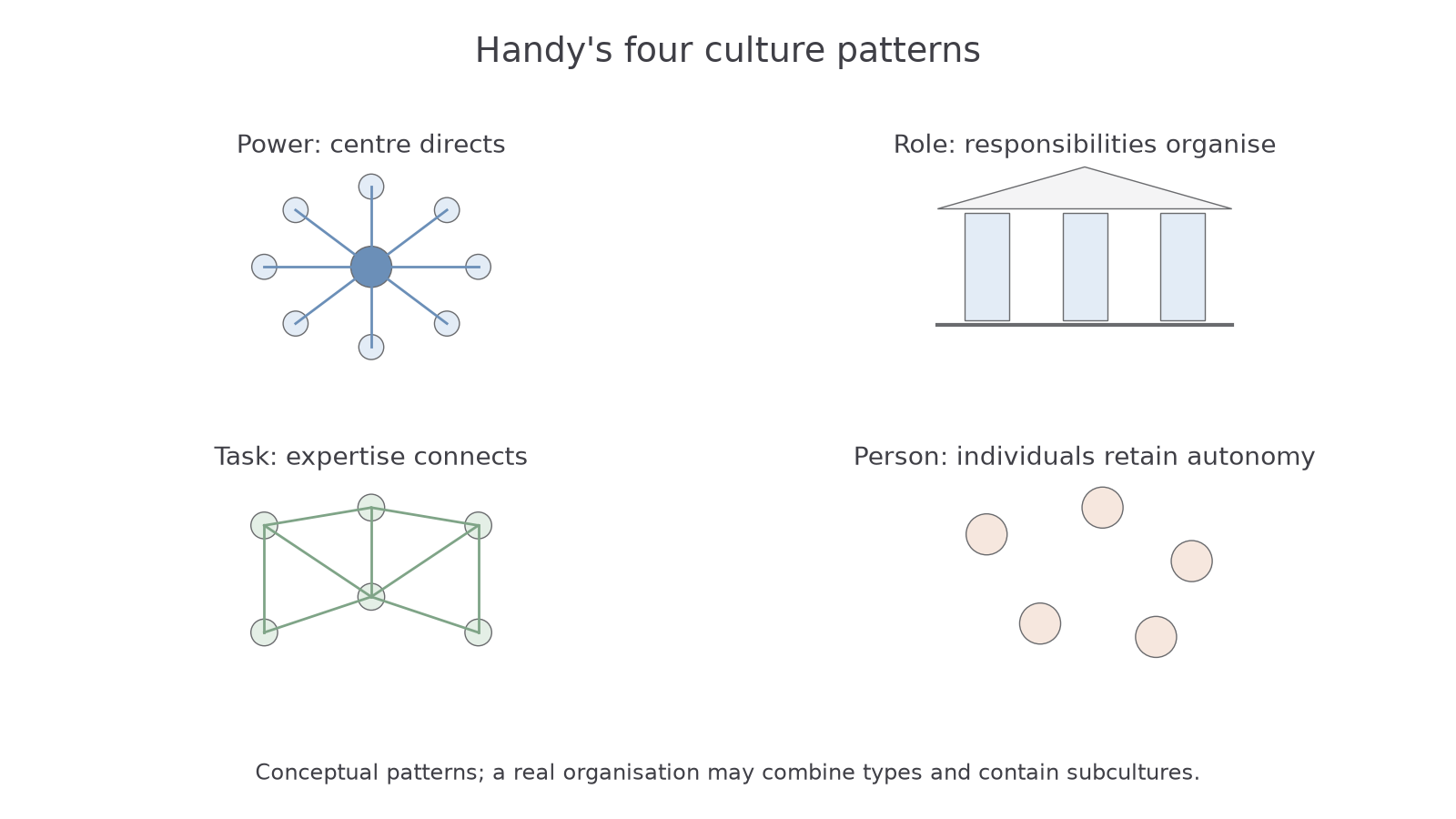
The source of authority changes how a problem is handled. In a power culture an employee may seek the central leader's judgement, giving speed when that person is available but creating a bottleneck when many decisions arrive together. In a role culture the employee follows a defined procedure and escalates an exception through the responsible role. This protects consistency and makes authority less dependent on personal relationships, but an unfamiliar customer problem may fall between job boundaries.
In a task culture, influence can move towards the person who understands the particular problem. A designer may lead technical choices while a finance specialist leads the funding assessment. The advantage is relevant expertise; the difficulty is resolving priorities when the same specialists serve several teams. Project work does not remove budgets, deadlines or accountability. A person culture is different again: independent professionals may share reception, premises and administration while preserving considerable control over their own professional work. It is not equivalent to a task culture simply because the professionals sometimes cooperate.
These differences help explain the fit with strategy. A repeated, regulated process can benefit from role clarity, whereas an unfamiliar design problem may benefit from expertise-based coordination. A founder's power can support a coherent entrepreneurial direction but may obstruct growth when employees cannot act without approval. The useful judgement is which behaviours enable the work and which create a constraint, rather than which cultural label sounds most attractive.
Influences on culture and strategic fit
Culture develops through an organisation's history, leadership, systems, people and experience of its environment.
Microsoft's 2025 Annual Report describes a growth mindset involving experimentation, evaluation and continuous improvement. This is evidence of the culture its leaders seek, rather than proof of how every employee behaves. To assess whether the stated value is embedded, look for what happens when a trial fails, whether teams share learning and whether promotion rewards thoughtful improvement. Microsoft, 2025.
Founders and senior leaders influence which behaviour is recognised and tolerated. Recruitment and promotion reinforce that pattern by selecting people for particular capabilities or conduct. Pay, performance measures and procedures communicate priorities. Past success can make established practices seem unquestionable, even after conditions change.
The work and environment also matter. A business requiring consistent procedures may emphasise roles and rules. One solving changing technical problems may place more weight on expertise and collaboration. National, professional and regional influences can contribute to subcultures, especially in international or acquired businesses.
Continue this lesson.
You’re previewing NovaLearn without an account. Create a free account to read the rest.
Create free account