3.2.1 - Management and leadership styles
Managers coordinate resources, while leaders influence people towards a direction; one person often does both. This lesson compares four styles, uses the Tannenbaum Schmidt continuum to locate decision authority and explains why effectiveness depends on the task, people and business circumstances.
Management and leadership functions
Management and leadership are related activities, but they describe different contributions to a business.
Management involves planning, organising, coordinating and controlling resources to achieve objectives. A manager forecasts staffing needs, allocates tasks, organises supplies and checks actual results against a plan. These activities turn intended goals into reliable operations.
Leadership involves influencing and motivating people to pursue a direction. A leader explains why a change matters, builds commitment and encourages people to work towards it. Formal authority can support leadership, but giving an instruction does not guarantee that staff believe in the direction or use their judgement to achieve it. People without senior job titles can also influence colleagues.
Illustrative case: a service manager introduces a faster appointment system. Allocating staff to shifts and checking waiting times are management activities. Explaining how the new system helps customers and gaining staff support are leadership activities. If the manager inspires support but fails to schedule enough staff, delivery can still fail. If the schedule is technically sound but staff distrust the purpose, they may resist or follow it mechanically without resolving problems.
The distinction is therefore useful without treating managers and leaders as two mutually exclusive categories. One person can manage and lead. The balance can also change: a routine operation may require close coordination, while a major change may require more attention to direction and commitment. Effective performance often needs both.
Four management and leadership styles
A style describes how a manager or leader relates to staff, especially how decisions are made and how authority is used.
An autocratic leader makes decisions with little staff involvement and gives clear instructions. This can allow rapid action and consistent procedures, particularly where coordination or safety is urgent. It can also overlook employees' knowledge, discourage suggestions and reduce commitment if people feel ignored. The manager's information and competence are therefore crucial.
A paternalistic leader makes decisions but presents them as being in employees' best interests. The leader may consult, provide welfare benefits and explain the reasoning, while retaining final authority. Employees may value the care and security. Others may resent the assumption that the leader knows what is best for them. Paternalism is not the same as democratic control: consultation does not necessarily transfer the decision.
A democratic leader involves staff in decisions through discussion, consultation or group participation. This can use employees' practical knowledge, improve the quality of ideas and encourage ownership of the outcome. Participation takes time, and conflicting opinions can make agreement difficult. The leader still needs clear boundaries and responsibility; democracy does not mean every employee decides every issue.
A laissez-faire leader gives capable staff substantial freedom to organise their work and make decisions. The leader may still establish objectives, provide resources and monitor results. Skilled, motivated teams can respond creatively without constant approval. Inexperienced staff may struggle with unclear expectations, and weak coordination can cause duplication or inconsistent service. Laissez-faire is not a requirement that managers abandon accountability.
A design team with specialist knowledge may benefit from freedom to choose its methods. The same freedom may be unsuitable for a newly recruited team following a tightly controlled safety procedure. An autocratic decision during an emergency and consultation during a later redesign can therefore be compatible within one business.
Style is influenced by the leader's personality, values and confidence, employees' skills and motivation, the type of task, organisational culture and time available. Business size and technology can change the practical need for coordination and the information people can access. A manager who trusts an experienced team may delegate more than one responsible for trainees. Style should be described through actual decision behaviour rather than assumed from a job title.
The Tannenbaum Schmidt continuum
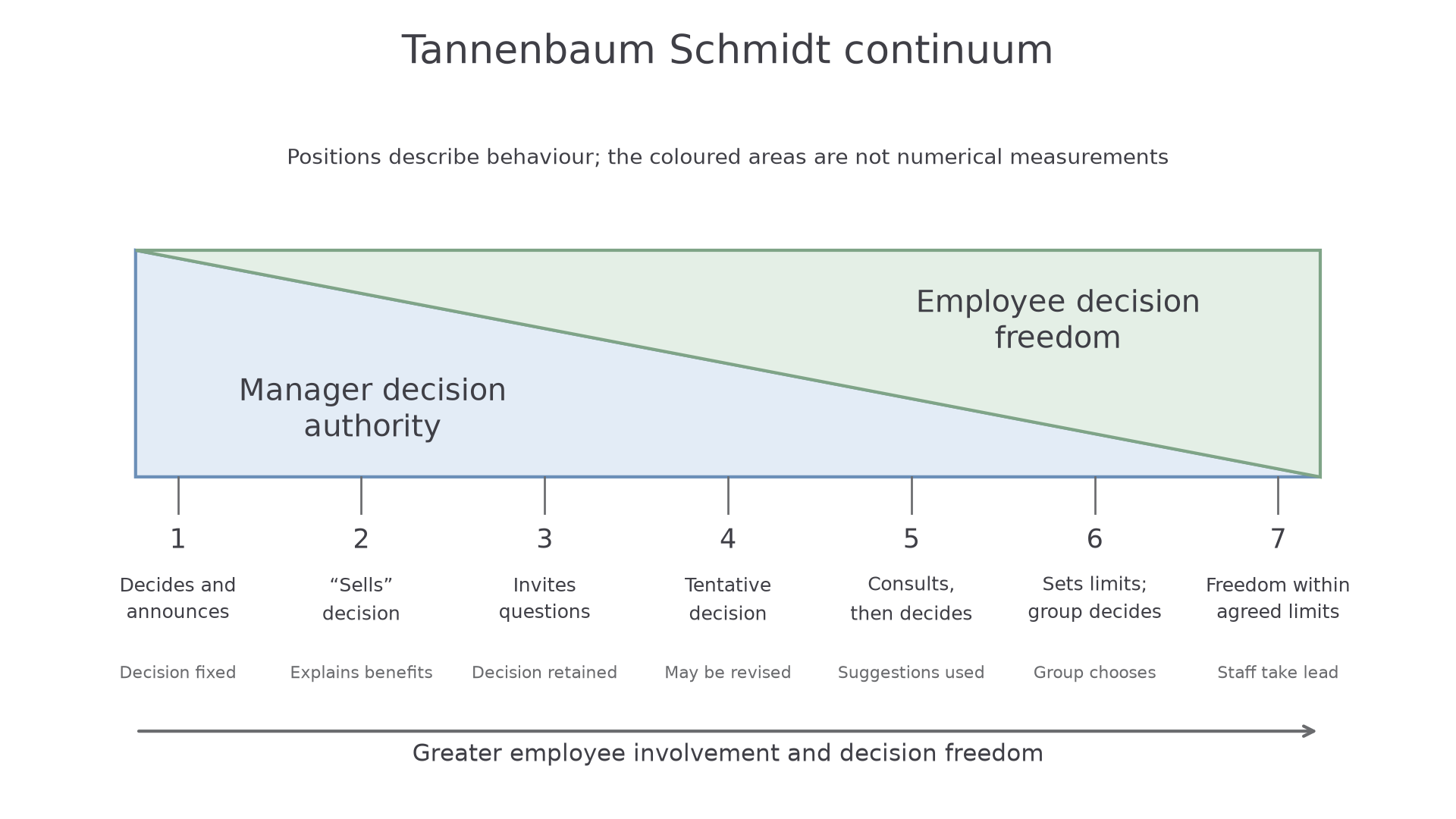
The Tannenbaum Schmidt continuum shows a range of ways decision authority can move from the manager towards employees.
At one end, the manager uses more authority and employees have little freedom to shape the decision. At the other, employees have more decision freedom within agreed limits. The model is a continuum: leaders can choose intermediate positions rather than being restricted to four fixed style labels.
The seven commonly described positions move through these behaviours:
- The manager makes the decision and announces it.
- The manager makes the decision and “sells” it by explaining its benefits.
- The manager presents ideas and invites questions, while retaining the decision.
- The manager presents a tentative decision that can be changed following discussion.
- The manager presents a problem, obtains suggestions and then decides.
- The manager defines limits and asks the group to decide within them.
- The manager permits employees to function within agreed limits, giving substantial decision freedom.
The important distinction is how much influence employees have, not how friendly the announcement sounds. Explaining a fixed decision still leaves authority with the manager. Asking for suggestions can influence the final choice while the manager retains it. Allowing the group to decide within a budget transfers more decision freedom, although senior management still establishes the boundary.
[DIAGRAM: asset_name: Decision authority on the Tannenbaum Schmidt continuum; asset_slug: aqa7132_b06_continuum; caption: Moving right reduces manager-controlled decision authority and increases employee decision freedom within agreed limits.; description: A seven-position Tannenbaum Schmidt continuum from manager decides and announces through sells, invites questions, offers a tentative decision, consults then decides, sets limits for a group decision, to employee freedom within agreed limits. Complementary blue and sage triangles show declining manager authority and increasing employee decision freedom; triangle areas are conceptual rather than measured data.]
Illustrative case: a manager initially announces a standard delivery procedure because staff are new. As staff learn the system, she asks for suggestions and makes the final revision. Later she gives the experienced team a service target and cost limit and lets it choose the rota. The movement towards greater freedom is justified by changing competence and the decision involved, rather than by the passage of time alone.
Three broad influences help locate a suitable position. Forces in the manager include confidence in staff, personal values and tolerance for loss of direct control. Forces in employees include competence, willingness to accept responsibility and understanding of the objectives. Forces in the situation include urgency, risk, task complexity and the organisation's rules or culture. A capable team can still require tight boundaries for a high-risk task.
The continuum helps explain behaviour, but does not prove that the far-right position is always best. Consultation can delay a time-critical decision; rigid control can waste specialist knowledge. Its usefulness lies in choosing and adjusting authority for the circumstances.
The John Lewis Partnership's 2025 report describes 60 elected Partners on its Partnership Council and three Partners elected to its Board. Formal representation creates channels for staff to challenge management and influence decisions. It illustrates democratic involvement, while specific managers still retain operational responsibilities; the evidence does not imply that every routine decision is decided by a staff vote. Partnership governance in 2025.
Choosing an effective style in context
An effective style helps achieve the relevant objective while using the information, skills and motivation available in the situation.
Judge a style against the task. An urgent equipment failure may require one person to give immediate, clear directions so several teams do not take conflicting actions. Autocratic direction may then support speed and safety. A longer-term redesign of working methods may benefit from democratic involvement because employees know where delays and defects occur. A specialist team developing a new service may need freedom to experiment, with clear objectives and limits.
The effects operate through mechanisms. Participation can improve decisions when staff contribute knowledge the manager lacks; it can improve motivation when people see their ideas taken seriously. These are different benefits, and neither follows merely from holding a meeting. Ignoring every suggestion can undermine trust, while consultation with people lacking relevant information may add little to decision quality.
Freedom also needs support. If staff lack training or the required resources, delegating a decision may simply shift an impossible problem onto them. Clear responsibilities, access to information and feedback make greater autonomy more workable. Conversely, highly skilled staff may leave if constant approval prevents them using expertise, increasing recruitment costs and losing knowledge.
Illustrative case: a restaurant recruits many inexperienced employees before a busy season. Clear instructions can reduce inconsistent food handling, while experienced chefs might contribute ideas about preparation and waste. The manager could use tighter control for safety procedures and more consultation for improving workflows. A single style across all decisions may be less effective than adjusting authority while keeping standards clear.
There are also trade-offs over time. A slower participative decision now may develop staff judgement and make future decisions faster. Strong direction can solve an immediate crisis but create dependence if used continuously. Paternalistic welfare provision can build loyalty, but employees may still want a greater voice. Assess results such as quality, retention and responsiveness alongside costs and speed, rather than judging style solely by popularity.