4.3.1.1a - Density Equation and Particle Model
Density tells you how much mass is packed into a volume. In this lesson you will use the density equation, then use simple particle diagrams to explain why solids, liquids and gases usually have different densities. The full density required practical is a separate split; here the focus is the equation and the particle model behind it.
What density means
A material is dense if a lot of mass is packed into a small volume. A less dense material has less mass in the same volume, or needs a larger volume to contain the same mass.
Density
Density is the mass per unit volume of a material.
That phrase "per unit volume" is the key. If two samples have the same volume, the one with the larger mass has the larger density. If two samples have the same mass, the one with the smaller volume has the larger density.
The standard GCSE Physics unit for density is kilograms per metre cubed, written as kg/m^3. You may also see g/cm^3 in some contexts, but a calculation must keep mass and volume units matched.
Use the density equation
AQA defines density using this relationship:
Density
In this equation, ρ is density in kg/m^3, m is mass in kg, and V is volume in m^3. In current 2026-2027 AQA exams the Physics Equations Sheet is provided, but the marks still depend on selecting the right relationship, substituting values, rearranging if needed, and giving the correct unit.
[DIAGRAM: asset_name: density_equation_relationships - diagram 1; asset_slug: 029_4_3_1_1a_density_equation_and_particle_model_diagram1; file: diagram_assets/029_4_3_1_1a_density_equation_and_particle_model_diagram1.png; recommended_method: deterministic_drawn; description: Exact formula relationship visual showing rho = m divided by V, m = rho times V, and V = m divided by rho, with labels for density in kg/m^3, mass in kg, and volume in m^3. Assessed formula meaning depends on exact symbols and units, so deterministic drawing is used.]
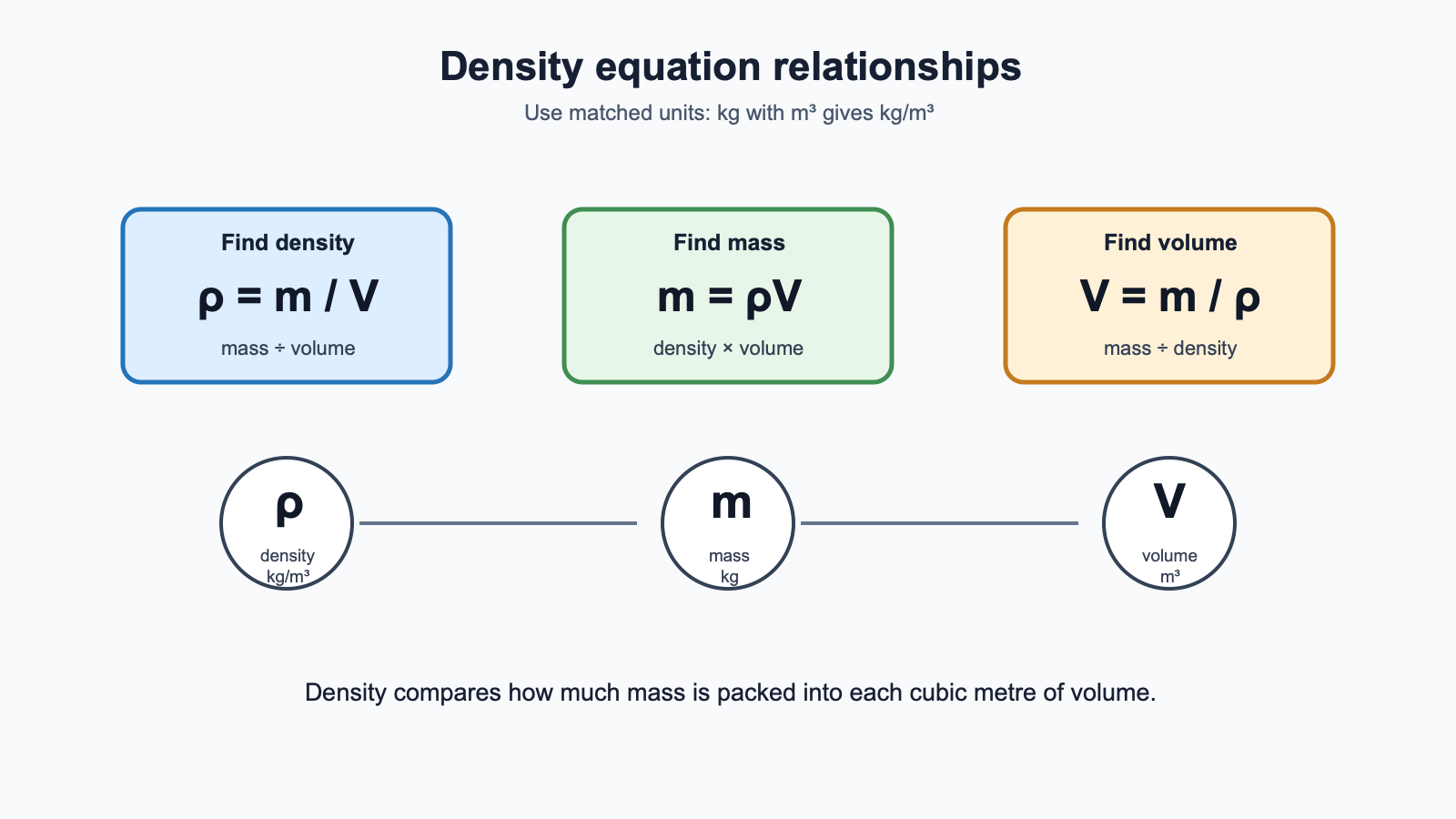
If density is the unknown, divide mass by volume. If mass is the unknown, rearrange to m = ρV. If volume is the unknown, rearrange to V = m/ρ.
Worked example:
A metal sample has mass 2.70 kg and volume 0.00100 m^3.
The answer is large because one cubic metre of the material would have a mass of 2700 kg.
When mass is conserved
"Mass is conserved" means no material has been added or removed. The same atoms or molecules are still present, so the mass is the same even if the sample changes shape or takes up a different volume.
For a fixed mass, density and volume move in opposite directions. If the same mass occupies a smaller volume, its density increases. If the same mass occupies a larger volume, its density decreases.
For example, a sealed sponge sample has mass 0.080 kg. If its volume is compressed to 0.00040 m^3, then:
If the same sponge is allowed to expand to 0.00080 m^3, the mass is still 0.080 kg, so:
The density halves because the same mass now takes up twice the volume.
Particle diagrams for states
Simple particle diagrams model atoms or molecules as small circles. The circles should usually be the same size in all three states; it is the arrangement and spacing that change.
[DIAGRAM: asset_name: particle_model_states - diagram 2; asset_slug: 029_4_3_1_1a_density_equation_and_particle_model_diagram2; file: diagram_assets/029_4_3_1_1a_density_equation_and_particle_model_diagram2.png; recommended_method: image_gen; description: Built-in Codex Image Gen particle-model diagram in a restrained/muted NovaLearn palette, showing three labelled same-size containers: solid particles close together in a regular fixed arrangement, liquid particles close together but irregular and able to move past one another, and gas particles far apart and spread throughout the whole container.]
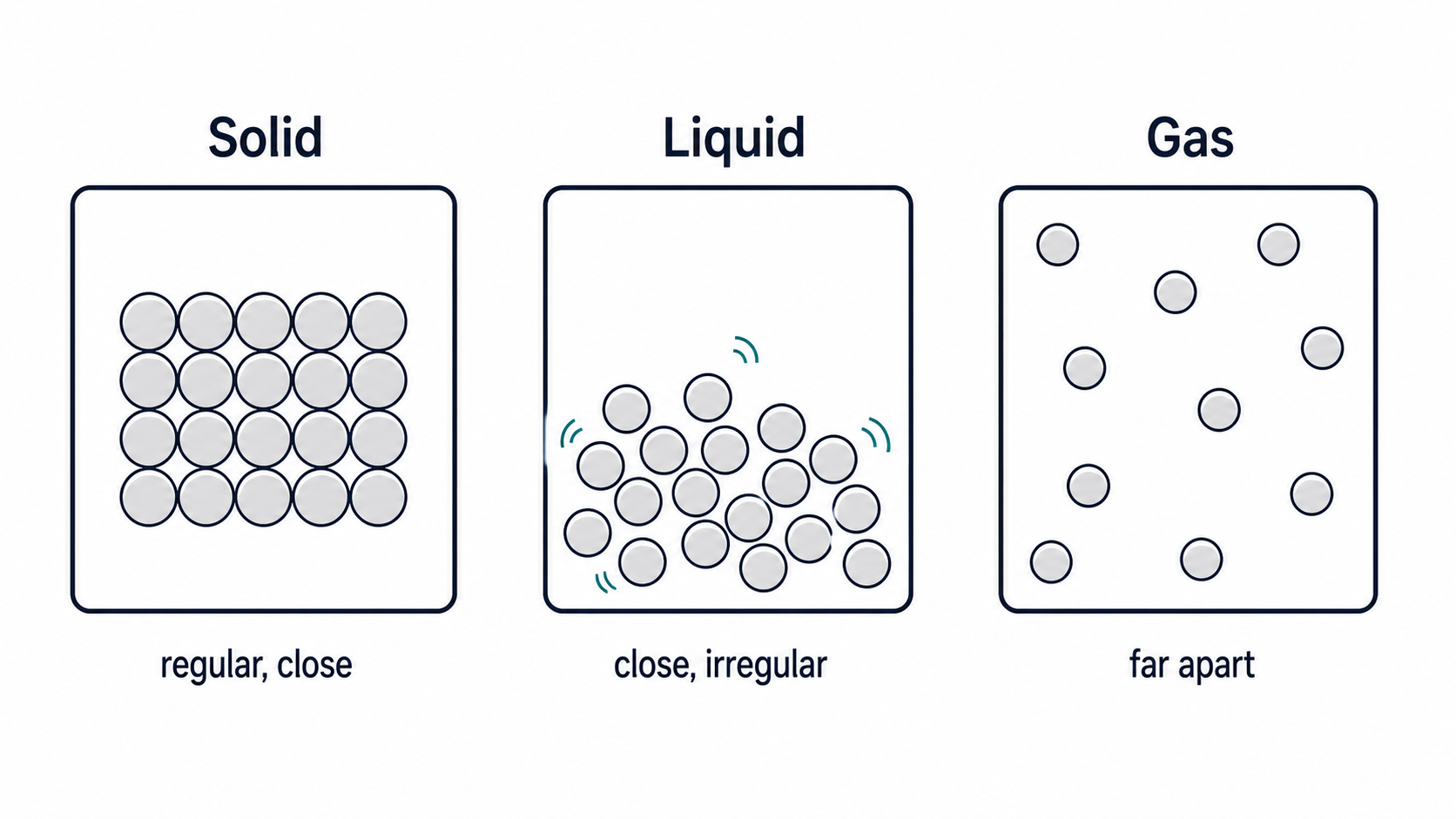
For a solid, draw particles close together in a regular pattern. The particles vibrate about fixed positions, so the solid keeps its shape and volume.
For a liquid, draw particles close together but in a random arrangement. They are not fixed in position, so a liquid can flow and take the shape of the bottom of its container while keeping a fixed volume.
For a gas, draw particles far apart in a random arrangement across the whole container. A gas fills the available volume, so a particle diagram for a gas should not show all the particles bunched at the bottom.
Explain density with particles
The particle model links directly to density. If particles of the same material are close together, a given volume contains more particles and therefore more mass. If the particles are far apart, the same volume contains fewer particles and therefore less mass.
This is why gases usually have much lower densities than solids and liquids. In a gas, the particles are far apart, so there is much less mass in each cubic metre. In solids and liquids the particles are close together, so there is much more mass in each cubic metre.
Be careful with wording: density is not about particles becoming heavier or larger. For this explanation, the important idea is how much empty space there is between particles in the same volume.
Now turn the idea around in your own words. A good explanation should mention both the equation and the particle spacing.
Exam habits
Most density mistakes are small but expensive. Always check that the question asks for mass, volume or density before choosing the rearranged equation. Always include units, and remember that volume is not the same as length or area.
For particle explanations, write in terms of atoms or molecules and their arrangement. A strong answer links the model back to the density equation: close particles mean more mass in the same volume, so density is greater.
Useful exam phrases:
- "more mass per unit volume"
- "the same mass occupies a smaller volume"
- "particles are close together / far apart"
- "the same volume contains more / fewer particles"
Density is mass per unit volume: calculate it with ρ = m/V, and explain state differences by how closely atoms or molecules are arranged.