4.2.3.2 - Mains Electricity and Three-Core Cable Safety
Most electrical appliances are connected to the mains with a cable containing separate wires for live, neutral and earth. The colours and functions of these wires matter because the live wire can be dangerous even when an appliance is not working. This lesson focuses on what each wire does, what potential difference it is at compared with Earth, and how to explain two common safety hazards.
Three-Core Cable
A three-core cable contains three insulated wires inside one outer protective sheath. The insulation on each wire is colour coded so the wires can be identified easily.
| Wire | Colour of insulation | Main role |
|---|---|---|
| live | brown | carries the alternating potential difference from the supply |
| neutral | blue | completes the circuit |
| earth | green and yellow stripes | safety wire to stop the appliance becoming live |
[DIAGRAM: asset_name: Mains Electricity and Three-Core Cable Safety - diagram 1; asset_slug: 023_4_2_3_2_mains_electricity_and_three_core_cable_safety_diagram1; file: diagram_assets/023_4_2_3_2_mains_electricity_and_three_core_cable_safety_diagram1.png; recommended_method: image_gen; description: Generated with built-in Codex Image Gen using a restrained, muted NovaLearn palette. It shows a three-core mains cable entering an appliance with labelled brown live, blue neutral, and green/yellow earth wires: live carrying the alternating potential difference from the supply, neutral completing the circuit, and earth connected to a metal case as a 0 V safety wire.]
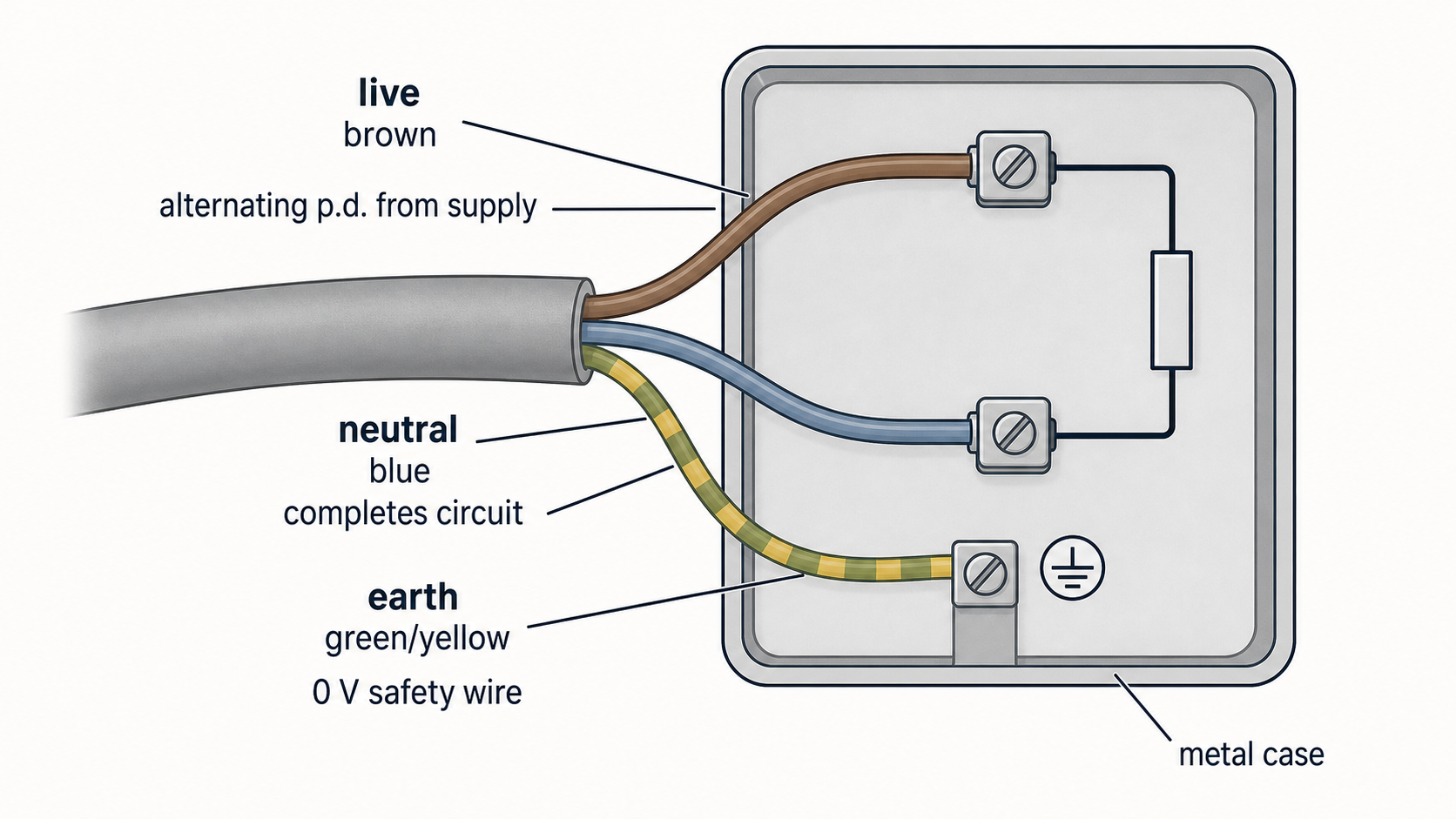
The words "core" and "wire" are often used together here: a three-core cable is one cable with three separate conducting cores. The colour coding is not decoration; it is part of safe identification.
Live, Neutral and Earth Roles
When an appliance is operating normally, the live and neutral wires are both part of the working circuit. The live wire provides the alternating potential difference from the mains supply. The neutral wire completes the circuit back to the supply.
Live Wire
The live wire carries the alternating potential difference from the mains supply.
The earth wire has a different job. It is a safety wire. In normal use, the earth wire should not carry a current. It is connected to parts that could otherwise become dangerous, such as the metal case of some appliances.
Earth Wire
The earth wire is a safety wire that helps stop an appliance becoming live.
The neutral wire is not the same as the earth wire. Neutral completes the normal circuit. Earth is there for safety if a fault occurs.
Potentials in a Mains Cable
Potential difference is measured between two points. In mains safety explanations, Earth is treated as the 0 V reference.
The live wire is at an alternating potential difference of about 230 V compared with Earth. This is why touching the live wire while also connected to Earth can be dangerous: there is a large potential difference that can drive current through the body.
The neutral wire is at, or close to, Earth potential. That means it is at, or close to, 0 V compared with Earth.
The earth wire is at 0 V. It should only carry current if there is a fault.
| Comparison | Approximate potential difference |
|---|---|
| live to earth | 230 V |
| neutral to earth | 0 V, or close to 0 V |
| earth wire | 0 V |
Be careful with the phrase "0 V". It does not mean the wire is unimportant. It means the wire is at the same reference potential as Earth.
The idea is worth being able to say in ordinary language, because it is easy to mistake "0 V" for "not doing anything".
Open Switch Danger
An open switch breaks a circuit, so the appliance may be off and no normal operating current flows. That does not prove every part connected to the mains is safe.
A live wire may still be connected to the supply side of an open switch. That live wire can still be about 230 V compared with Earth. If a person touches that live conductor while also connected to Earth, the person may provide a path for current.
[DIAGRAM: asset_name: Mains Electricity and Three-Core Cable Safety - diagram 2; asset_slug: 023_4_2_3_2_mains_electricity_and_three_core_cable_safety_diagram2; file: diagram_assets/023_4_2_3_2_mains_electricity_and_three_core_cable_safety_diagram2.png; recommended_method: image_gen; description: Generated with built-in Codex Image Gen using a restrained, muted NovaLearn palette. Panel A shows an open switch stopping normal current while a supply-side live conductor remains about 230 V to earth. Panel B shows a live-earth fault path from brown live to earthed metal case, warning that a large current/electric shock/burn/fire hazard can result.]
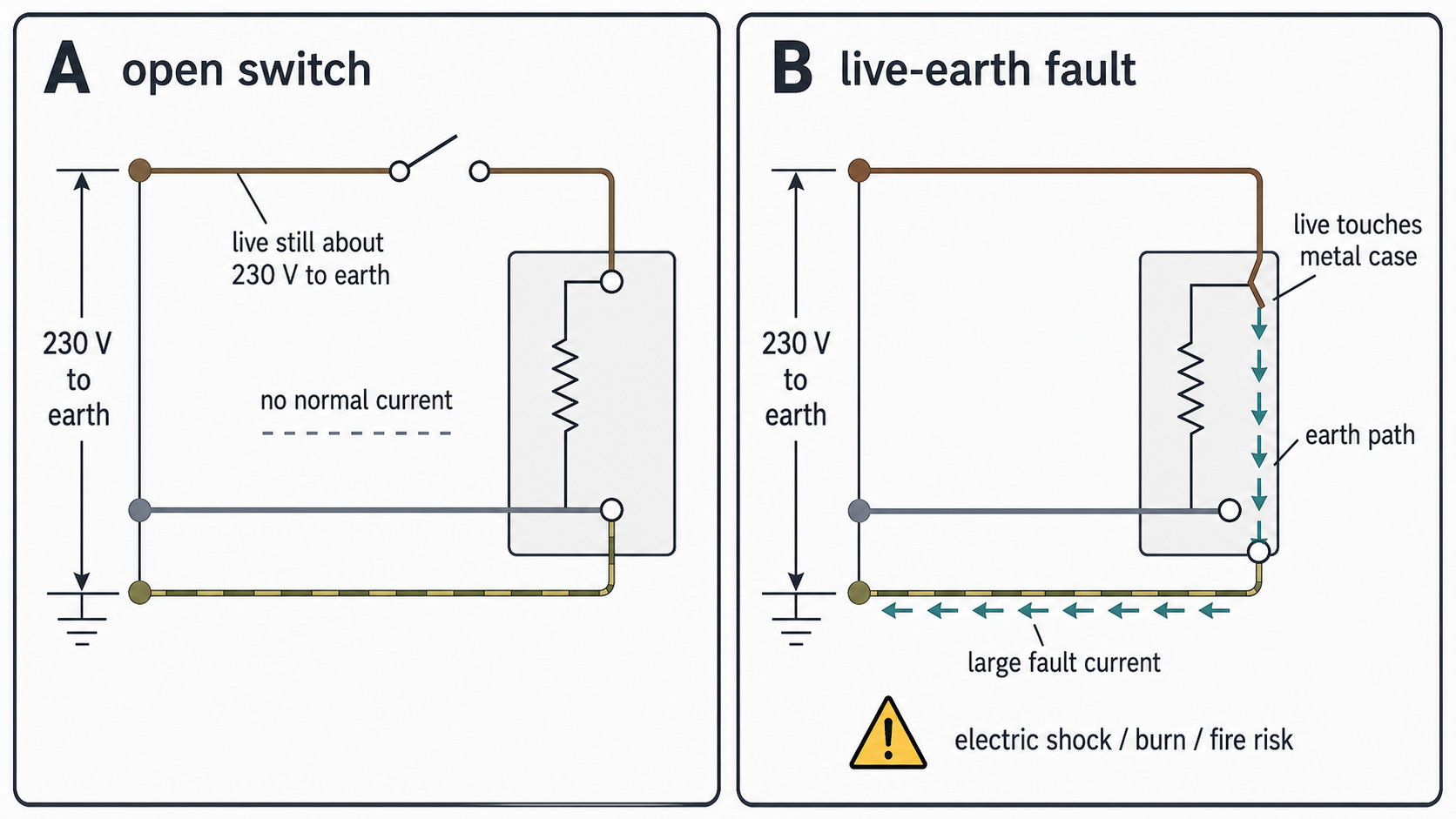
The key exam idea is the difference between "no current in the appliance" and "no danger". An open switch can stop the appliance working, but a live conductor can still have a dangerous potential difference to Earth.
Live-Earth Connection
Connecting the live wire to Earth is dangerous because the live wire is about 230 V compared with Earth. A conducting path between live and Earth can allow a large current to flow.
That connection might happen by damaged insulation, incorrect wiring, or a fault where the live wire touches a metal case. If a person becomes part of the live-to-Earth path, current can pass through the body and cause electric shock or burns. A large current can also heat wires and cause a fire risk.
The earth wire is meant to be a safety path during a fault, not a wire to connect casually to live. In normal operation it carries no current. During a fault, it can carry current because it provides a conducting path at 0 V.
Live is dangerous because it is about 230 V compared with Earth; Earth is a safety reference at 0 V, and the earth wire should only carry current during a fault.
A strong explanation links the potential difference to the current path:
- live wire is about 230 V to Earth
- a live-earth connection completes a conducting path
- current can flow through the path
- current through a person can cause electric shock, and large currents can cause heating or fire
Exam Habits and Cautions
Use the exact wire names and colours in this lesson. In an answer about a three-core mains cable, write "live", "neutral" and "earth", not just "positive" and "negative". Mains is alternating, so positive and negative are not the right labels here.
Common mistakes to avoid:
| Mistake | Better GCSE Physics answer |
|---|---|
| "The earth wire powers the appliance." | The earth wire is a safety wire and normally carries no current. |
| "The neutral wire is the safety wire." | The neutral wire completes the circuit; the earth wire is the safety wire. |
| "If the switch is open, all wires are safe." | A live wire may still be about 230 V to Earth. |
| "0 V means harmless in every situation." | 0 V is a reference potential; danger depends on potential difference and the current path. |
This lesson explains GCSE physics ideas, not instructions for working on mains wiring. Damaged plugs, visible internal wires and suspected faults should be treated as unsafe and dealt with by a competent person.