4.2.1.3a - Current, Resistance and Potential Difference
Current, resistance and potential difference are linked, so changing one can change the others. This lesson focuses on the relationship for a single component: how current depends on the component's resistance and the potential difference across it. You will also recall and apply the equation V = IR.
The three circuit quantities
In this topic, a component might be a resistor, lamp, motor or another part of a circuit. The current through that component depends on two things:
- the resistance of the component
- the potential difference across the component
Current
Current is the rate of flow of electric charge. It is measured in amperes, A. "Amp" is accepted for ampere.
Potential difference is measured across a component. It tells you about the energy transferred by each coulomb of charge as charge passes through that part of the circuit.
Potential difference
Potential difference is the energy transferred per unit charge between two points. It is measured in volts, V.
AQA questions use the term potential difference. If you write voltage correctly, you can still gain credit, but "potential difference" is the safer exam word.
Resistance describes how much a component opposes the flow of current. It is measured in ohms, with symbol Ω.
Resistance
Resistance is a measure of how difficult it is for current to flow through a component. It is measured in ohms, Ω.
These quantities are different. Current is not "voltage". Resistance is not a store of current. Potential difference is across a component; current is through a component.
How resistance affects current
For a fixed potential difference across a component, increasing the resistance decreases the current. This is the key relationship in words:
greater resistance means smaller current for the same potential difference.
For example, if the potential difference is fixed at 6 V:
- a 3
Ωcomponent has currentI = 6 / 3 = 2 A - a 6
Ωcomponent has currentI = 6 / 6 = 1 A
The potential difference has not changed, but the current is smaller because the resistance is larger.
[DIAGRAM: asset_name: current_vs_resistance_fixed_pd - diagram 1; asset_slug: 015_4_2_1_3a_current_resistance_and_potential_difference_diagram1; file: diagram_assets/015_4_2_1_3a_current_resistance_and_potential_difference_diagram1.png; recommended_method: deterministic_drawn; description: Exact graph for a fixed potential difference of 6 V showing I = V/R for R from 1 ohm to 12 ohms, with points at 1, 2, 3, 6 and 12 ohms. Assessed meaning: at constant potential difference, current decreases as resistance increases. Nearby prose states the relationship so the graph supports rather than replaces the text.]
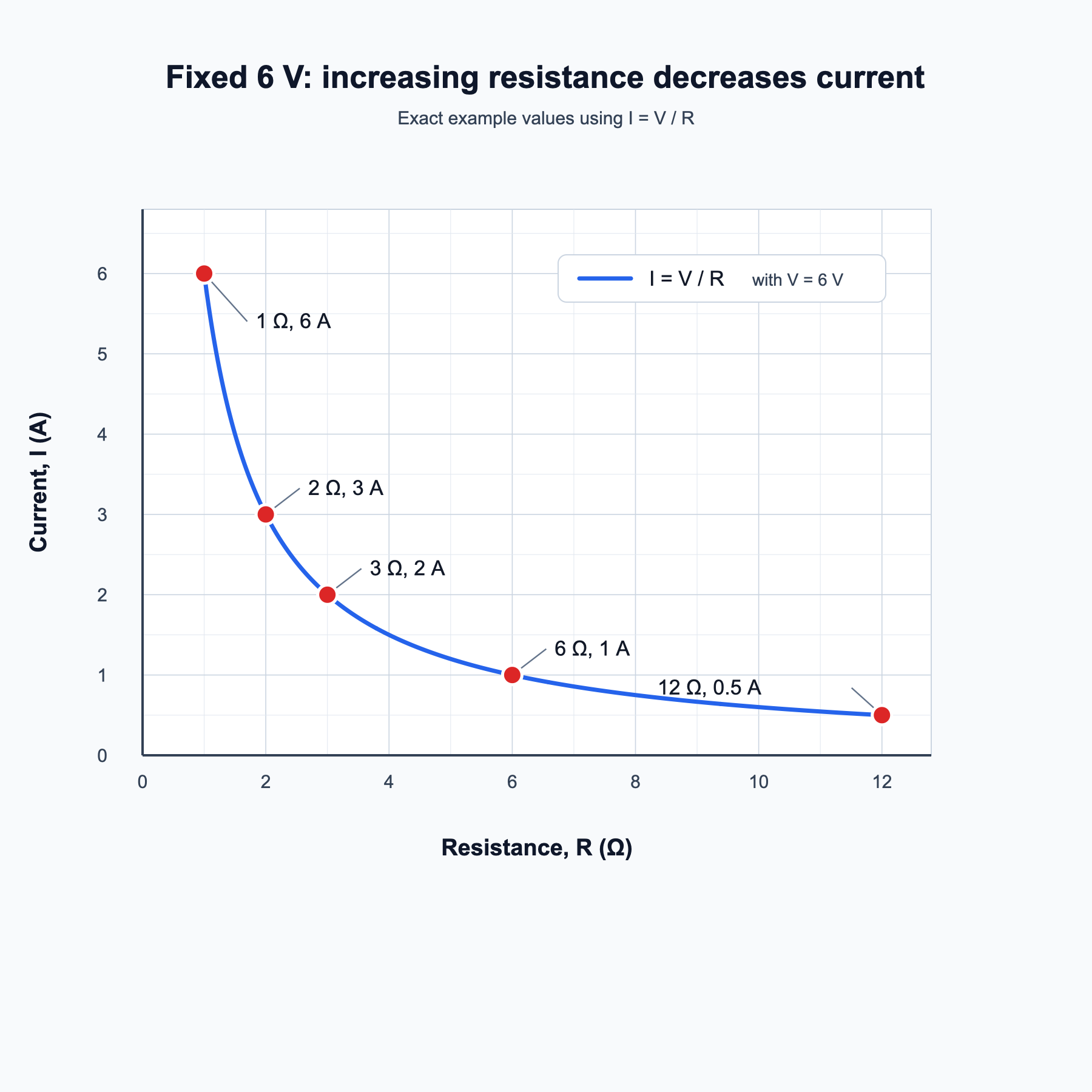
The same idea works the other way round. For a fixed resistance, increasing the potential difference increases the current. The current depends on both quantities, so it is not enough to say "the current is high" unless you know the resistance and the potential difference.
The equation V = IR
The relationship between potential difference, current and resistance is:
Potential difference, current and resistance
In words:
The symbols and units are:
V= potential difference in volts, VI= current in amperes, AR= resistance in ohms,Ω
The same letter V is used for the quantity potential difference and for the unit volt. In V = IR, the first V means the quantity. In an answer such as 12 V, the V after the number means volts.
The specification labels this as a recall-and-apply equation. Whether or not an exam-year equation sheet is supplied, you need to recognise it, rearrange it and understand what it means: current increases if the potential difference increases, and current decreases if the resistance increases.
Calculating potential difference
Use V = IR directly when the question asks for potential difference and gives current and resistance.
A current of 0.40 A passes through a 15 Ω resistor. Calculate the potential difference across the resistor.
The unit is volts because potential difference is being calculated. You may see answers written as 6 V or 6.0 V; both are fine here.
Calculating current and resistance
You also need to rearrange the equation. Start from the same relationship each time:
To find current:
For a component with potential difference 12 V and resistance 6 Ω:
To find resistance:
For a component with potential difference 9.0 V and current 0.30 A:
When rearranging, check the unit you need before doing the calculation. If the answer is a current, the unit must be A. If the answer is a resistance, the unit must be Ω.
In GCSE calculations, numbers may include prefixes such as milliamps. Convert before substituting if needed. For example, 500 mA = 0.500 A, because 1000 mA = 1 A.
Checking your answer
A good answer does more than get a number. It shows the equation, substitution, answer and unit. That makes the physics clear and helps you collect method marks if the arithmetic goes wrong.
Common errors to avoid:
- using
R = I / Vinstead ofR = V / I - forgetting that milliamps must be converted to amperes
- writing
Awhen the answer is a potential difference, orVwhen the answer is a current - saying the current is fixed by the battery alone, when it also depends on the resistance of the component
- using "voltage" vaguely when the question asks for potential difference across a named component
When you check a calculation, ask whether it matches the relationship. If a fixed 6 V supply is connected across a larger resistance, the current should not get larger. If your result says it does, revisit the rearrangement.
For a component, V = IR: potential difference is in volts, current is in amperes, and resistance is in ohms. At fixed potential difference, increasing resistance decreases current.