4.2.4.2 - Energy Transfers in Everyday Appliances
Everyday electrical appliances are designed to transfer energy in useful ways. A fan transfers energy to the kinetic energy store of moving air, while a kettle transfers energy to the thermal energy store of water. In this lesson you will connect those transfers to power ratings, time, charge flow and potential difference using two recall-and-apply equations.
Appliances as energy-transfer devices
An electrical appliance is not just something that "uses electricity". It is designed to bring about a particular energy transfer.
For a battery-powered appliance, energy is transferred from the chemical store of the battery. For a mains appliance, energy is transferred by the ac mains supply. The appliance then transfers energy to the store or pathway needed for its job.
Common GCSE examples include:
- a fan, vacuum cleaner or washing machine motor transferring energy to kinetic energy stores
- a kettle, toaster, iron or electric heater transferring energy by heating
- a hairdryer transferring energy both to a heating element and to the kinetic energy store of moving air
When you describe an appliance, name the input source and the useful output transfer. For example, a mains kettle transfers energy from the ac mains supply to the thermal energy store of the water. A battery-powered toothbrush transfers energy from the chemical store of the battery to the kinetic energy store of the motor and brush head.
Those two examples are different devices, but the answer structure is the same: input source first, useful output transfer second.
A good appliance answer says where the energy comes from and which useful store or pathway it is transferred to.
Power rating and time
The power rating of an appliance tells you the rate at which it transfers energy during normal operation. One watt means one joule transferred each second:
A 60 W lamp transfers 60 J every second. A 1200 W toaster transfers 1200 J every second. The toaster has the larger power rating, so it transfers energy at a greater rate.
The total energy transferred depends on two things:
- the power of the appliance
- the time it is switched on for
Energy transferred from power
In this equation:
| Quantity | Symbol | Unit |
|---|---|---|
| energy transferred | joule, J | |
| power | watt, W | |
| time | second, s |
This is a recall-and-apply equation. Use seconds with watts to get joules.
[DIAGRAM: asset_name: Appliance power ratings and energy transferred - diagram 1; asset_slug: 025_4_2_4_2_energy_transfers_in_everyday_appliances_diagram1; file: diagram_assets/025_4_2_4_2_energy_transfers_in_everyday_appliances_diagram1.png; recommended_method: image_gen; description: Image-generated comparison chart showing three domestic appliances switched on for 60 s: 20 W small fan transfers 1200 J mainly to kinetic energy, 800 W toaster transfers 48000 J mainly by heating, and 2000 W kettle transfers 120000 J mainly by heating. The visual teaches that higher power means more energy each second, while total energy also depends on time.]
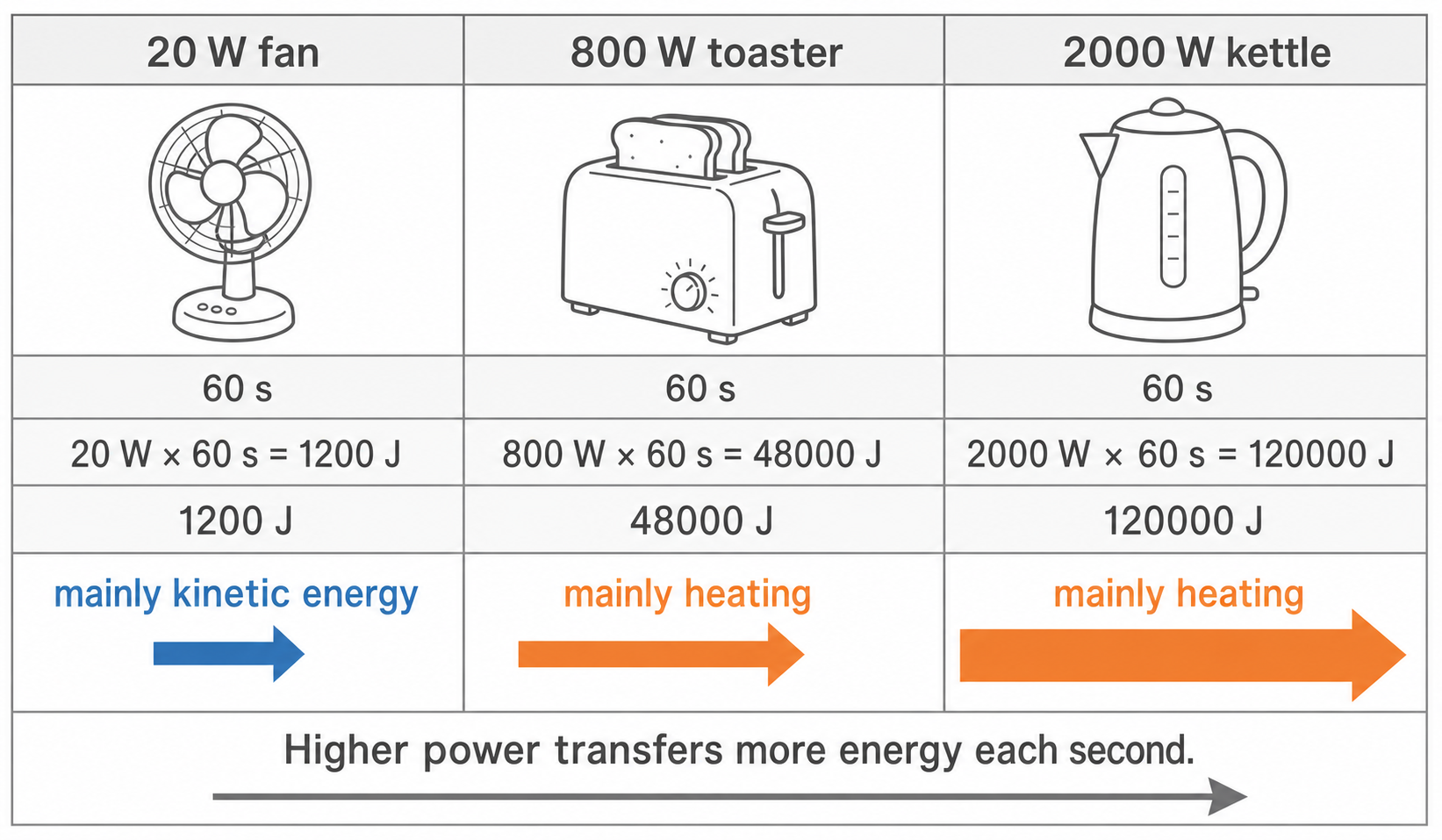
Worked example: a 1200 W toaster is switched on for 90 s. Calculate the energy transferred.
So the toaster transfers 108 000 J of energy in 90 s. Most of the useful transfer is by heating.
Be careful: a higher power rating does not always mean a larger total energy transfer. A low-power appliance left on for a long time can transfer more total energy than a high-power appliance used briefly.
Electrical work and charge
Work is done when charge flows in a circuit. The moving charge transfers energy to circuit devices such as lamps, motors and heating elements.
Potential difference tells you how much energy is transferred for each coulomb of charge passing through a device. A potential difference of 12 V means 12 J of energy is transferred by each coulomb of charge.
Energy transferred by charge flow
In this equation:
| Quantity | Symbol | Unit |
|---|---|---|
| energy transferred | joule, J | |
| charge flow | coulomb, C | |
| potential difference | volt, V |
This is also a recall-and-apply equation. It is useful when a question gives charge flow and potential difference instead of power and time.
Worked example: a charge flow of 30 C passes through a 12 V motor. Calculate the energy transferred to the motor.
The circuit does 360 J of work on the motor. The motor then transfers energy mainly to kinetic energy stores, with some energy usually dissipated by heating and sound.
Power, potential difference and current
The power of a circuit device is linked to the potential difference across it and the current through it.
Potential difference tells you the energy transferred by each coulomb of charge. Current tells you the rate of charge flow: how many coulombs pass each second. So a device has a greater power when:
- each coulomb transfers more energy, because the potential difference is greater
- more coulombs pass each second, because the current is greater
This matches the circuit power relationship:
where is power in watts, is current in amperes and is potential difference in volts.
For example, a motor connected to a 12 V supply with a current of 2 A has:
That means it transfers 24 J of energy each second. Over 10 s:
The same idea can be explained without calculation: increasing the potential difference increases the energy transferred per coulomb, and increasing the current increases the number of coulombs transferring energy each second.
That explanation is often enough for a written answer, even when no numerical calculation is needed.
Choosing the correct equation
Both official equations calculate energy transferred, but they use different information.
Use when the question gives:
- power in W
- time in s
Use when the question gives:
- charge flow in C
- potential difference in V
If a question asks about a power rating, it is usually testing the idea that power is energy transferred per second. If a question asks about charge flowing through a potential difference, it is usually testing electrical work.
A reliable exam method is:
- Identify the appliance and useful energy transfer.
- Pick the equation that matches the quantities given.
- Convert time into seconds if using watts.
- Substitute values with units.
- Check whether the answer makes sense for the power rating and time.
For example, a 40 W fan running for 300 s transfers:
A 2000 W kettle running for 6 s also transfers:
The kettle has a much higher power rating, but it is on for a much shorter time, so the total energy transferred can be the same.
That is the core exam habit for this section: always connect the rating to the time switched on.
Power rating tells you the rate of energy transfer; total energy transferred needs both the rate and the time.