4.2.4.3 - The National Grid
The National Grid transfers electrical power from power stations to consumers such as homes, schools, shops and factories. Its key idea is simple but important: use transformers and cables so that electricity can travel long distances with less energy wasted by heating the cables. In this lesson, focus on the roles of step-up and step-down transformers and the explanation of why the system is efficient.
What the National Grid is
The National Grid is the large-scale system used to transfer electrical power from where it is generated to where it is used. The specification definition is deliberately short: it is a system of cables and transformers linking power stations to consumers.
National Grid
The National Grid is a system of cables and transformers linking power stations to consumers.
The cables provide the route for energy transfer. The transformers change the potential difference at different stages of the route. A consumer can be a home, business, school, hospital, factory or any other place using electrical power from the grid.
In exam answers, use the term potential difference because that is the wording AQA uses in questions. The word voltage means the same physical quantity and is often used in everyday explanations.
Transformers in the grid
Electrical power does not travel from a power station straight to a house at one unchanged potential difference. The National Grid uses a step-up transformer near the power station and step-down transformers before domestic use.
[DIAGRAM: asset_name: The National Grid - diagram 1; asset_slug: 026_4_2_4_3_the_national_grid_diagram1; file: diagram_assets/026_4_2_4_3_the_national_grid_diagram1.png; recommended_method: image_gen; description: Generated with built-in Codex Image Gen using a restrained, muted NovaLearn palette. It shows electrical power moving from a power station to consumers through a step-up transformer, high-potential-difference low-current transmission cables, and a step-down transformer. It teaches the positions and roles of the two transformers and the efficiency chain: higher potential difference gives smaller current, so less energy is transferred by heating in the cables and more energy reaches consumers.]
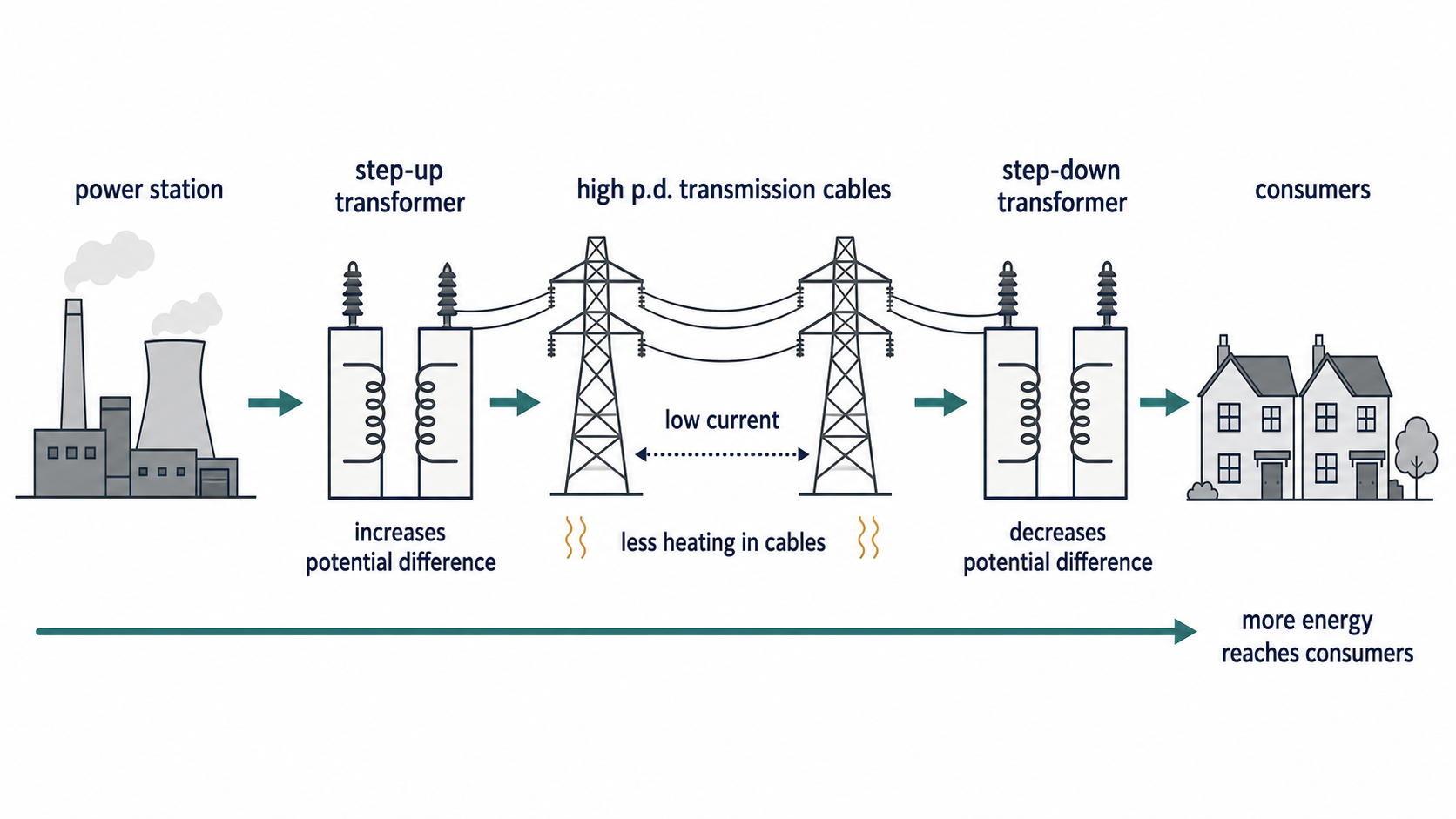
A step-up transformer increases the potential difference from the power station to the transmission cables. This makes the transmission cables operate at a high potential difference.
A step-down transformer decreases the potential difference to a much lower value before the electricity is supplied for domestic use. This much lower potential difference is suitable for consumers.
This lesson does not require the construction of a transformer, the number of turns on each coil, or transformer equation calculations. Those details belong to the separate Higher-tier transformers topic.
Why high potential difference is efficient
The National Grid has to transfer a large amount of power over long distances. Transmission cables have resistance, so a current in the cables causes heating. Energy transferred by heating to the cables and surroundings is not useful energy delivered to consumers.
The step-up transformer makes the transmission potential difference very high. For the same power transfer, a higher potential difference means a lower current, because electrical power depends on both potential difference and current:
You do not need a new National Grid equation here. The important GCSE reasoning is qualitative:
- power must be transferred over a long distance
- increasing the potential difference means the same power can be transferred with a smaller current
- a smaller current causes less heating in the transmission cables
- less energy is transferred to the thermal energy store of the surroundings
- more of the energy reaches consumers, so the transfer is more efficient
Do not say that no energy is wasted. Real systems still dissipate some energy. The GCSE point is that the National Grid reduces unwanted thermal energy transfer compared with using a lower potential difference and larger current in the transmission cables.
That sequence matters. An answer that just says "high voltage is efficient" is too thin; it must link potential difference to current, current to heating, and heating to wasted energy.
Why step-down transformers are needed
High potential difference is useful for long-distance transmission, but it is not suitable for homes and other domestic consumers. Before electricity is supplied for domestic use, step-down transformers decrease the potential difference to a much lower value.
This is why the National Grid uses both types of transformer. The step-up transformer supports efficient transmission through the long cables. The step-down transformer makes the supply suitable and safer for consumers at the end of the journey.
Real electricity networks may step the potential difference down in stages at substations before the final domestic supply. For this specification point, the required idea is simply that step-down transformers decrease the potential difference to a much lower value for domestic use.
Writing full explanations
A strong National Grid explanation is a linked chain, not a list of separate facts. Start with the transformer, then follow the effect through to the energy transfer.
For a step-up transformer, the chain is:
- The step-up transformer increases the potential difference.
- For the same power transfer, this decreases the current in the transmission cables.
- A smaller current means less heating in the cables.
- Less energy is transferred to the thermal energy store of the surroundings.
- The energy transfer to consumers is more efficient.
For a step-down transformer, keep the answer separate:
- The step-down transformer decreases the potential difference.
- The supply becomes a much lower, safer value for domestic use.
Common mistakes are saying that the step-up transformer decreases potential difference, saying that high potential difference directly means high current, or saying that no energy is transferred to the surroundings. The safer wording is less energy is transferred by heating to the surroundings.
That corrected wording is close to what exam mark schemes reward: a change made by the transformer, followed by a current change, followed by a reduced unwanted energy transfer.
The National Grid is efficient because step-up transformers allow high-potential-difference, low-current transmission, which reduces heating losses in the cables; step-down transformers then reduce the potential difference for domestic use.