4.2.4.1 - Electrical Power in Circuits
Electrical power tells you how quickly a circuit device transfers energy. In this lesson, the device might be a resistor, lamp, heater, motor, or any other component where energy changes happen. You need to connect power to the potential difference across the device, the current through it, and the resistance of the device.
Power in a Device
A circuit device transfers energy when charge passes through it. A lamp transfers energy electrically to thermal stores and by radiation to the surroundings. A resistor transfers energy electrically to thermal stores. The power of the device is the rate of that energy transfer: the number of joules transferred each second.
Power
Power is the rate at which energy is transferred or the rate at which work is done.
For one circuit device, use the potential difference across that device and the current through that device. The word "across" matters: a voltmeter connected across the device would measure its potential difference. The word "through" matters too: an ammeter in series with the device would measure the current through it.
[DIAGRAM: asset_name: power_in_a_circuit_device; asset_slug: 024_4_2_4_1_electrical_power_in_circuits_diagram1; file: diagram_assets/024_4_2_4_1_electrical_power_in_circuits_diagram1.png; recommended_method: image_gen; description: Image-generated circuit-style learning diagram showing a cell, ammeter in series, a generic circuit device with resistance R, and a voltmeter across the device. It labels current I through the device and potential difference V across it so students connect P=VI and P=I^2R to the measured quantities. Nearby prose states the same physics for accessibility.]
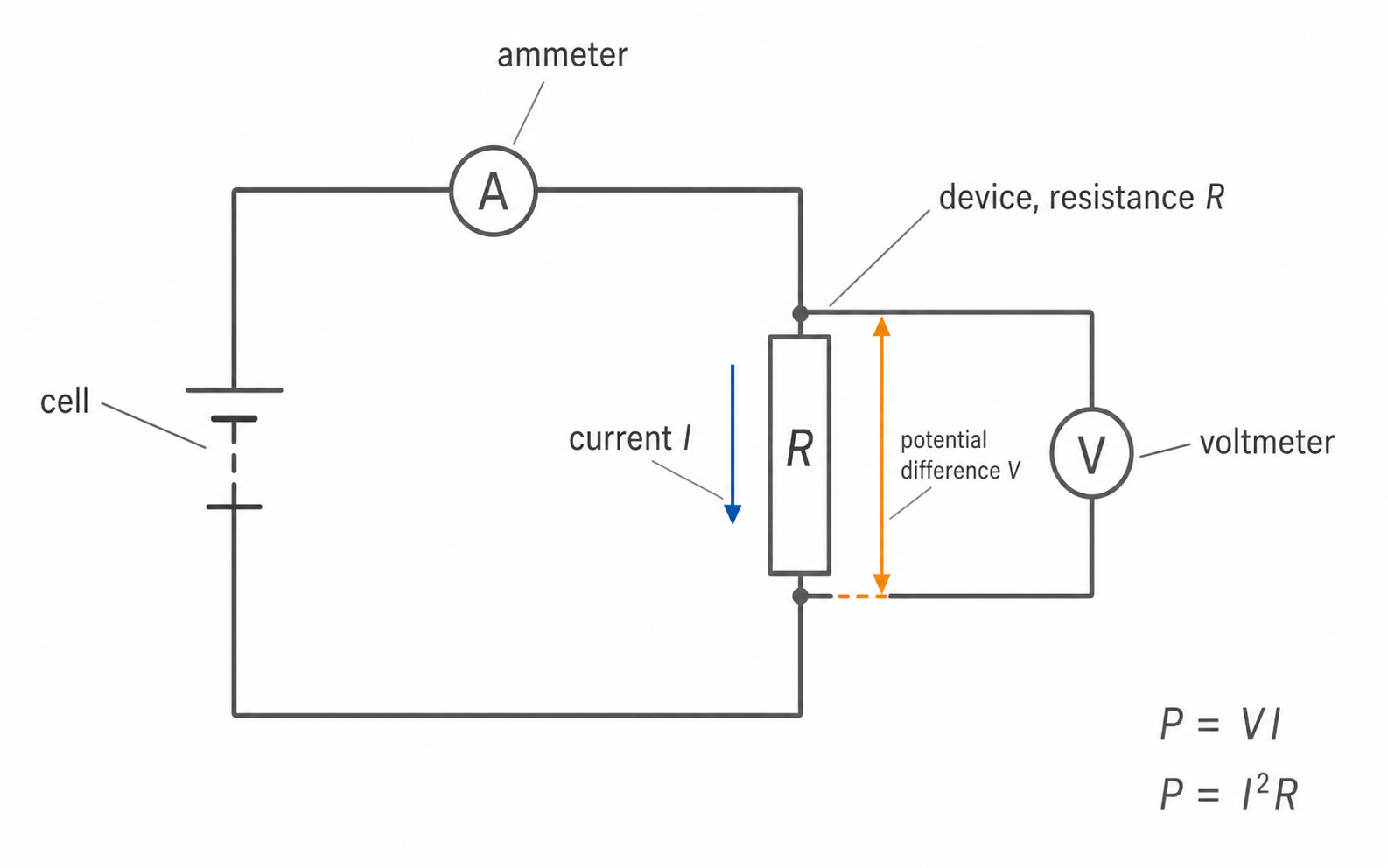
If a question gives values for a whole circuit and for one component, be careful to choose the values for the component whose power you are calculating. Power is local to the device named in the question.
Using P = VI
The first electrical power equation links power to potential difference and current.
Electrical Power from Potential Difference and Current
The symbols and units are:
| Quantity | Symbol | Unit |
|---|---|---|
| power | watt, W | |
| potential difference | volt, V | |
| current | ampere, A |
An amp is acceptable for ampere. The equation says that, for the same current, a greater potential difference gives a greater power. For the same potential difference, a greater current gives a greater power.
Worked example: a lamp has a potential difference of 12 V across it and a current of 0.50 A through it. Calculate the power of the lamp.
So the lamp transfers 6.0 J of energy each second.
To rearrange this equation, divide by the quantity you already know:
Worked example: a motor has a power of 48 W and a current of 4.0 A. Calculate the potential difference across it.
Using P = I^2R
The second electrical power equation links power to current and resistance.
Electrical Power from Current and Resistance
The symbols and units are:
| Quantity | Symbol | Unit |
|---|---|---|
| power | watt, W | |
| current | ampere, A | |
| resistance | ohm, |
The squared current is important. In , square the current first, then multiply by the resistance.
Worked example: a resistor has a resistance of and a current of 2.0 A through it. Calculate the power transferred in the resistor.
The equation also helps explain why current has a strong effect on heating in a resistor. For the same resistance, doubling the current makes four times bigger.
This equation is connected to . For a component where , substituting for in gives:
You do not need a new idea for this equation: it is still power as the rate of energy transfer, now written using current and resistance.
Choosing and Explaining
Choose the equation that matches the quantities in the question:
| Given information | Best equation |
|---|---|
| potential difference and current | |
| current and resistance | |
| power and current, asked for potential difference | |
| power and current, asked for resistance |
For explanation questions, do not just quote an equation. Say which quantity changes, how the equation links it to power, and what that means for energy transferred each second.
Example: the current through the same resistor doubles.
- Original current: , so
- New current: , so
The power becomes four times greater, so the resistor transfers four times as much energy each second.
Be cautious with statements such as "higher resistance always means higher power". In , that is only true if the current is kept the same. In a real circuit, changing resistance may also change current, so exam questions must tell you enough information to decide.
Exam Habits
Both electrical power equations are specification recall-and-apply equations. In exams where an equation sheet is provided, you still need to choose the correct relationship, substitute correctly, rearrange when needed, and use the correct units.
A reliable calculation method is:
- Identify the device whose power is being calculated.
- Write the equation.
- Check that current is in amperes, potential difference is in volts, and resistance is in ohms.
- Substitute the values.
- Calculate and give the unit W.
Common mistakes are usually small but expensive:
- using the supply potential difference when the question asks about one device
- forgetting to square the current in
- writing , which is not an AQA equation
- giving the unit as J instead of W
- treating power as total energy rather than energy transferred each second
This lesson does not cover later calculations for total electrical energy transferred, electricity costs, the National Grid, or transformers. Those belong to neighbouring electricity sections.