4.2.5.1 - Static Charge
Static electricity is the set of effects caused when electric charge builds up on an object instead of flowing steadily as a current. In this physics-only lesson, you will describe how rubbing insulating materials can produce static electricity and sparking. You will also explain the observations using electron transfer and the rule that charged objects can attract or repel without touching.
Charged insulators
Objects are made from atoms. In a neutral object, the total positive charge and total negative charge balance, so the object has no overall charge.
For this GCSE model, the positive charges are in protons and the negative charges are in electrons. Electrons are much easier to transfer between materials than protons. That is why explanations of static charge focus on electrons moving from one object to another.
Static electricity
Static electricity is the effect of electric charge that has built up on an object and is not flowing as a current.
Insulating materials are important because charge does not move through them easily. If charge is transferred to or from an insulating surface, it can remain there for long enough to produce observable effects such as a small shock, a spark, or the movement of another charged object.
Electron transfer by rubbing
When certain insulating materials are rubbed against each other, they become electrically charged. The rubbing brings the surfaces into close contact again and again, so electrons can be transferred from one material to the other.
[DIAGRAM: asset_name: Static Charge - diagram 1; asset_slug: 027_4_2_5_1_static_charge_diagram1; file: diagram_assets/027_4_2_5_1_static_charge_diagram1.png; recommended_method: image_gen; description: Built-in Codex Image Gen conceptual particle diagram in a restrained/muted NovaLearn palette, showing two neutral insulating materials before rubbing and the same two materials after rubbing. It labels electrons as e-, positive charge as +, shows electrons transferred from material A to material B, and states that the material losing electrons becomes positive while the material gaining electrons becomes negative.]
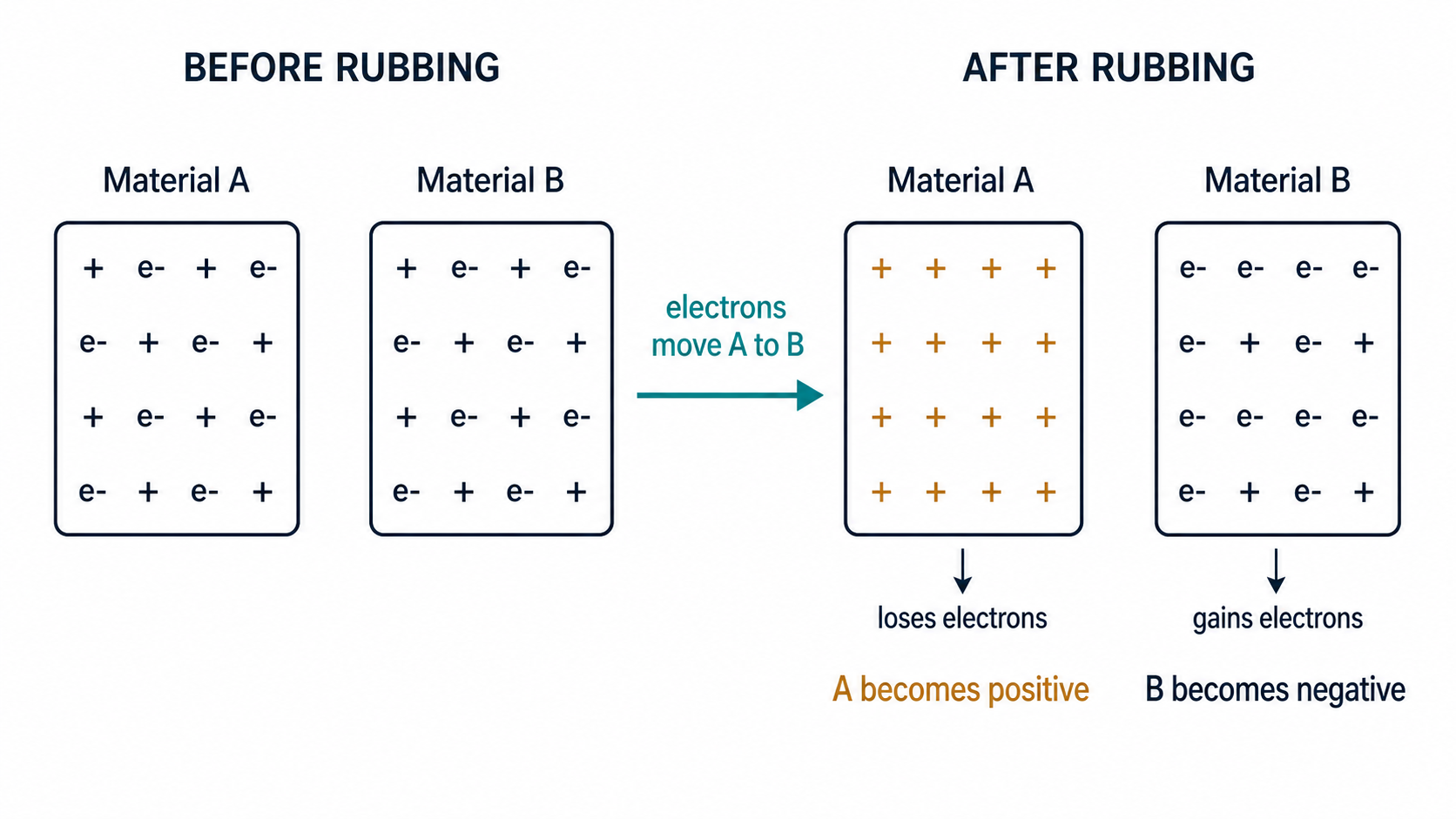
The material that gains electrons becomes negatively charged because it now has more negative charge than positive charge. The material that loses electrons is left with an equal positive charge because it now has less negative charge than before.
This does not mean that positive electrons moved, or that protons were rubbed from one object to the other. In the GCSE explanation, the key movement is:
electrons move from one material to the other -> one object becomes negative, the other becomes positive
If a question tells you the direction of electron transfer, use it directly. For example, if electrons move from a cloth to a plastic rod, the rod gains electrons and becomes negative; the cloth loses electrons and becomes positive.
Sparking as discharge
Rubbing surfaces can build up static charge. A familiar example is walking across a synthetic carpet and then reaching for a metal door handle. Rubbing between shoe soles and carpet can transfer electrons, leaving a build-up of charge on the person or the carpet.
A spark is a sudden discharge: charge moves rapidly across a small gap or through a conducting path. You may see a flash, hear a crack, or feel a brief shock. At this point in the specification, you only need a qualitative description of sparking from charge build-up after rubbing; detailed explanations of why the spark jumps across air come later.
The useful exam sequence is:
- rubbing transfers electrons
- static charge builds up
- charge suddenly moves to reduce the imbalance
- this sudden movement can be seen, heard or felt as a spark
Forces without contact
Charged objects exert forces on each other when they are brought close together. They do not have to touch.
[DIAGRAM: asset_name: Static Charge - diagram 2; asset_slug: 027_4_2_5_1_static_charge_diagram2; file: diagram_assets/027_4_2_5_1_static_charge_diagram2.png; recommended_method: image_gen; description: Built-in Codex Image Gen qualitative force diagram in a restrained/muted NovaLearn palette, showing separated charged objects on threads. One panel shows two negatively charged objects repelling with arrows away from each other; the other shows a positive and a negative object attracting with arrows towards each other. It explicitly shows a gap between objects to teach non-contact force evidence.]
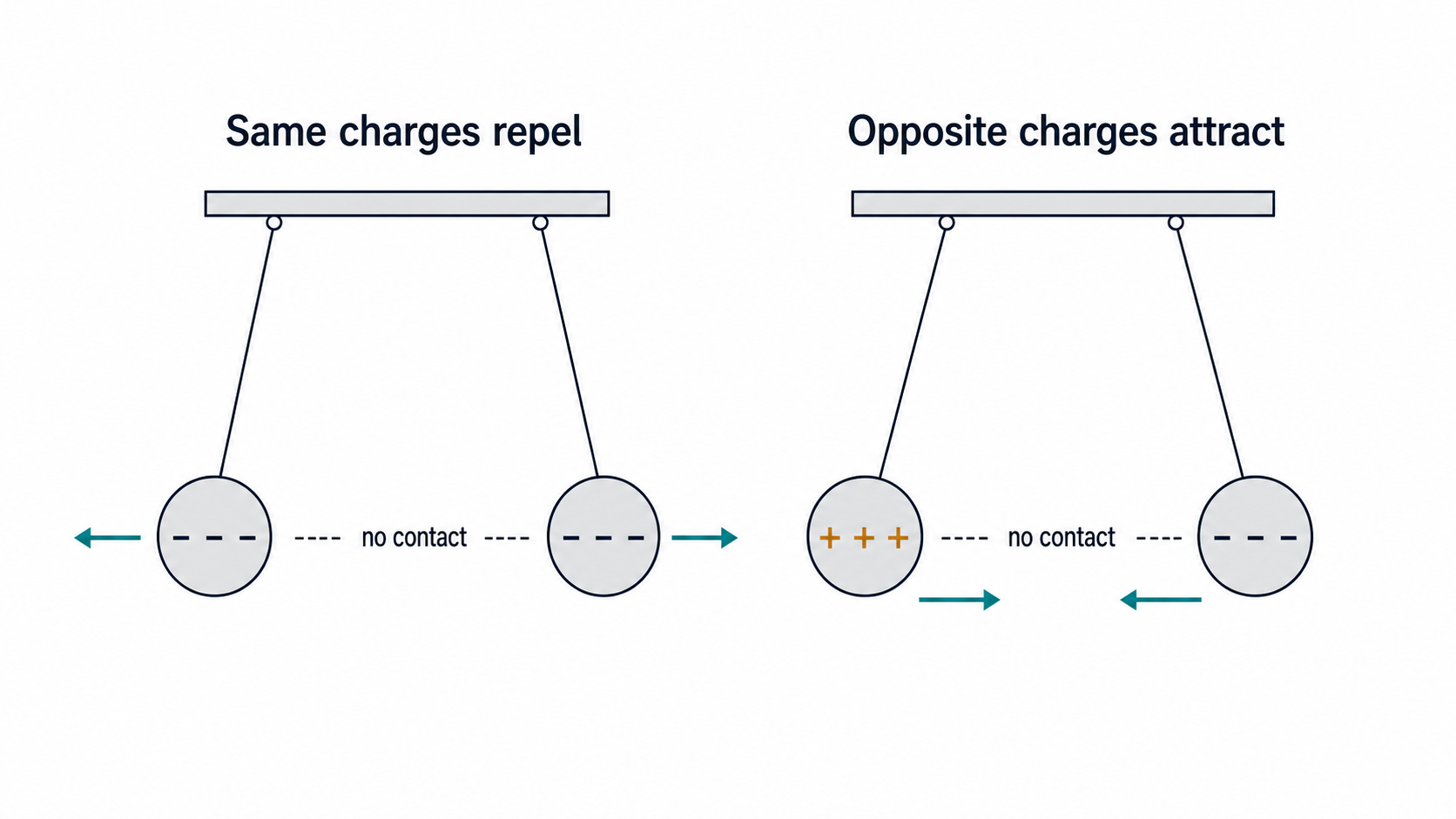
The rule is simple:
| Charges on the two objects | Force |
|---|---|
| Same type, such as positive-positive or negative-negative | Repel |
| Different types, positive-negative | Attract |
Attraction and repulsion between charged objects are examples of non-contact forces. A non-contact force acts even though the objects are separated by a gap. In a classroom demonstration, two charged rods suspended by threads may swing towards each other or away from each other before touching.
Building exam explanations
Good static-charge answers link the observation to electron transfer and then to the force rule. Avoid writing that friction creates charge from nothing. Rubbing transfers electrons, so one object gains electrons and the other loses electrons.
A clear explanation often follows this pattern:
| Step | What to write |
|---|---|
| Charging step | State that rubbing transfers electrons. |
| Charge on each object | Say which object gains electrons and which loses electrons if the question gives enough information. |
| Interaction | Use same charges repel or different charges attract. |
| Evidence | Say the objects move while not touching, so the force is non-contact. |
Repulsion is especially strong evidence that both objects are charged, because only two objects with the same type of charge repel. Attraction can also be observed between oppositely charged objects, but your explanation must say why the objects have different charges.
Static charge is explained by electron transfer: gaining electrons makes an object negative, losing electrons leaves it positive, and charged objects can attract or repel without contact.
Use the word electron carefully. Electrons are negative, so an object that gains electrons becomes negative. An object that loses electrons has not gained positive particles; it is positive because negative electrons have been removed.