4.2.5.2 - Electric Fields
Charged objects can affect other charged objects even when they are not touching. This physics-only lesson explains that effect using the idea of an electric field: a region around a charged object where another charged object can experience a force. You will also learn the field pattern for an isolated charged sphere and how electric fields help explain sparking.
What an electric field is
A charged object changes the space around it. That region of space is called an electric field. If a second charged object is placed in the field, it experiences an electrostatic force.
Electric field
An electric field is the region around a charged object where another charged object experiences a force.
The field is not a visible material. Field lines are a model used to show its direction and relative strength. This helps explain how a force can act without contact: the first charged object creates the field, and the second charged object responds to that field.
The direction of an electric field is defined as the direction of the force on a small positive charge. This convention is why diagrams for positive and negative charges have opposite arrow directions.
Field strength and distance
The electric field is strongest close to the charged object. Further away from the charged object, the field is weaker.
At GCSE for this specification point, you only need this qualitative relationship. No electric field strength equation is required here. The exam idea is about direction, distance and explanation.
If a second charged object is placed in the field, the force on it depends on how strong the field is at that position. When two charged objects are moved closer together, each object is in a stronger part of the other object's electric field, so the electrostatic force is stronger. When the objects are further apart, the field is weaker and the force is weaker.
Field around an isolated charged sphere
An isolated charged sphere has a radial electric field pattern. Radial means the field lines spread out from, or point in towards, the centre of the sphere.
[DIAGRAM: asset_name: isolated charged sphere field pattern - diagram 1; asset_slug: 028_4_2_5_2_electric_fields_diagram1; file: diagram_assets/028_4_2_5_2_electric_fields_diagram1.png; recommended_method: image_gen; description: Image-generated field-line visual showing positive and negative isolated charged spheres. Lines are radial and perpendicular to each sphere surface; arrows point away from the positive sphere and towards the negative sphere; line spacing is closer near the sphere to show stronger field.]
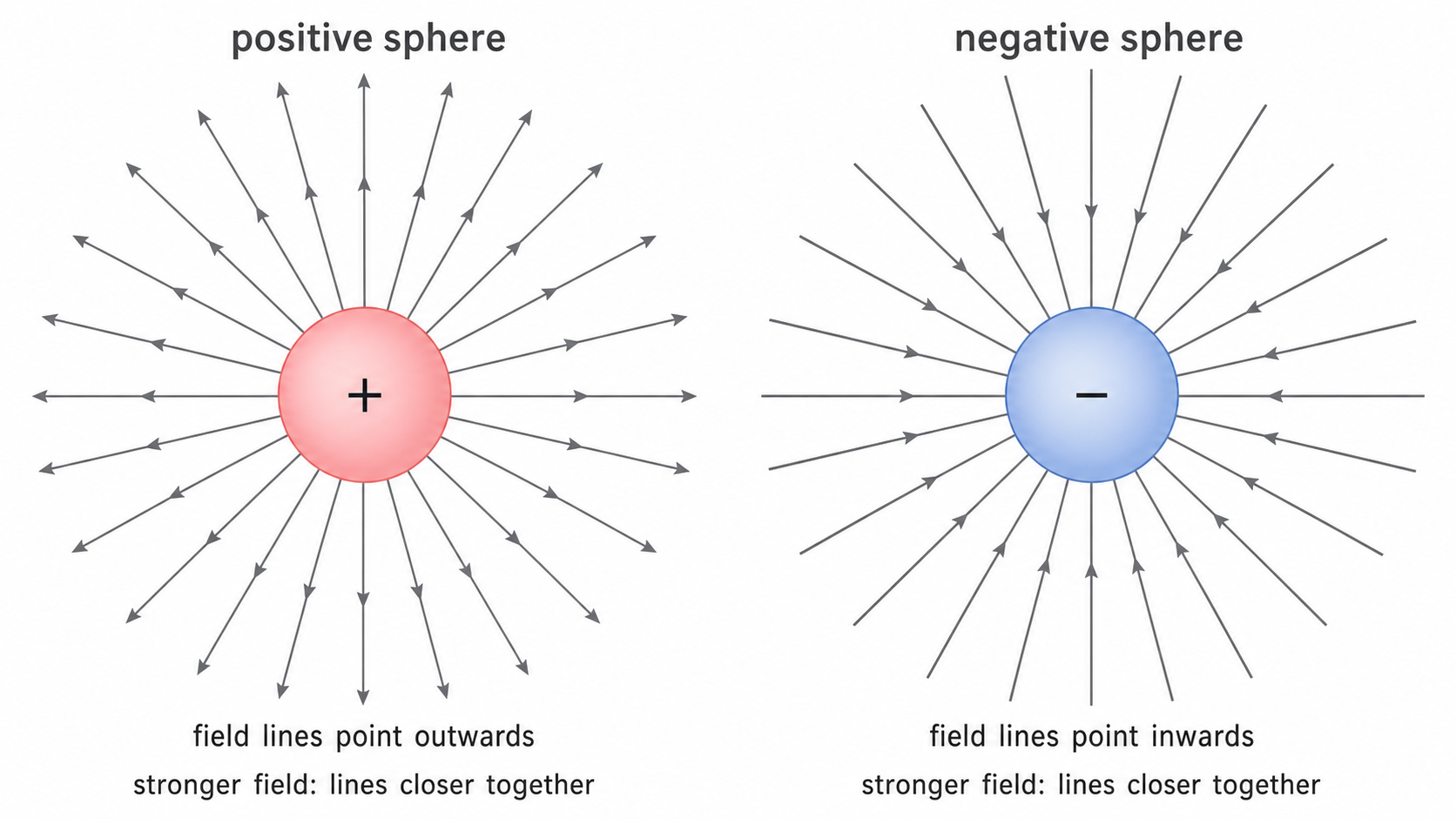
For a positively charged isolated sphere, the field lines point outwards because a small positive test charge would be repelled. For a negatively charged isolated sphere, the field lines point inwards because a small positive test charge would be attracted.
When drawing this pattern, use several straight, evenly spaced radial lines around the whole sphere. Add arrowheads. Keep the lines closer together near the sphere and more spread out further away. Do not make field lines cross, curve around the isolated sphere, or point the arrows the wrong way.
Non-contact forces between charges
Two charged objects can exert forces on each other without touching. This is a non-contact force.
The field explanation is:
- one charged object creates an electric field around itself
- the second charged object is placed in that field
- the second charged object experiences a force because it is charged
The force direction depends on the charges. Like charges repel, so two positive objects or two negative objects push away from each other. Opposite charges attract, so a positive object and a negative object pull towards each other.
The field model is useful because it avoids saying that one object somehow "reaches across empty space" directly. Instead, each charged object affects the space around it, and another charged object in that space experiences a force.
After explaining it, check that your answer uses the word field and links the field to the force. A common weak answer only says "opposites attract" or "likes repel"; that is true, but it does not explain the field concept.
Sparking
Sparking is another electrostatic phenomenon that can be explained using electric fields. Air is normally an insulator, so charge does not usually flow through it. However, if a charged object is close to another object, the electric field in the small air gap can become very strong.
[DIAGRAM: asset_name: electric field sparking gap - diagram 2; asset_slug: 028_4_2_5_2_electric_fields_diagram2; file: diagram_assets/028_4_2_5_2_electric_fields_diagram2.png; recommended_method: image_gen; description: Conceptual labelled image-generated visual showing oppositely charged objects separated by a small air gap, field lines across the gap, a spark path, and force arrows towards each other. Used to support the field explanation of non-contact forces and sparking.]
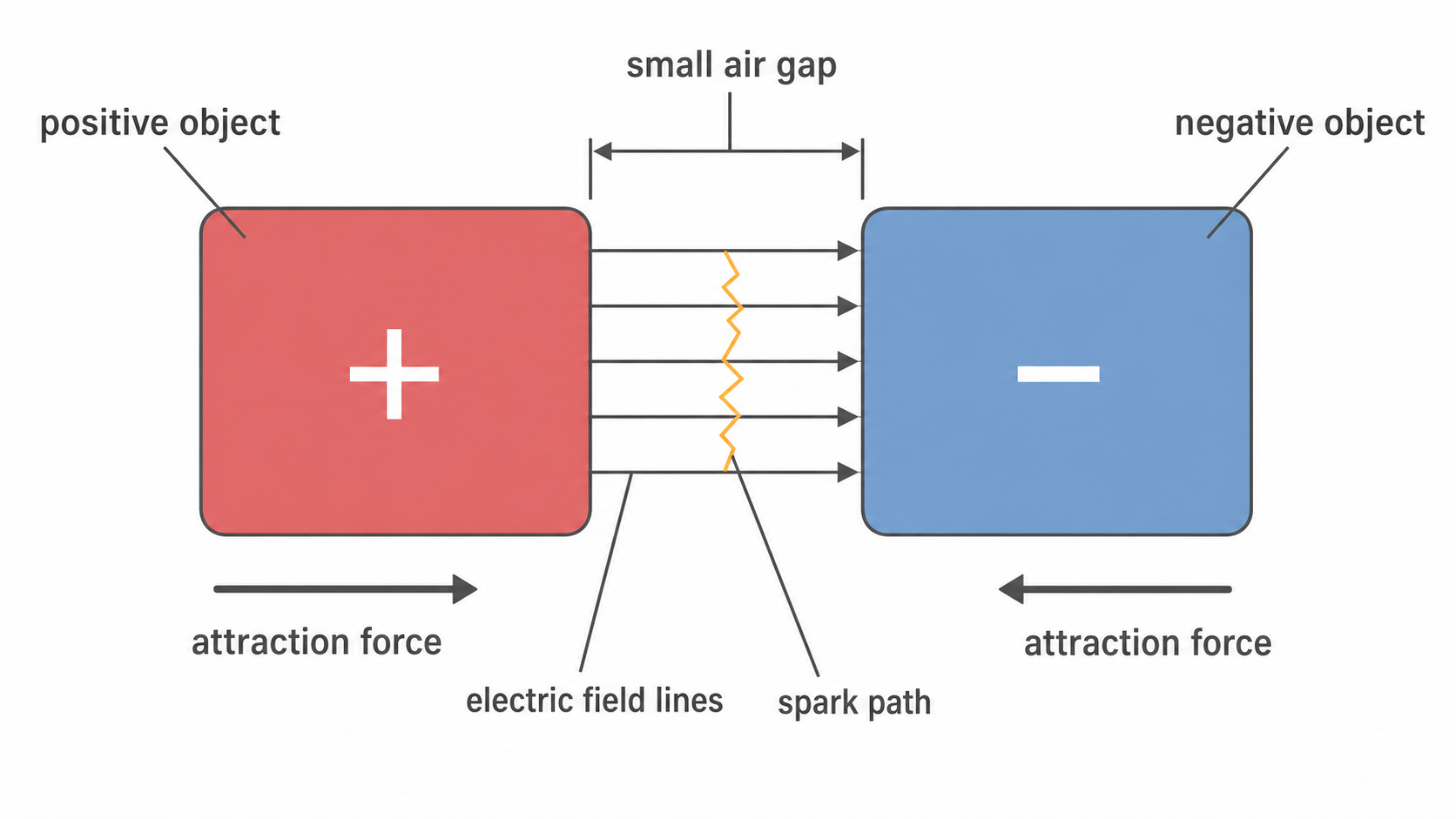
When the field is strong enough, charge can move through the air. The air becomes conducting for a short time, and the sudden movement of charge is seen as a spark. This is more likely when there is a large amount of charge or a small gap, because both make the field in the gap stronger.
This is the same field idea as before: a charged object creates a field around itself. A nearby charged or conducting object can be affected by that field. If the field across the air becomes strong enough, the electrostatic effect is no longer just a force; charge actually transfers across the gap.
The key link in every explanation is the same: charge creates a field, and the field causes an effect on other charged matter nearby.
Electric fields explain how charged objects can exert non-contact forces and why strong fields across small gaps can produce sparks.