4.2.3.1 - Direct and alternating potential difference
Potential difference is often called voltage, and it is measured in volts, V. This lesson compares two ways a supply can provide potential difference: direct and alternating. You also need the key UK mains facts: mains electricity is ac, has a frequency of 50 Hz, and is about 230 V.
Potential difference and polarity
A potential difference across a source or component can make charge move in a complete circuit. For this lesson, the important question is not the size of the current, but whether the potential difference keeps the same polarity or reverses polarity.
Polarity means which side of the supply is positive compared with the other side. If the polarity stays the same, the supply keeps driving current in the same direction. If the polarity reverses repeatedly, the current reverses direction repeatedly.
Potential difference
Potential difference is a voltage between two points in a circuit. It is measured in volts, V.
The word "direct" or "alternating" describes how the potential difference behaves with time. It does not describe whether the circuit is simple or complicated.
Direct potential difference
A direct potential difference has one polarity. One side of the supply remains positive compared with the other side, so a complete circuit has a current in one direction.
Direct potential difference
A direct potential difference is a potential difference that does not reverse polarity.
Cells and batteries provide direct potential difference. In a simple GCSE voltage-time trace, a steady direct potential difference is drawn as a horizontal line above or below zero because its polarity is not changing.
Do not confuse "direct" with "large". A 1.5 V cell provides a direct potential difference, even though its potential difference is much smaller than the UK mains supply.
Alternating potential difference
An alternating potential difference repeatedly reverses polarity. The supply is positive one way, then passes through zero, then is positive the opposite way, and this cycle repeats.
Alternating potential difference
An alternating potential difference is a potential difference that repeatedly reverses polarity.
In a complete circuit, an alternating potential difference produces an alternating current. The current changes direction because the potential difference driving the charge has changed direction.
[DIAGRAM: asset_name: Direct and alternating potential difference traces - diagram 1; asset_slug: 022_4_2_3_1_direct_and_alternating_potential_difference_diagram1; file: diagram_assets/022_4_2_3_1_direct_and_alternating_potential_difference_diagram1.png; recommended_method: deterministic_drawn; description: Exact voltage-time trace comparison showing direct potential difference as a steady one-polarity trace and alternating potential difference as a 50 Hz trace that repeatedly crosses zero and reverses polarity. The axes are time and potential difference, one cycle is labelled 0.020 s, and the vertical scale is qualitative so it does not imply a UK mains peak value. Deterministic rendering is used because the graph shape, labels, cycle time and polarity are assessed; nearby prose supplies all assessed details.]
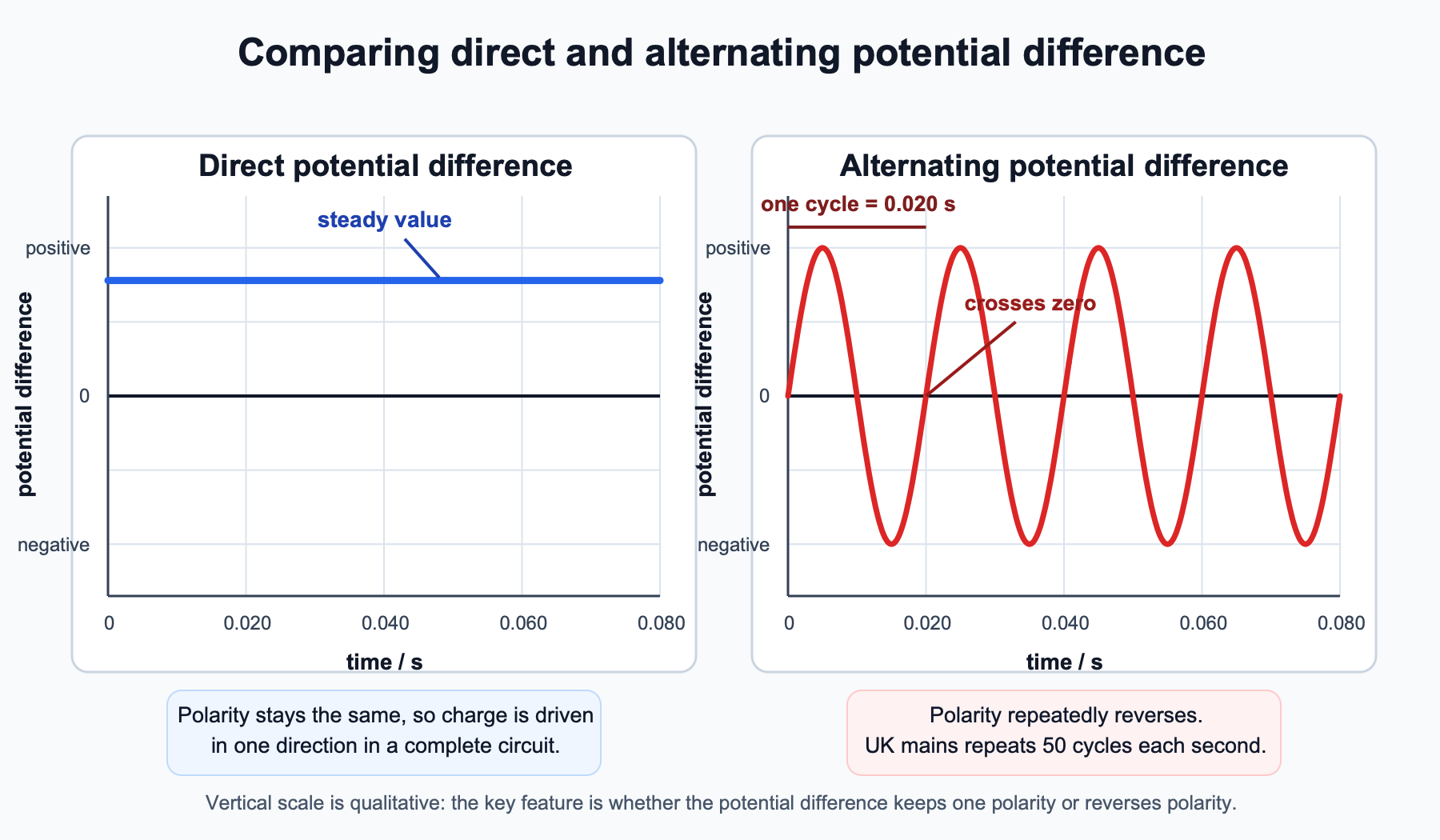
The graph shape is a quick way to identify the supply. A direct potential difference does not cross from positive to negative. An alternating potential difference crosses zero and swaps which side of the supply is positive.
UK mains values
Mains electricity is the domestic electricity supply from wall sockets. In the United Kingdom, mains electricity is an ac supply.
For this specification point, learn these two values exactly:
- frequency: 50 Hz
- potential difference: about 230 V
Frequency tells you how many complete cycles happen each second. A frequency of 50 Hz means the alternating potential difference completes 50 cycles every second. One complete cycle therefore takes 0.020 s, but the key recall value is 50 Hz.
The phrase "about 230 V" is important. The domestic supply is not a small cell and it is not treated as a fixed battery-like value in this topic. In GCSE answers, use AQA's wording: UK mains is ac, 50 Hz, and about 230 V.
Comparing direct and alternating potential difference
A strong comparison answer gives the matching feature for each type of potential difference. It should not just describe one and leave the other unstated.
| Type of potential difference | What happens to polarity? | Current in a complete circuit |
|---|---|---|
| Direct potential difference | Polarity stays the same | Current flows in one direction |
| Alternating potential difference | Polarity repeatedly reverses | Current repeatedly reverses direction |
Common mistakes are easy to avoid:
- do not swap the UK mains values; it is 50 Hz and about 230 V, not 50 V and 230 Hz
- do not say ac means "current turns on and off"; the key idea is that direction reverses
- do not bring in mains cable wiring details unless the question asks about them
- do not say direct potential difference must be high or low; direct means it does not reverse polarity
When an exam question asks you to "explain the difference", use both sides of the comparison. For example: "A direct potential difference has one polarity and produces current in one direction in a complete circuit, whereas an alternating potential difference repeatedly reverses polarity and produces current that repeatedly reverses direction."
UK mains is an alternating potential difference: it is ac, 50 Hz, and about 230 V.