4.1.3a - Energy Resources, Uses and Reliability
Energy resources are the sources humans use to transfer energy for useful purposes. In this lesson you will sort the main resources into renewable and non-renewable groups, compare their uses for transport, electricity generation and heating, and explain why some resources are more reliable than others. You do not need to describe how electricity is generated from each resource in this specification point.
Energy resources and renewability
An energy resource is something available on Earth that can be used to transfer energy usefully. The specification names fossil fuels, nuclear fuel and several renewable resources because these are common contexts for supplying energy to people, homes, vehicles and national electricity systems.
Energy resource
An energy resource is a source that can be used to transfer energy for a useful purpose, such as transport, electricity generation or heating.
The first sorting question is whether the resource is renewable or non-renewable. A renewable resource is being replenished, or can be replenished, as it is used. This does not mean it is available every second. For example, sunlight is renewable, but a solar resource is not available at night.
Renewable energy resource
A renewable energy resource is one that is being, or can be, replenished as it is used.
A non-renewable resource is not replaced fast enough to keep up with human use. Fossil fuels and nuclear fuel are non-renewable because their useful fuel supplies are finite on human timescales.
The important exam distinction is the replacement of the resource, not whether the resource is clean, cheap, popular, modern or easy to use. Those are different comparisons.
Sorting the main resources
The main energy resources available for use on Earth are:
- fossil fuels: coal, oil and gas
- nuclear fuel
- bio-fuel
- wind
- hydro-electricity
- geothermal
- the tides
- the Sun
- water waves
The non-renewable group is fossil fuels and nuclear fuel. Fossil fuels include coal, oil and gas. Nuclear fuel is also non-renewable because the useful fuel is not replenished as it is used.
The renewable group is bio-fuel, wind, hydro-electricity, geothermal, the tides, the Sun and water waves. Bio-fuel can catch students out because it is still a fuel, but it is classed as renewable if new plant material or biological waste can replace what is used.
[DIAGRAM: asset_name: Resource sorting and use map - diagram 1; asset_slug: 011_4_1_3a_energy_resources_uses_and_reliability_diagram1; file: diagram_assets/011_4_1_3a_energy_resources_uses_and_reliability_diagram1.png; recommended_method: image_gen; description: A labelled organiser generated with built-in Codex Image Gen using a restrained, muted NovaLearn palette. It splits the named AQA resources into renewable and non-renewable groups, then links them to the required use categories and reliability cues. Nearby prose gives the same classification for accessibility.]
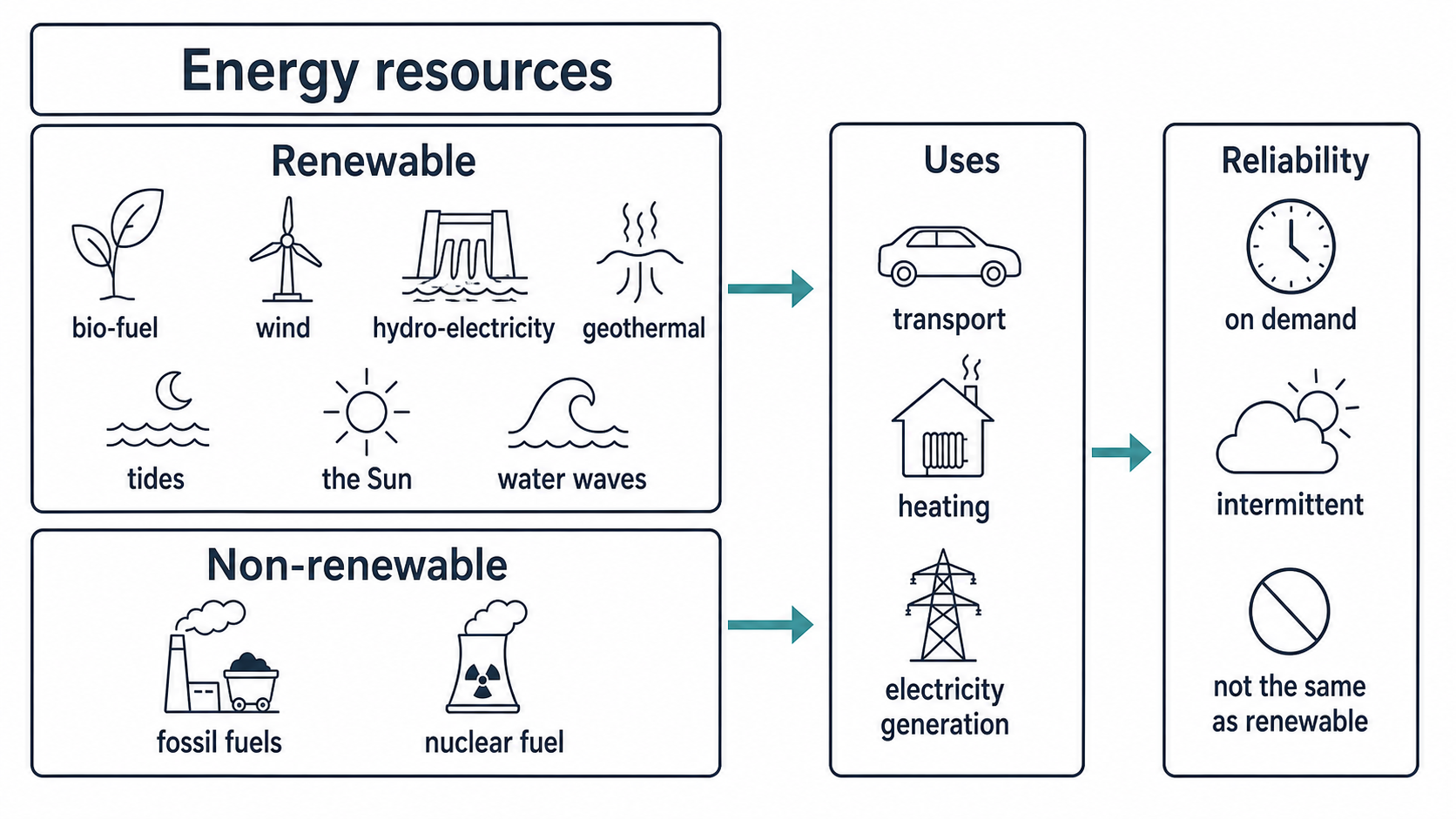
Do not sort nuclear fuel as renewable just because a nuclear power station can run for a long time. The fuel itself is not being replenished as it is used. Also do not sort wind, sunlight or waves as non-renewable just because they are not available on demand; that is a reliability issue, not a renewability issue.
Renewable and reliable are different ideas: renewable is about replacement of the resource, while reliable is about availability when needed.
Uses of energy resources
The required uses are transport, electricity generation and heating. In an exam answer, compare the use of resources by linking the resource to one of those uses.
For transport, oil-based fuels are common because fuels such as petrol, diesel and aviation fuel store energy in a compact form that vehicles can carry. Bio-fuels can also be used as transport fuels in some contexts. Electric vehicles use electricity, but the electricity may have been generated using a range of resources.
For electricity generation, many resources can be used: fossil fuels, nuclear fuel, wind, hydro-electricity, geothermal, the tides, the Sun and water waves can all appear in electricity-supply contexts. At this level, you only need to compare which resources are used; you do not need to describe the internal steps of each electricity-generating system.
For heating, gas is widely used for space heating and water heating. Electricity can also be used for heating. Bio-fuel can be burned for heating, geothermal resources can supply heat where suitable underground conditions exist, and energy from the Sun can be used in solar heating contexts.
Reliability of resources
Reliability means how dependably a resource can supply energy when it is needed. A reliable resource for meeting demand is available at the required time and can often be stored or controlled.
Fossil fuels are usually reliable because the fuel can be stored, transported and used when demand is high. Gas is often useful for meeting changing demand because fuel supply can be controlled. Nuclear fuel is also reliable in the sense that a small amount of stored fuel can run a power station for long periods, although nuclear stations are usually not used for rapid changes in demand.
Some renewable resources are less reliable at a chosen time because they depend on current natural conditions. Wind depends on wind speed. The Sun depends on daylight and cloud conditions. Water waves depend on wave conditions. These resources can be renewable but still not available exactly when people want energy.
Other renewable resources can be more predictable or controllable. The tides are intermittent, but their timing can be predicted. Hydroelectricity can be more reliable if water is stored in a reservoir. Geothermal resources can be steady in suitable locations because the underground heat source is continuous. Bio-fuel can be stored like a fuel, so its use can be controlled if a supply is available.
When comparing reliability, use cause-and-effect language. Do not just write "gas is reliable" or "wind is unreliable". Say what makes the supply reliable or less reliable.
Exam answer habits
For this specification point, keep answers inside the resource-use-reliability boundary. You should be able to describe the main energy resources, distinguish renewable from non-renewable resources, compare their uses, and explain why reliability differs.
A strong distinguish answer gives the rule and then applies it:
- renewable: being, or can be, replenished as it is used
- non-renewable: not replenished fast enough as it is used
A strong compare answer puts two resources in the same sentence or linked sentences. For example: "Oil is commonly used as a transport fuel, whereas wind is used for electricity generation." Separate isolated facts are weaker than a direct comparison.
For reliability, the best answers use one of these ideas:
- fuel can be stored
- output can be controlled
- resource depends on weather, daylight, wave conditions or water supply
- timing is predictable, as with tides, even if supply is not continuous
Avoid writing a long description of how a power station works. Descriptions of how energy resources are used to generate electricity are not required here. Environmental impacts, patterns and trends in resource use, and political, social, ethical or economic decisions belong to the next split lesson, not this one.
That boundary discipline matters because the next lesson will take the same resources into environmental and decision-making comparisons.
For this lesson, compare resources by renewability, use and reliability, not by detailed electricity-generation mechanisms or environmental impact.