4.2.1.4a - Ohmic conductors, filament lamps and diodes
Different circuit components do not all keep the same resistance. Some behave almost like a fixed opposition to current, but others change because they heat up or because their direction in the circuit matters. In this lesson you will compare the resistance behaviour of an ohmic conductor, a filament lamp and a diode.
Constant and changing resistance
Resistance tells you how strongly a component opposes current. It is measured in ohms, Ω. From earlier electricity work, a larger resistance gives a smaller current for the same potential difference across the component.
In this spec point, the important question is not just "What is the resistance?" but "Does the resistance stay the same as the current changes?"
For some resistors, the value of resistance remains constant as current changes. For other components, the resistance changes when the current changes. That can happen because the component warms up, or because the component behaves differently in opposite directions.
Constant resistance
A component has constant resistance if the value of resistance stays the same as the current through it changes.
The word component matters. A fixed resistor, a filament lamp and a diode can all be connected in circuits, but they do not respond to changing potential difference in the same way.
Ohmic conductors
An ohmic conductor is the simplest behaviour in this lesson. If the temperature is kept constant, the current through an ohmic conductor is directly proportional to the potential difference across it.
Ohmic conductor
An ohmic conductor is a conductor where current is directly proportional to potential difference, provided the temperature is constant.
Directly proportional means that the ratio between potential difference and current stays the same. If the potential difference doubles, the current doubles. If the potential difference is halved, the current is halved.
That is why the resistance remains constant as the current changes. The condition "at constant temperature" is part of the idea. If a conductor heats up enough, its resistance may no longer stay constant.
For example, suppose a resistor at constant temperature has a current of 0.20 A when the potential difference is 3.0 V. If the potential difference is increased to 6.0 V, the current becomes 0.40 A because the potential difference has doubled.
For an ohmic conductor at constant temperature, current is directly proportional to potential difference, so resistance stays constant.
Filament lamps
A filament lamp does not keep a constant resistance. The filament is a thin metal wire that becomes hot when current flows through it. As the current increases, the filament temperature increases.
In a metal, electrons move through a lattice of positive ions. When the filament gets hotter, the ions vibrate more. Moving electrons then collide with the vibrating ions more often, so the electrons lose energy more often and the opposition to current increases.
That is why the resistance of a filament lamp increases as the temperature of the filament increases.
Do not explain this by saying only "current increases, so resistance increases." The GCSE physics link is the temperature change in the filament. More current makes the filament hotter; the hotter filament has a higher resistance.
Diodes
A diode is different because direction matters. Current through a diode flows in one direction only. In the reverse direction, the diode has a very high resistance, so only a tiny current flows, or the current is treated as zero in ordinary GCSE descriptions.
The direction that allows current is called the forward direction. When a diode is connected the other way around, it is in the reverse direction. Reversing a diode is therefore not like reversing a fixed resistor; a fixed resistor behaves the same in either direction, but a diode does not.
This makes a diode useful when a circuit needs current to pass one way but be blocked the other way. For this lesson, keep the explanation qualitative: one direction has low enough resistance for current to flow, and the reverse direction has very high resistance.
A diode is directional: current flows in one direction only, and reverse direction has very high resistance.
Comparing the components
These three components are often confused because all can be placed in a circuit and all can have a resistance value at a particular moment. The difference is whether that value stays constant, changes with temperature, or depends on direction.
[DIAGRAM: asset_name: Ohmic conductors, filament lamps and diodes - diagram 1; asset_slug: 017_4_2_1_4a_ohmic_conductors_filament_lamps_and_diodes_diagram1; file: diagram_assets/017_4_2_1_4a_ohmic_conductors_filament_lamps_and_diodes_diagram1.png; recommended_method: image_gen; description: A three-panel conceptual summary generated with built-in Codex Image Gen using a restrained, muted NovaLearn palette: an ohmic conductor/fixed resistor at constant temperature where current is proportional to potential difference and resistance stays constant; a filament lamp where current heats the filament, increased ion vibration causes more collisions, and resistance increases; and a diode where current can flow in the forward direction but reverse direction has very high resistance. This is a qualitative assessed-behaviour visual, not an I-V graph or required-practical circuit.]
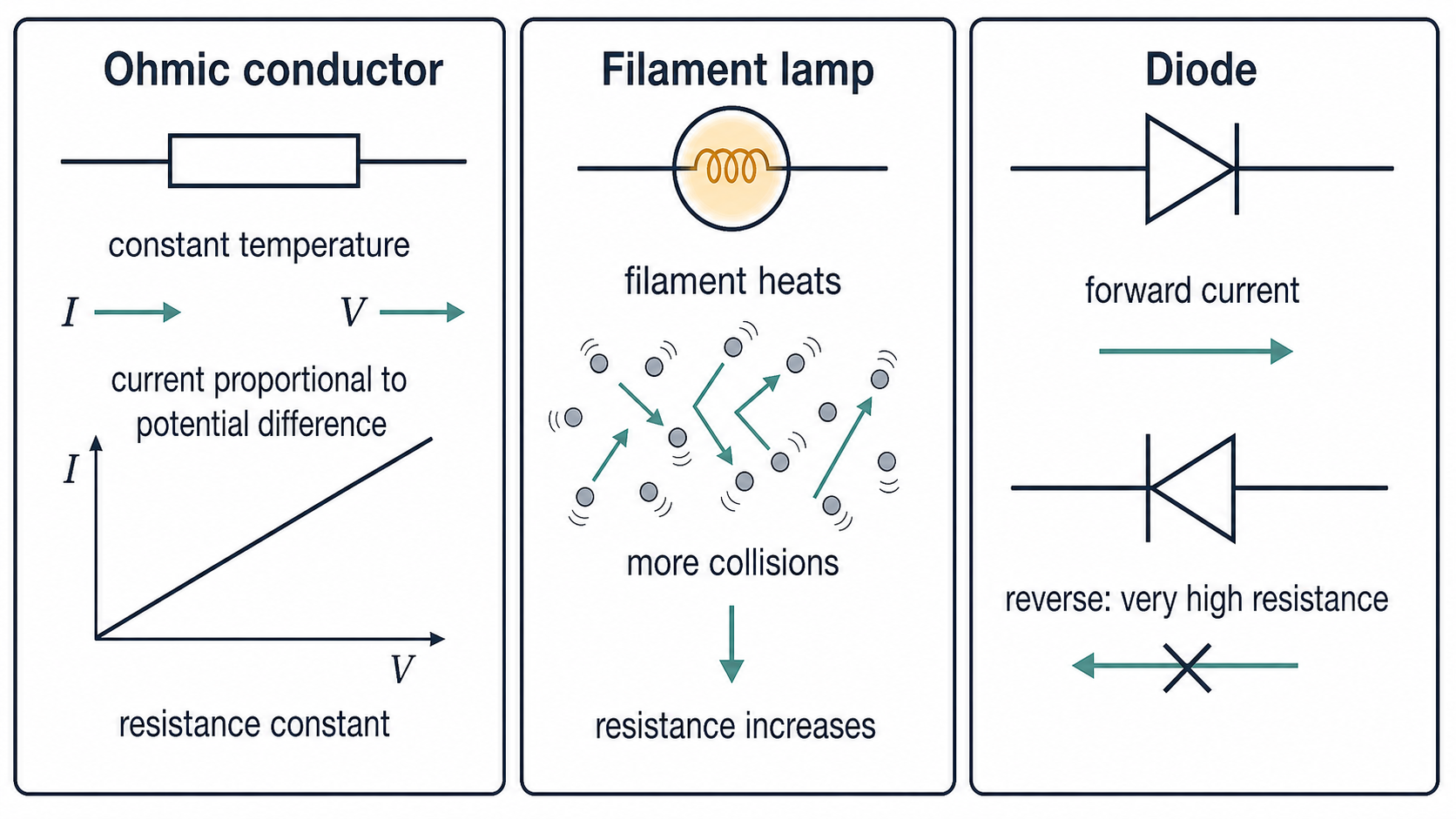
| Component | What stays the same? | What changes? | Key condition or cause |
|---|---|---|---|
| Ohmic conductor | Resistance stays constant | Current changes in proportion to potential difference | Temperature is constant |
| Filament lamp | It is still the same metal filament | Resistance increases as the filament gets hotter | Higher temperature means more electron-ion collisions |
| Diode | It is the same diode | Resistance is very high in the reverse direction | Direction of current through the diode matters |
The common exam trap is treating every component as if resistance is fixed. That is only safe for an ohmic conductor at constant temperature. For a lamp, mention the temperature of the filament. For a diode, mention the direction.