4.2.1.2 - Electrical Charge and Current
Electric current is not the same thing as energy. It is a flow of electrical charge, and its size tells you how quickly charge is flowing. This lesson builds the circuit conditions needed for charge to flow, then uses the AQA relationship between charge flow, current and time.
Closed Circuits and Potential Difference
For charge to flow through a circuit, the circuit must be closed. A closed circuit has a complete conducting path from one terminal of the source, through the components, and back to the other terminal of the source.
The circuit must also include a source of potential difference. In GCSE circuit diagrams this is usually a cell, battery or power supply. The source is what makes it possible for charge to keep moving around the complete loop.
If there is a break in the circuit, such as an open switch, charge does not keep flowing around the loop. If there is a closed loop of wire but no source of potential difference, there is no steady electric current in the circuit.
Charge flows in a circuit only when there is a complete closed path and a source of potential difference.
That is why a cell connected to only one end of a wire is not enough: the path must go all the way around.
Current as Charge Flow
Electric current is a flow of electrical charge. In a metal wire, the moving charges are electrons, but the AQA definition you need is broader and simpler: current is charge flowing.
Electric Current
Electric current is the rate of flow of electrical charge.
The word rate means "per second". A larger current means a larger amount of charge passes a point in the circuit each second. A smaller current means less charge passes each second.
Current is measured in amperes, A. One ampere means one coulomb of charge passes a point each second:
1 A = 1 C/s
So a current of 2 A means 2 C of charge passes a point each second. A current of 0.25 A means 0.25 C of charge passes a point each second.
If that feels abstract, keep returning to the phrase "coulombs per second".
Charge, Current and Time
Charge flow, current and time are linked by this relationship:
Charge Flow
In words:
charge flow = current x time
AQA expects you to recall and apply this relationship in this section. The symbols and units must be used carefully:
| Symbol | Quantity | Unit |
|---|---|---|
Q | charge flow | coulomb, C |
I | current | ampere, A |
t | time | second, s |
The equation matches the meaning of current. If I is the number of coulombs flowing each second, multiplying by the number of seconds gives the total charge flow.
Worked example: A lamp has a current of 0.40 A for 30 s. Calculate the charge flow through the lamp.
Q = I t
Q = 0.40 x 30
Q = 12 C
So 12 C of charge flows through the lamp.
Rearranging and Units
The same relationship can be rearranged when the question asks for current or time.
To find current:
I = Q / t
To find time:
t = Q / I
Use seconds for time. If a question gives time in minutes, convert first:
1 min = 60 s
Worked example: 180 C of charge flows through a component in 2.0 min. Calculate the current.
First convert the time:
2.0 min = 120 s
Then calculate:
I = Q / t
I = 180 / 120
I = 1.5 A
The answer is a current, so the unit is amperes.
Be careful not to swap the units. Charge flow is measured in coulombs, C; current is measured in amperes, A; time is measured in seconds, s.
Current in a Single Closed Loop
In a single closed loop, there is only one route for charge to follow. AQA states that a current has the same value at any point in a single closed loop.
[DIAGRAM: asset_name: Current in a single closed loop - diagram 1; asset_slug: 014_4_2_1_2_electrical_charge_and_current_diagram1; file: diagram_assets/014_4_2_1_2_electrical_charge_and_current_diagram1.png; recommended_method: image_gen; description: Circuit diagram showing one closed loop with a cell labelled source of potential difference, a component, and three ammeters at different positions each reading I = 0.40 A. The visual teaches that the current is the same at every point in one single closed loop. Nearby prose states the same rule for accessibility.]
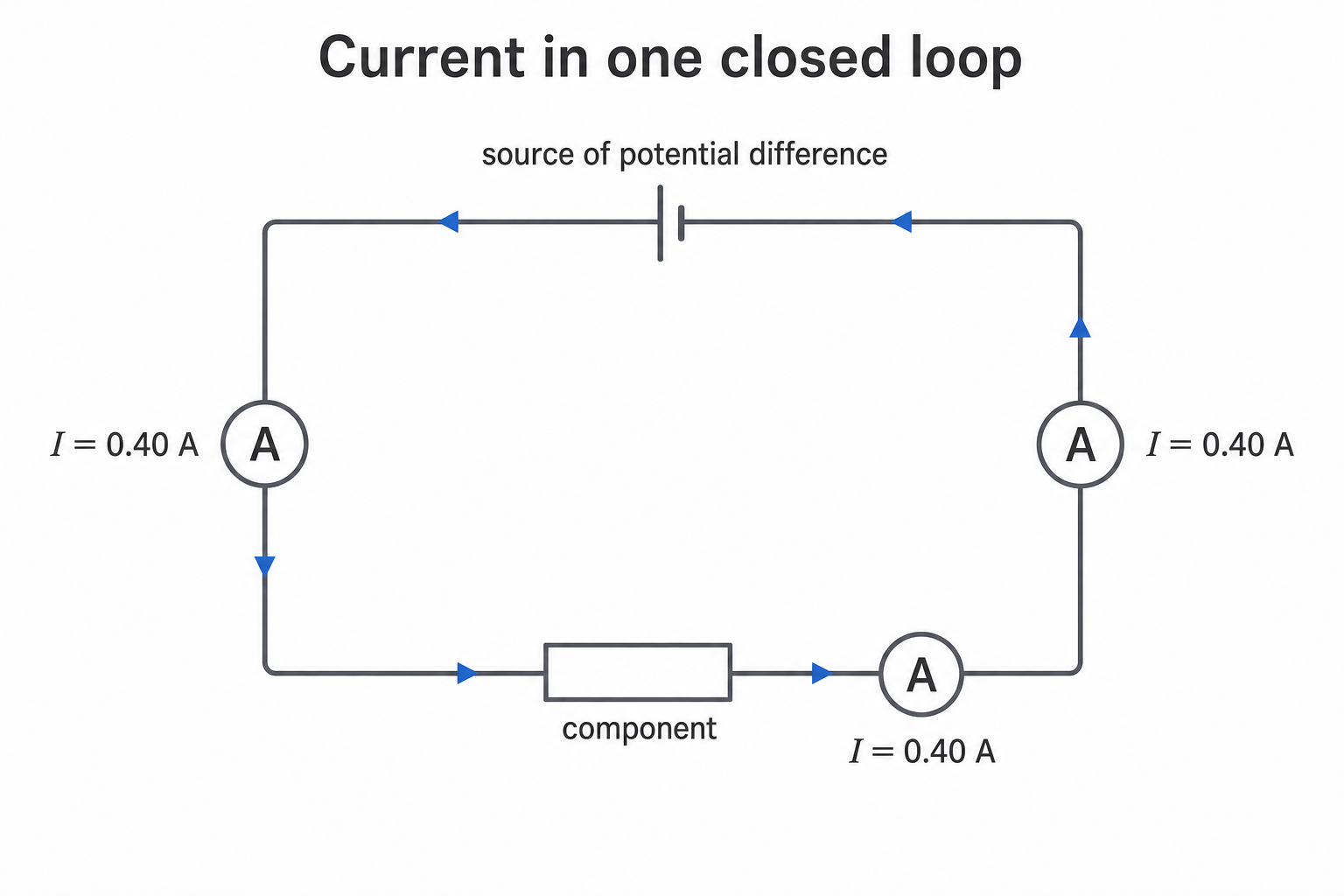
This rule is about a single closed loop, not a circuit with branches. If three ammeters are placed at different positions in one complete loop, they should show the same current. Charge is not used up as it passes around the circuit.
The components may transfer energy, but that is not the same as using up current. The current describes how much charge passes each point per second, and in one unbranched loop the same amount of charge passes each point per second.
Exam Care
For this lesson, stay focused on charge flow and current. Later electricity lessons use resistance, potential difference across components, power and electrical energy transfer. Do not import those equations into a Q = I t calculation unless the question explicitly gives a multi-step context.
Use this checklist for charge-flow questions:
- Is the circuit closed and is there a source of potential difference?
- Is the time in seconds?
- Did you use
Q = I t, or the correct rearrangement? - Is charge flow in
C, current inA, and time ins? - In a single closed loop, have you kept the current the same at every point?