4.1.3b - Environmental Impact and Energy Resource Decisions
Energy resources are not judged only by how much energy they can supply. Their use can affect the atmosphere, land, water, habitats, health, landscapes and future generations. In this lesson you will describe those environmental impacts, explain patterns in energy-resource use from data, and evaluate why scientific evidence does not automatically decide what society does next.
Environmental impacts of energy resources
An environmental impact is a change caused to the surroundings, living things or natural systems. In energy-resource questions, do not just say that one resource is "good" or "bad". Name the impact and link it to the resource being used.
Environmental impact
An environmental impact is an effect on the environment, such as greenhouse gas emissions, air pollution, land use, habitat damage, visual impact, water pollution or radioactive waste.
Different resources cause different impacts:
| Energy resource or group | Environmental issues to consider |
|---|---|
| Fossil fuels: coal, oil and gas | Carbon dioxide from burning contributes to climate change. Other pollutants can affect air quality. Extraction, transport and spills can damage land or water. |
| Nuclear fuel | Very low greenhouse gas emissions during operation, but radioactive waste must be stored safely for a long time. Mining fuel and building/decommissioning plants also affect the environment. |
| Bio-fuel | Plants can be regrown, but burning releases carbon dioxide. Growing fuel crops can use land, water and fertilisers that might otherwise be used for food or habitats. |
| Wind, the Sun, tides, water waves and geothermal | No fuel is burned during operation, so direct greenhouse gas emissions are low. Building the equipment, using land or sea areas, visual impact, noise, habitat change and material use can still matter. |
| Hydro-electricity | No fuel is burned during operation, but dams and reservoirs can flood land, change river habitats and affect local communities. |
The key exam habit is balance. A renewable resource can still have environmental impacts. A non-renewable resource can be reliable or already built into the energy system, but still have major environmental costs. A good answer compares specific impacts rather than relying on a label such as renewable or non-renewable.
Using data to describe trends
A pattern is what the data shows overall. A trend is the direction of change over time. Energy-resource questions often give a table, graph or short passage, then ask you to describe or explain what is happening.
For example, recent UK data can be summarised like this:
| Resource in UK electricity generation | 2025 data point |
|---|---|
| Renewables | 52.5% of generation |
| Wind | 30.0% of generation |
| Solar | 6.9% of generation |
| Gas | 31.5% of generation |
| Coal | 0% of generation |
You do not need to memorise those figures. They are here to practise the skill: use the supplied data, quote a number, and then explain the pattern.
A weak trend answer says:
"Renewables went up."
A stronger answer says:
"Renewables supplied 52.5% of UK electricity generation in 2025, so they supplied over half. Coal supplied 0%, showing that coal had been phased out of UK electricity generation by then."
When percentages are compared, use percentage points for the difference between two percentages. If a resource rises from 30% to 35%, the increase is 5 percentage points. Do not call it "5%" unless you have calculated a percentage increase.
Explaining patterns in resource use
Explaining a trend means giving reasons for it. In energy-resource questions, those reasons may be scientific, technological, economic or social.
Useful reasons include:
- availability of the resource in that country or region
- cost of extracting, importing, building or maintaining the resource
- reliability of supply, such as whether output changes with weather or time of day
- new technology making a resource cheaper or easier to use
- government decisions, taxes, subsidies or environmental laws
- public concern about pollution, landscape change, safety or waste
- existing infrastructure, such as gas networks, power lines, ports or fuel supplies
- demand from transport, heating, industry and electricity use
Use the data first, then the reason. For example:
"Solar generation increased because more solar panels were installed and there were favourable sunshine conditions. However, solar output still changes with the weather and time of day, so other resources or storage may be needed."
That explanation stays inside this lesson because it explains a pattern. It does not describe the internal working of a solar cell or a gas-fired power station.
Science evidence and decision limits
Science can identify many environmental issues. Measurements can show how much carbon dioxide is released, how air quality changes, whether a habitat has been damaged, how much land is flooded, or whether radioactive waste is safely contained. Models can also estimate future effects, such as how emissions may affect climate.
Science cannot, by itself, decide what a government, company or community must do. That is because decisions also involve values, money, fairness, law, jobs, public opinion and international relationships.
[DIAGRAM: asset_name: Energy resource decision framework - diagram 1; asset_slug: 012_4_1_3b_environmental_impact_and_energy_resource_decisions_diagram1; file: diagram_assets/012_4_1_3b_environmental_impact_and_energy_resource_decisions_diagram1.png; recommended_method: image_gen; description: A labelled decision framework generated with built-in Codex Image Gen using a restrained, muted NovaLearn palette. It shows science evidence about environmental impacts and energy-use trends feeding into an energy-resource decision, alongside political, social, ethical and economic considerations. No generation mechanism or exact data is assessed; the nearby prose explains each label.]
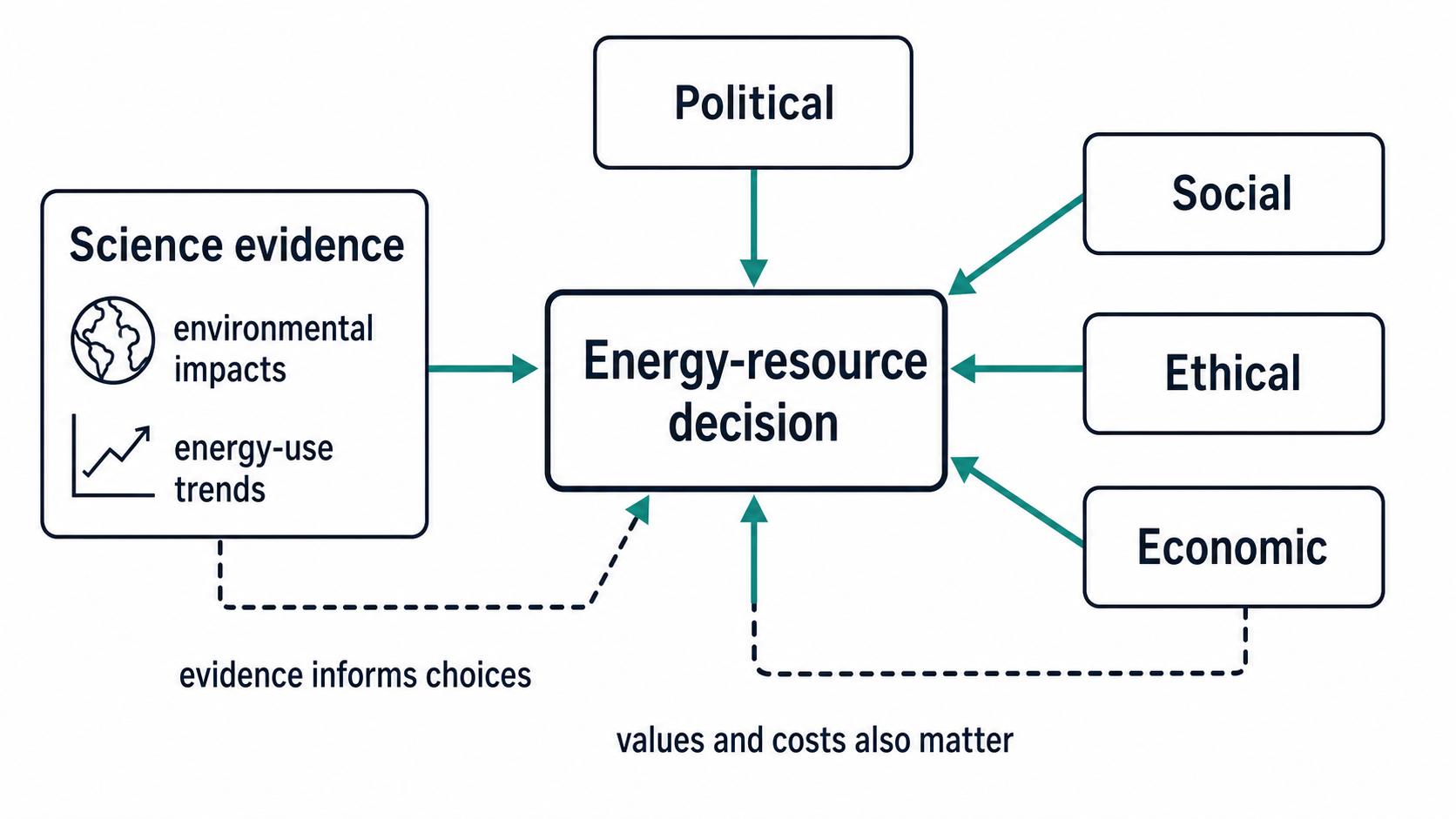
Think of a proposed new wind farm. Science can measure wind speeds, estimate output, map habitats and predict noise levels. It can identify environmental benefits, such as lower direct greenhouse gas emissions than fossil fuel use, and possible environmental problems, such as habitat disruption or visual impact. But the final decision may also depend on planning law, local views, jobs, cost, who pays, who benefits and whether alternative resources are available.
The same is true for many energy choices:
| Consideration | Example question |
|---|---|
| Political | What has the government promised or legally required? |
| Social | How will nearby people, workers or consumers be affected? |
| Ethical | Is the cost or risk being placed fairly on different groups or future generations? |
| Economic | Can the country, company or household afford the option now and later? |
After this lesson, be careful with the phrase "science proves we should...". A stronger exam answer is: "Scientific evidence shows this environmental issue, but action may be limited by political, social, ethical or economic factors."
Writing evaluation answers
An evaluation answer makes a judgement after considering evidence on both sides. In this topic, you are often judging whether an energy-resource choice is sensible in a particular situation.
Use this structure:
- State the decision or option.
- Give environmental evidence for it.
- Give environmental evidence against it or a limitation.
- Add a political, social, ethical or economic consideration if relevant.
- Make a final judgement linked to the evidence.
Example:
"The council should consider approving a new solar farm rather than relying on more gas use. This could reduce carbon dioxide emissions because the solar farm would not burn fuel during operation. However, building it uses land and materials, and its output changes with sunlight. The decision is strongest if the site avoids valuable habitats and the cost is acceptable for local people."
Notice the balance: the answer does not pretend there is a perfect resource. It also does not sit on the fence. It reaches a judgement and explains why.
Common mistakes to avoid:
- saying "renewable means no environmental impact"
- saying "non-renewable means never useful"
- describing how electricity is generated, which is outside this lesson boundary
- giving a trend without quoting data
- giving a political, social, ethical or economic factor without linking it to the energy decision
That is the exam habit to keep: evidence first, then a judgement that recognises real-world limits.
Strong answers use evidence to describe impacts and trends, then explain why real energy-resource decisions also involve political, social, ethical and economic considerations.