4.1.1.3 - Specific Heat Capacity and Required Practical 1
When a material is heated and its temperature rises, energy has been transferred to its thermal energy store. Specific heat capacity tells us how much energy a material needs for a given temperature rise. In this lesson you will use the given equation and learn the required practical method for determining the specific heat capacity of one or more materials.
What specific heat capacity means
Different materials do not warm up by the same amount when the same energy is transferred to them. A small pan of water and a metal spoon can receive energy from the same hob, but the spoon's temperature changes much more quickly because the materials and masses are different.
Specific heat capacity
The specific heat capacity of a substance is the amount of energy required to raise the temperature of 1 kg of the substance by 1 degree Celsius.
A high specific heat capacity means a material needs a large energy transfer for each kilogram to warm by 1 degree Celsius. A low specific heat capacity means the same mass warms more for the same energy transfer.
The units are joules per kilogram per degree Celsius, written as J/kg °C. For example, saying that a material has a specific heat capacity of 900 J/kg °C means that 900 J is needed to raise 1 kg of that material by 1 °C.
Using the given equation
The change in thermal energy can be calculated when the mass, specific heat capacity and temperature change are known.
Change in thermal energy
This equation is given on the Physics equation sheet. You should be able to select it, identify the quantities, substitute values with units, and rearrange it. The assessment focus here is applying the equation, not recalling it from memory.
In the equation:
Delta Eis the change in thermal energy in joules,Jmis the mass in kilograms,kgcis the specific heat capacity in joules per kilogram per degree Celsius,J/kg °CDelta thetais the temperature change in degrees Celsius,°C
Temperature change means final temperature minus initial temperature:
If the question asks for specific heat capacity, rearrange the given equation:
Worked example: a 0.50 kg aluminium block receives 18 000 J of energy. Its temperature increases from 20.0 °C to 59.5 °C.
First find the temperature change:
Then substitute into the rearranged equation:
To an appropriate number of significant figures:
The most common calculation errors are using grams instead of kilograms, using the final temperature instead of the temperature change, and dropping the unit from the final answer.
Required practical apparatus
Required practical 1 determines the specific heat capacity of one or more materials. A common school method uses a metal block heated by an electrical heater. The work done by the heater is linked to the increase in the block's thermal energy store and its temperature rise.
[DIAGRAM: asset_name: Specific Heat Capacity and Required Practical 1 - diagram 1; asset_slug: 006_4_1_1_3_specific_heat_capacity_and_required_practical_1_diagram1; file: diagram_assets/006_4_1_1_3_specific_heat_capacity_and_required_practical_1_diagram1.png; recommended_method: image_gen; description: Exact required-practical apparatus layout generated with built-in Codex Image Gen using a restrained, muted NovaLearn palette. It shows a metal block wrapped in insulation on a heatproof mat, an immersion heater connected to a low-voltage power supply with an ammeter in series, a voltmeter across the heater, a thermometer in a separate hole with water for thermal contact, plus a stopwatch and balance. It teaches which quantities are measured: mass, current, potential difference, time and temperature; nearby prose supplies all assessed details.]
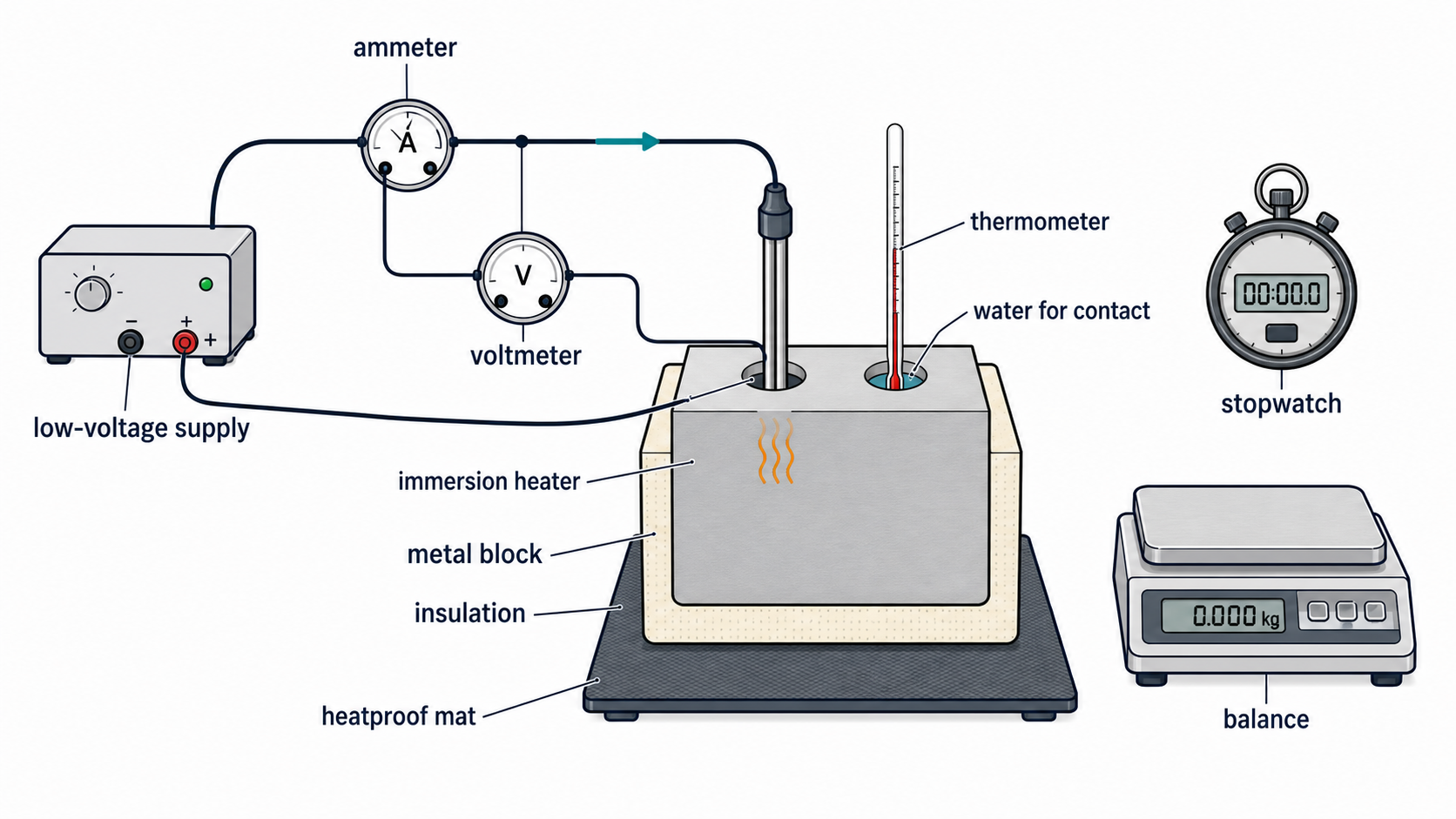
The usual apparatus is:
- metal block, such as copper, iron or aluminium, with holes for a heater and thermometer
- insulation wrapped around the block to reduce energy transfer to the surroundings
- immersion heater and low-voltage power supply
- ammeter in series with the heater to measure current
- voltmeter across the heater to measure potential difference
- thermometer, with a small amount of water in the thermometer hole to improve thermal contact
- stopwatch or stopclock
- balance to measure mass
- heatproof mat
The main measured quantities are mass, current, potential difference, time and temperature. The current and potential difference allow the electrical power of the heater to be found:
The energy transferred, or work done, by the heater during a time interval is:
These two electrical relationships are used here as part of the practical method. The specific heat capacity calculation still uses the given equation Delta E = m c Delta theta.
Method, variables and safety
A clear method keeps the energy transfer and temperature rise linked.
- Measure and record the mass of the metal block in kilograms.
- Wrap the block in insulation and place it on a heatproof mat.
- Place the immersion heater in one hole and the thermometer in another. Add a small amount of water to the thermometer hole to improve thermal contact.
- Connect the heater, ammeter and low-voltage power supply in series. Connect the voltmeter across the heater.
- Record the starting temperature of the block.
- Switch on the power supply and start the stopwatch.
- Record the current and potential difference. Check whether they stay steady during the experiment.
- Record the temperature at regular time intervals, for example every minute for 10 minutes.
- Calculate the energy transferred at each time using
E = P t. - Use the temperature change, mass and energy transferred to determine the specific heat capacity.
If the investigation compares different materials, the independent variable is the material. The dependent variable is the calculated specific heat capacity or the temperature rise for a known energy transfer. Important control variables include the energy supplied, timing method, insulation, starting temperature as far as practical, and the way the heater and thermometer are placed.
Safety matters because the apparatus gets hot and is connected to an electrical supply. Use a low-voltage supply, keep the apparatus dry, check leads before use, place the block on a heatproof mat, do not touch the hot block or heater, and switch off before moving the apparatus.
Processing practical data
For each time reading, the energy transferred by the heater can be calculated from E = P t. The temperature rise is found from:
A simple calculation can use one final temperature reading:
A stronger method uses all the readings by plotting temperature rise against work done. This helps reveal anomalies and gives a line of best fit.
[DIAGRAM: asset_name: Specific Heat Capacity and Required Practical 1 - diagram 2; asset_slug: 006_4_1_1_3_specific_heat_capacity_and_required_practical_1_diagram2; file: diagram_assets/006_4_1_1_3_specific_heat_capacity_and_required_practical_1_diagram2.png; recommended_method: deterministic_drawn; description: Exact graph-style visual of temperature rise Delta theta against work done E, with labelled axes, a slight curved start, a straight best-fit region, and annotations showing gradient = Delta theta / E and c = 1 / (m × gradient). Deterministic drawing is required because axes, labels, gradient meaning and calculation relationship are assessed; nearby prose states all calculations.]
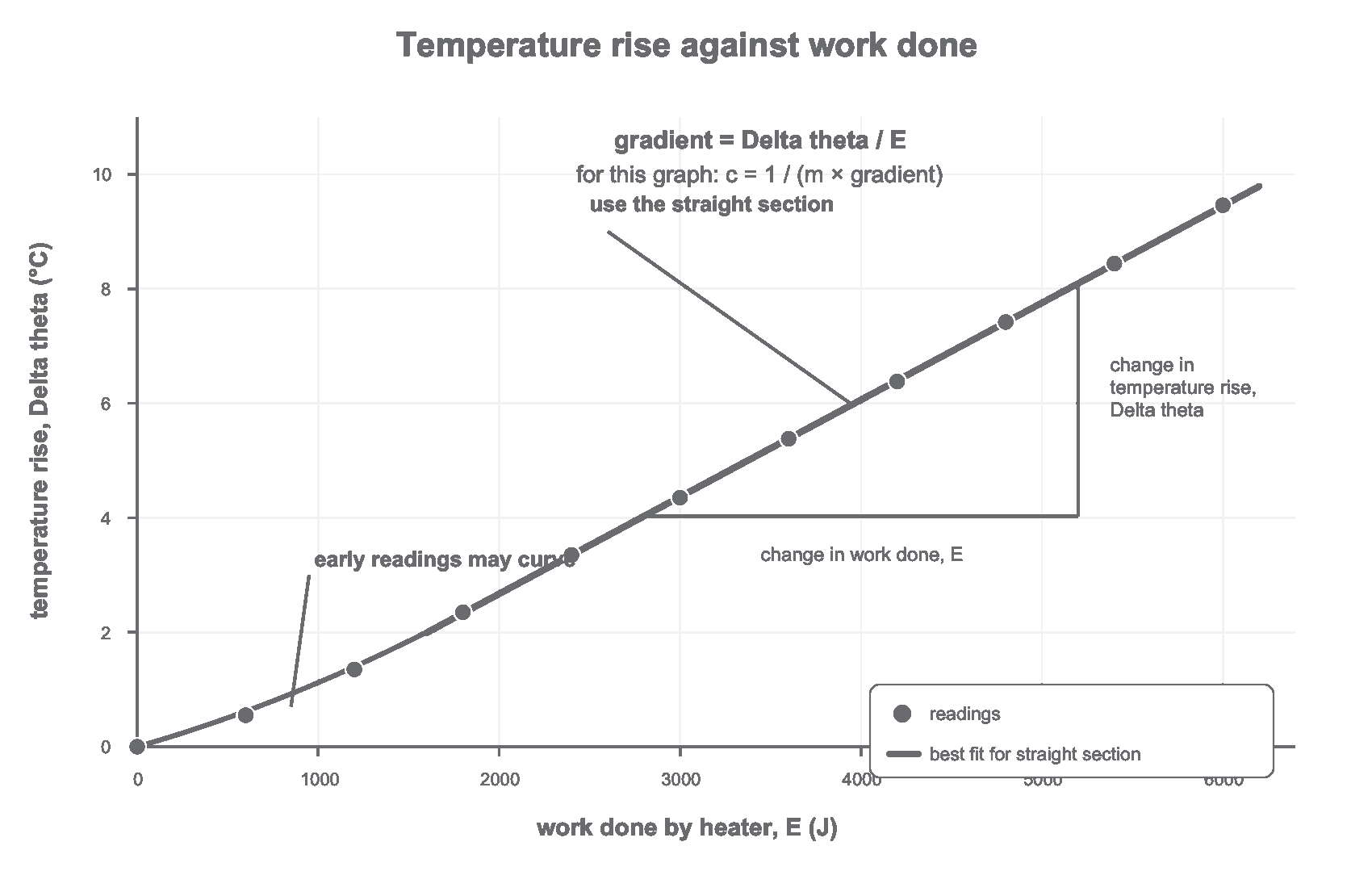
If Delta theta is on the y-axis and E is on the x-axis:
From Delta E = m c Delta theta, the gradient is:
So:
The beginning of the graph may be curved because the heater, block and thermometer take time to reach steady thermal contact. Use the straight section for a line of best fit if that is the best representation of the data.
Data quality and evaluation
The measured specific heat capacity is only as good as the energy and temperature measurements. Some energy from the heater is transferred to the surroundings instead of the block. If the calculation assumes all the electrical energy warmed the block, heat loss usually makes the measured temperature rise too small, so the calculated specific heat capacity can be too large.
Good data-quality decisions include:
- repeat the experiment for the same material and calculate a mean specific heat capacity after checking for anomalies
- repeat the method for different metals only if the comparison is part of the investigation
- keep insulation, heater position, thermometer position and timing intervals the same
- use enough heating time to produce a clear temperature rise, but avoid overheating
- read the thermometer at eye level if using a liquid-in-glass thermometer
- record values to a sensible number of significant figures based on instrument resolution
- identify random errors, such as fluctuating temperature readings, and systematic errors, such as energy lost to the surroundings
The conclusion should connect the evidence to the physics: the heater does work on the block, the block's thermal energy store increases, and the temperature rise allows the specific heat capacity to be determined.
In required practical 1, the calculation is not just substitution. You must know how the energy transfer was measured, how the temperature rise was recorded, and why heat loss and measurement uncertainty affect the final value of specific heat capacity.
Heat loss cannot be completely removed, but it can be reduced and evaluated. That is why exam answers often credit insulation, repeat readings, means, anomaly checks, and comments on accuracy, precision, repeatability and uncertainty.