4.9.2.1–4.9.2.2 - Network topology and peer-to-peer or client-server models
Separate a network's physical connections from the way its data travels. Then compare equal peers with clients requesting centrally managed services, using the requirements of a real organisation.
Physical star and logical bus
A network's topology can describe either its physical connections or its logical pattern of communication.
In a physical star, each device has its own connection to a central device. The drawing looks like spokes around a centre. A workstation's cable failure normally disconnects that workstation while leaving the other spokes intact. A failure of the central device can disrupt the whole star. The central device and separate cables add cost, but individual links are relatively easy to locate, add and troubleshoot.
A logical bus is a shared communication medium: transmitted data is made available to the attached devices, which determine whether it is addressed to them. The access rules must manage sharing. If devices try to transmit incompatibly at the same time, their transmissions can interfere; the selected protocol governs access and recovery. “Logical bus” describes this delivery and shared-medium behaviour, not a compulsory straight physical cable.
[DIAGRAM: asset_slug: physical-star-logical-bus; description: A hub-based physical star repeats A's signal to B, C and D, giving a shared logical medium.]
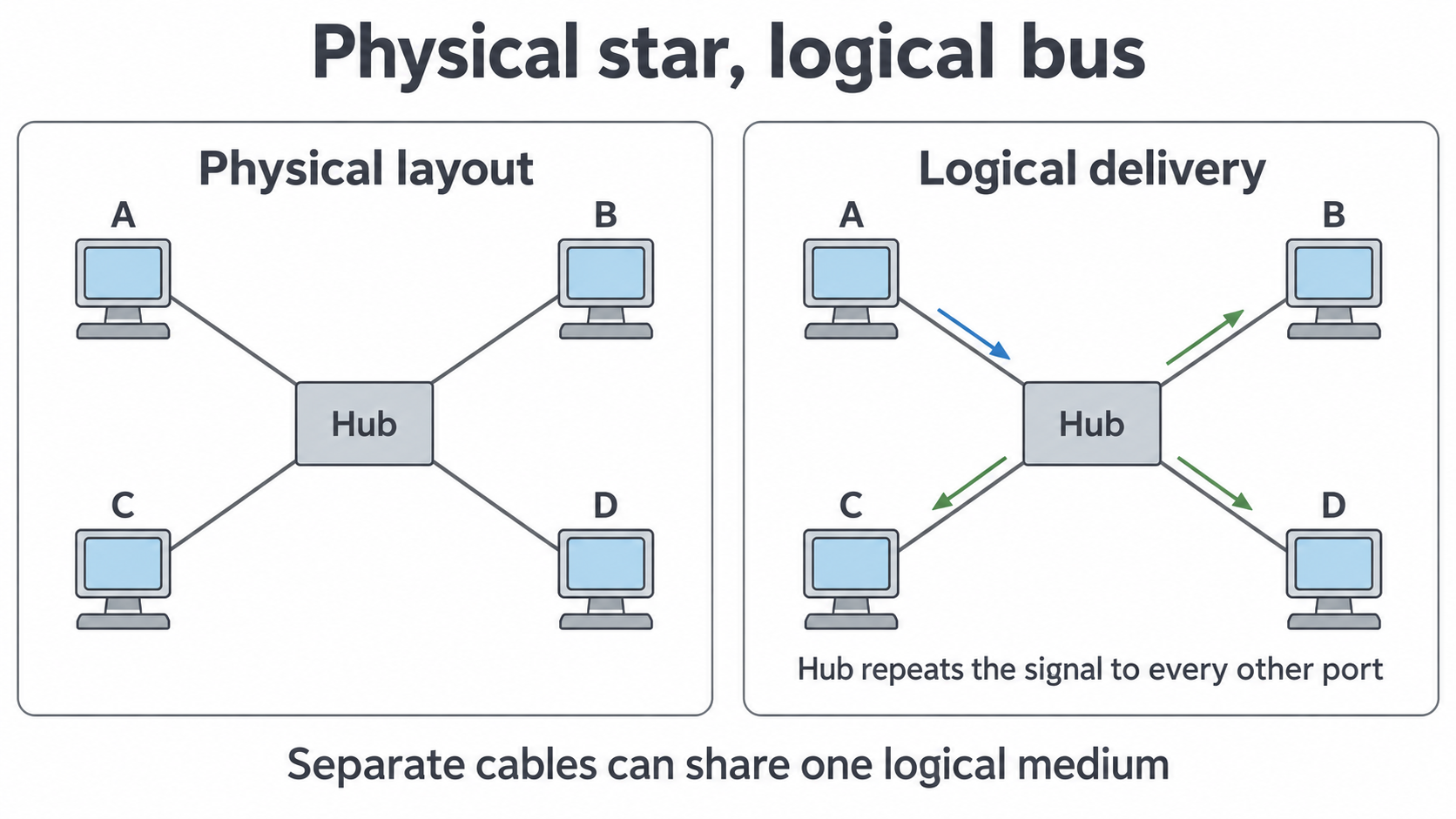
The illustrated historical hub has separate physical cables but repeats an incoming signal to its other ports. A sends a frame addressed to B; C and D also receive the repeated signal and their adapters normally reject the frame because they are not its destination. With the appropriate shared-medium access protocol, the star therefore behaves logically as a bus.
A switch in the same physical star can instead use destination MAC addresses and its learned address table to forward a known unicast frame only onto the appropriate destination link. Some traffic, such as a broadcast or an unknown destination, can still be sent to several ports. Do not infer logical bus operation from the star-shaped cable drawing alone: the central device and protocol determine the behaviour.
Physical and logical descriptions answer different questions. “Which cable runs to which device?” concerns physical topology. “Who receives a transmission, and how do devices share access?” concerns logical topology. Both are needed to explain how a particular network operates.
Peer-to-peer services
A peer-to-peer model allows the computers to provide and use services without a dedicated central server controlling the exchange.
Peer-to-peer network
A network model in which computers have equal status and may provide resources to, and request resources from, other peers.
Equal status concerns their roles, not identical hardware or identical permissions on every file. One peer might share a folder while another shares a printer. A device can act as the provider for one request and the requester for another. A small group can therefore share resources without buying or maintaining a dedicated server.
Consider three designers collaborating temporarily. Each stores their own files and shares a selected folder. This is inexpensive to set up and each designer can control the resource they provide. However, the provider must be available for its files to be accessed. If a designer switches off their computer, its shared folder may become unavailable.
Administration is distributed too. User permissions, updates and backup decisions may need managing on each peer. It is harder to ensure that every important file has been backed up, every account is consistent and every device follows the same policy as the group grows. A shared file is not automatically a backup; several peers can depend on the same sole copy.
Peer-to-peer suits a small or temporary group with modest sharing and administration needs. It is less suitable where many users require centrally enforced permissions, continuous service or reliable organisation-wide backups. Peer-to-peer services can run over a physical star: service roles and cable topology are separate choices.
Client-server services
A client-server model assigns service requests to clients and service provision to nominated servers.
Client-server network
A network model in which clients request services from one or more servers that provide those services.
A file server can store shared files and check access rights. An email server can accept, store and deliver messages. A server is a service role and may provide several services; an organisation can also distribute services across several server machines. A client is not simply a less powerful computer: the name describes its role in a particular exchange.
For a school with hundreds of accounts, centrally managed authentication and file permissions can enforce a consistent access policy. Files kept on managed servers can be included in scheduled backups, and maintenance can be organised by administrators. A workstation's shutdown does not remove everyone else's access to centrally stored resources.
These benefits require suitable server hardware, software, administration and network capacity. A heavily loaded server can become a bottleneck. If a sole server fails, its service is unavailable to its clients; redundancy and tested recovery procedures can reduce that risk at extra cost. Central backup is only a benefit if backup and restoration are actually managed.
Compare using requirements rather than memorising that one model is always better. A small temporary group may value the low setup cost of peers. A growing organisation may justify server cost to obtain consistent permissions, backups and availability. The models describe resource management, whereas physical star and logical bus describe connections and delivery. A physical star can support either service model.