4.3.6.1 - Dijkstra's shortest-path algorithm (C#)
Learn to apply a supplied shortest-path algorithm, update tentative distances and reconstruct a least-weight route from predecessor records.
The C# route is incomplete: runnable support pending. Code work is written-only with no Run. AQA requires understanding and tracing Dijkstra's algorithm; recall of its steps is not required. Algorithm-amendment tasks supply the relevant source or steps.
Tentative distances and visited nodes
Dijkstra's algorithm finds shortest paths from a starting vertex in a graph with non-negative edge weights. A path's cost is the sum of its edge weights; the path with the fewest edges need not have the least cost.
Tentative and final distances
A tentative distance is the smallest start-to-vertex cost found so far. Finalising the unvisited vertex with the smallest tentative distance makes that value permanent when all edge weights are non-negative.
Use this supplied algorithm. “Finalised” is often called “visited” in Dijkstra questions; here it means selected for processing, rather than merely discovered.
- Give the start distance 0 and every other distance infinity; all vertices are unfinalised and have no predecessor.
- Select an unfinalised vertex with the smallest finite tentative distance. If there is none, stop.
- For each unfinalised neighbour, calculate current distance plus edge weight. If this is smaller than its stored distance, replace that distance and record the current vertex as predecessor.
- Finalise the current vertex and repeat. Stop once every reachable vertex is finalised, or once the requested destination is finalised.
Equal smallest distances can be resolved using a stated tie rule. Infinity means not yet reached, not a huge real path cost. A disconnected vertex remains infinity. Negative edges break the guarantee that no later path can improve a finalised distance, so this algorithm's guarantee excludes them.
This weighted undirected graph will be used throughout the worked trace. Edges not listed do not exist.
| Edge | Weight |
|---|---|
| A–B | 4 |
| A–C | 1 |
| B–C | 2 |
| B–D | 1 |
| C–D | 5 |
| C–E | 9 |
| D–E | 3 |
[DIAGRAM: asset_slug: dijkstra-network; description: Exact weighted undirected network A–B 4, A–C 1, B–C 2, B–D 1, C–D 5, C–E 9 and D–E 3.]
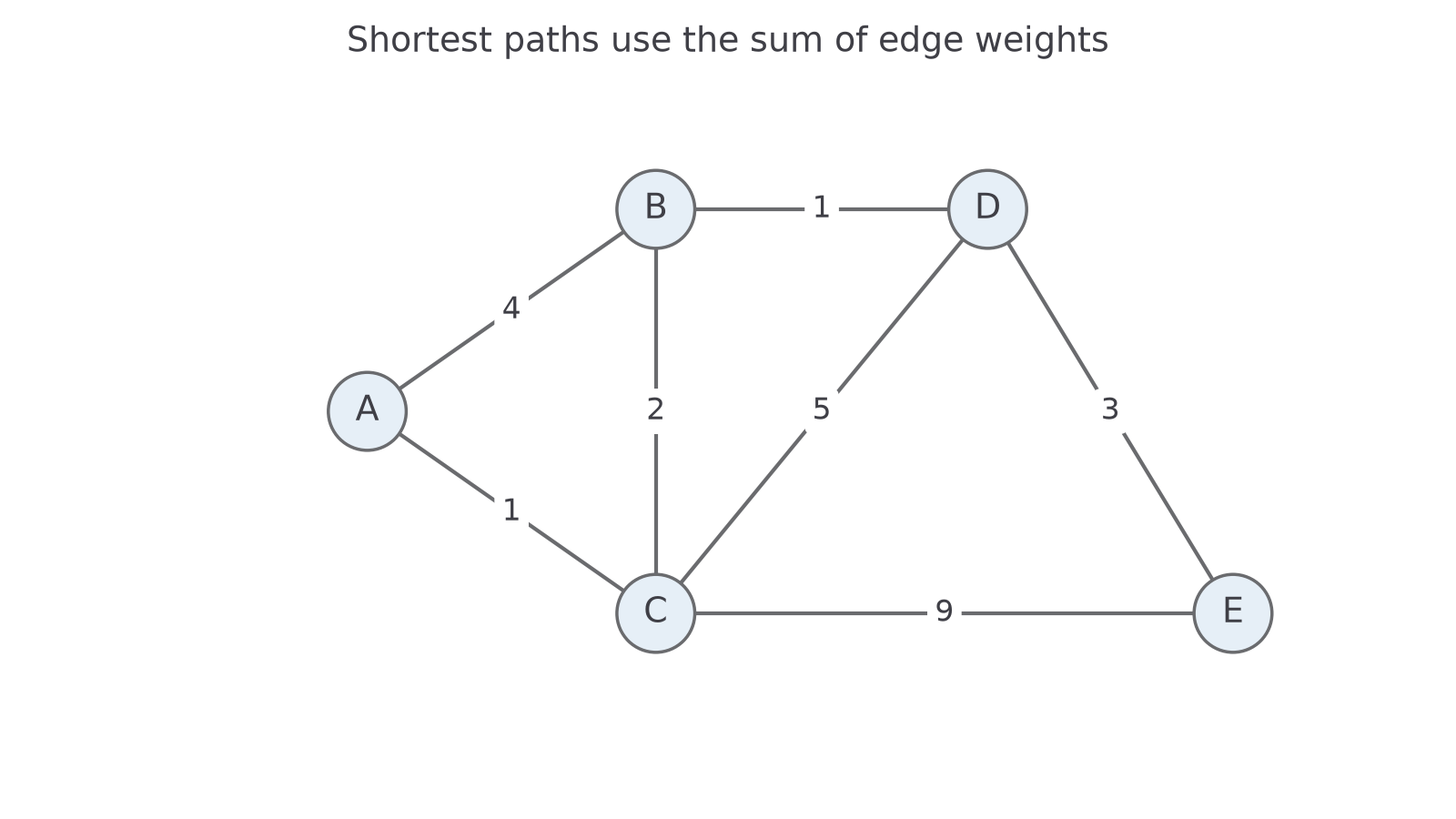
Relaxing weighted edges
Relaxation means checking whether a route through the current vertex improves a neighbour's known distance. A newly found route replaces a distance only when it is smaller; do not overwrite a better route simply because another edge is examined.
Starting at A, the supplied algorithm produces this state after each selected vertex's neighbours have been considered. Brackets show the predecessor; a dash means none.
| Selected | A | B | C | D | E |
|---|---|---|---|---|---|
| initial | 0 (–) | ∞ (–) | ∞ (–) | ∞ (–) | ∞ (–) |
| A | 0 (–) | 4 (A) | 1 (A) | ∞ (–) | ∞ (–) |
| C | 0 (–) | 3 (C) | 1 (A) | 6 (C) | 10 (C) |
| B | 0 (–) | 3 (C) | 1 (A) | 4 (B) | 10 (C) |
| D | 0 (–) | 3 (C) | 1 (A) | 4 (B) | 7 (D) |
| E | 0 (–) | 3 (C) | 1 (A) | 4 (B) | 7 (D) |
After A, C's distance 1 is smaller than B's 4, so C is next. Via C, B improves to 1+2=3. Via B, D improves from 6 to 3+1=4. Via D, E improves from 10 to 4+3=7. Distances can improve before finalisation; the selection order is A, C, B, D, E.
The following complete static C# program implements the supplied steps. Vertices A–E are indices 0–4. A matrix value -1 means no edge, allowing an actual zero-weight edge. Guaranteed finite path totals fit an int. The finite-distance selection guard prevents adding a weight to the infinity sentinel.
using System;
class Program
{
    static void Main()
    {
        int[,] weights = {
            { -1, 4, 1, -1, -1 }, { 4, -1, 2, 1, -1 },
            { 1, 2, -1, 5, 9 }, { -1, 1, 5, -1, 3 },
            { -1, -1, 9, 3, -1 }
        };
        int n = weights.GetLength(0);
        int[] distance = new int[n];
        int[] predecessor = new int[n];
        bool[] finalised = new bool[n];
        for (int v = 0; v < n; v++)
        {
            distance[v] = int.MaxValue;
            predecessor[v] = -1;
        }
        distance[0] = 0;
        for (int step = 0; step < n; step++)
        {
            int current = -1;
            for (int v = 0; v < n; v++)
                if (!finalised[v] && distance[v] != int.MaxValue &&
                    (current == -1 || distance[v] < distance[current]))
                    current = v;
            if (current == -1) break;
            for (int next = 0; next < n; next++)
                if (!finalised[next] && weights[current, next] >= 0)
                {
                    int candidate = distance[current] + weights[current, next];
                    if (candidate < distance[next])
                    {
                        distance[next] = candidate;
                        predecessor[next] = current;
                    }
                }
            finalised[current] = true;
        }
        Console.WriteLine(distance[4]);
    }
}
Continue this lesson.
You’re previewing NovaLearn without an account. Create a free account to read the rest.
Create free account