4.3.6.1 - Dijkstra's shortest-path algorithm (Java)
Apply a supplied shortest-path algorithm to a weighted graph, trace tentative distances and recover a route from predecessors. AQA does not require recall of Dijkstra's steps. Java amendments are written practice. This route is incomplete: runnable support pending.
Tentative distances and finalised vertices
Dijkstra's algorithm finds minimum-total-weight routes from a start vertex when all edge weights are non-negative.
Tentative distance
A tentative distance is the best route cost found so far. A finalised vertex has had its minimum distance established and will not be selected again.
An edge weight might represent travel time, distance or a communication cost. Fewest edges is not necessarily least total weight. Initially the start distance is0 and all others are infinity, meaning no route has yet been found. Infinity is a state, not a very long measured route.
Use this supplied algorithm throughout the lesson:
- Select the unfinalised vertex with the smallest finite tentative distance; ties use alphabetical order. Stop if none exists.
- Finalise that vertex u. For every unfinalised neighbour v, calculate distance(u)+weight(u,v). If this is smaller than distance(v), replace distance(v) and record u as v's predecessor.
- Repeat until all reachable vertices are finalised, or until the required destination is finalised if only its shortest route is needed.
[DIAGRAM: asset_slug: dijkstra_graph; description: Non-negative weighted graph with edges A–B4, A–C1, B–C2, B–D5, C–D8, C–E10 and D–E2.]
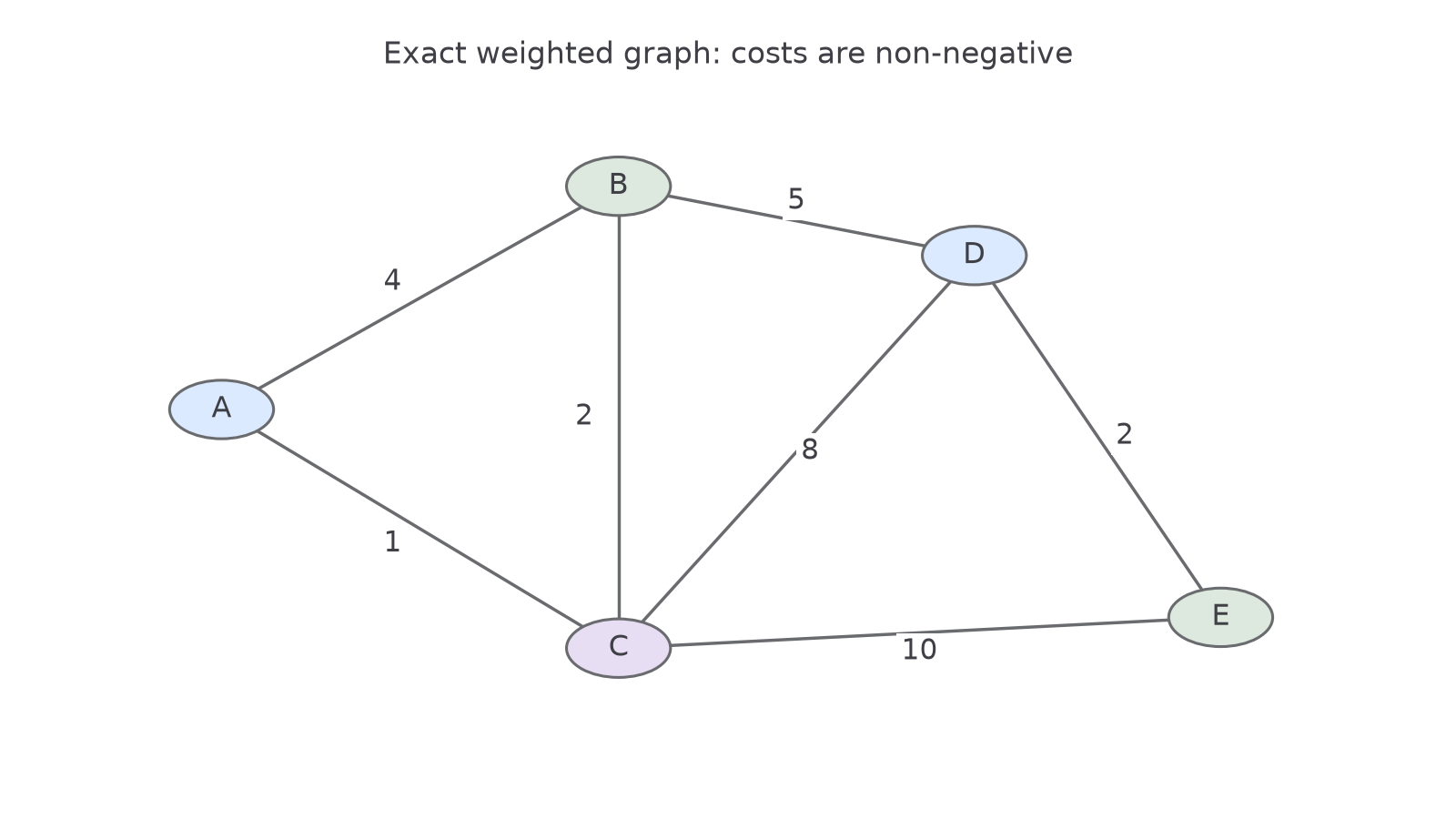
The graph is undirected, with exactly the edges listed in the caption. Starting at A, the first selection finalises A0 and sets B4,C1. Select C next, since1 is smaller than4. Taking B before C simply because it was discovered first would not follow the supplied algorithm. Non-negative weights mean a route through a later, no-cheaper vertex cannot make an already finalised distance smaller. Negative weights invalidate that reasoning; this lesson does not apply Dijkstra to them.
Relaxing weighted edges
Relaxation tests whether a newly considered route improves a neighbour's current tentative distance.
After C1 is selected, the route A–C–B costs1+2=3, improving B4. C also offers D9 and E11. B3 then offers D8, improving D9. D8 offers E10, improving E11. Do not replace a smaller distance with a worse candidate or add a weight to an unreachable infinity value.
| Just finalised | A | B | C | D | E |
|---|---|---|---|---|---|
| A | 0 | 4 | 1 | ∞ | ∞ |
| C | 0 | 3 | 1 | 9 | 11 |
| B | 0 | 3 | 1 | 8 | 11 |
| D | 0 | 3 | 1 | 8 | 10 |
| E | 0 | 3 | 1 | 8 | 10 |
This supplied Java implementation belongs inside a class with import java.util.Arrays;. weight[u][v] is−1 for no edge and a non-negative integer otherwise. Indices are valid; all finite path sums fit below Integer.MAX_VALUE. Scanning indices in increasing order and replacing the selection only on a strict improvement gives lowest-index ties.
static int[] distances(int[][] weight, int start) {
    int n = weight.length;
    int[] d = new int[n];
    Arrays.fill(d, Integer.MAX_VALUE);
    boolean[] done = new boolean[n];
    d[start] = 0;
    while (true) {
        int u = -1;
        int best = Integer.MAX_VALUE;
        for (int v = 0; v < n; v++) {
            if (!done[v] && d[v] < best) {
                u = v;
                best = d[v];
            }
        }
        if (u == -1) break;
        done[u] = true;
        for (int v = 0; v < n; v++) {
            if (!done[v] && weight[u][v] >= 0) {
                int candidate = d[u] + weight[u][v];
                if (candidate < d[v]) d[v] = candidate;
            }
        }
    }
    return d;
}
Only finite vertices are selected, so the addition never starts from infinity. A zero-weight edge is valid and must not be confused with no edge. An unreachable vertex stays at the sentinel value when selection stops.
Continue this lesson.
You’re previewing NovaLearn without an account. Create a free account to read the rest.
Create free account