4.3.1.1 - Breadth-first and depth-first graph traversal (Java)
Learn how breadth-first and depth-first search visit a graph, trace their changing state and choose between them for an unweighted route or a maze. Java examples and code answers are written practice. This route is incomplete: runnable support pending.
Breadth-first search and queues
Breadth-first search explores the start vertex's neighbours before vertices further away, using a queue to keep discovered vertices in first-in, first-out order.
Discovery and processing
A vertex is discovered when the algorithm first schedules it for exploration. It is processed when it is removed from the queue and its neighbours are examined.
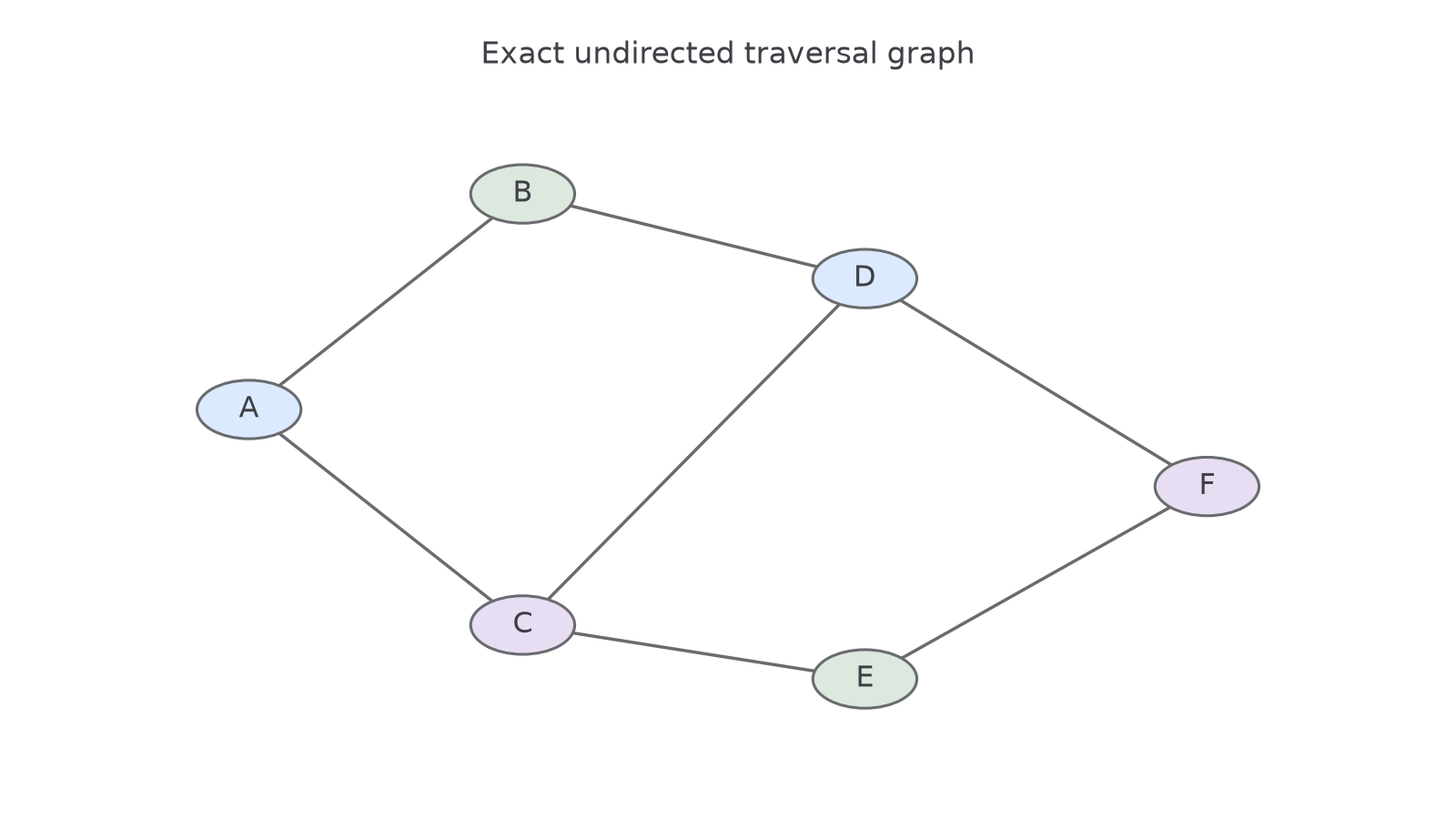
The example is an undirected graph. A vertex's adjacency list is examined in the listed order: A: B, C; B: A, D; C: A, D, E; D: B, C, F; E: C, F; F: D, E. Mark a vertex discovered when adding it, rather than when removing it, so two parents cannot queue it twice. Starting at A gives the following state; queue front is at the left.
[DIAGRAM: asset_slug: traversal_graph; description: Undirected graph A–F with exactly the adjacency relationships used in the breadth-first and depth-first traces.]
| Processed vertex | Newly discovered | Queue after processing |
|---|---|---|
| A | B, C | B, C |
| B | D | C, D |
| C | E | D, E |
| D | F | E, F |
| E | none | F |
| F | none | empty |
With indices A=0 through F=5, the method below returns the processing order. These methods belong inside a class; import java.util.*; supplies the collection classes. The start index and every neighbour index are guaranteed valid.
static List<Integer> bfs(int[][] neighbours, int start) {
    boolean[] discovered = new boolean[neighbours.length];
    Deque<Integer> queue = new ArrayDeque<>();
    List<Integer> order = new ArrayList<>();
    discovered[start] = true;
    queue.addLast(start);
    while (!queue.isEmpty()) {
        int u = queue.removeFirst();
        order.add(u);
        for (int v : neighbours[u]) {
            if (!discovered[v]) {
                discovered[v] = true;
                queue.addLast(v);
            }
        }
    }
    return order;
}
An isolated start still produces a one-element list. A single search visits only the component reachable from its start, not disconnected vertices elsewhere.
Continue this lesson.
You’re previewing NovaLearn without an account. Create a free account to read the rest.
Create free account