4.9P-4.11 - Wave interactions and refraction
Follow reflected, transmitted and absorbed wave energy at a boundary, then explain refraction and why the material and wavelength both matter. The speed explanation in 4.10 and all of 4.11 are Higher-tier content.
What happens at a material interface
Think about sound reaching a wall. Some sound energy returns as an echo, some may pass into the room beyond, and some is transferred to the wall. The surface where the two materials meet is a material interface, or boundary.
Four words describe possible effects at an interface:
- Reflection: wave energy changes direction and remains in the original material.
- Transmission: wave energy passes across the boundary into the second material.
- Refraction: a transmitted wave changes speed at the boundary and, when it arrives at an angle, changes direction.
- Absorption: the second material takes in some wave energy, usually increasing the internal energy of the material.
The arrows in the diagram are a model of the direction in which wave energy travels. They are not physical tracks left in the material.
[DIAGRAM: asset_name: 15_1PH0-P1-04C_4.8P-4.11 - Wave interactions and refraction - diagram 01; asset_slug: edexcel-gcse-physics-4-8p-4-11-wave-interactions-refraction_diagram_01; recommended_method: image_gen; description: four-panel monochrome model isolating reflection, transmission, refraction and absorption at a vertical material interface with correct normals, arrows and energy labels]
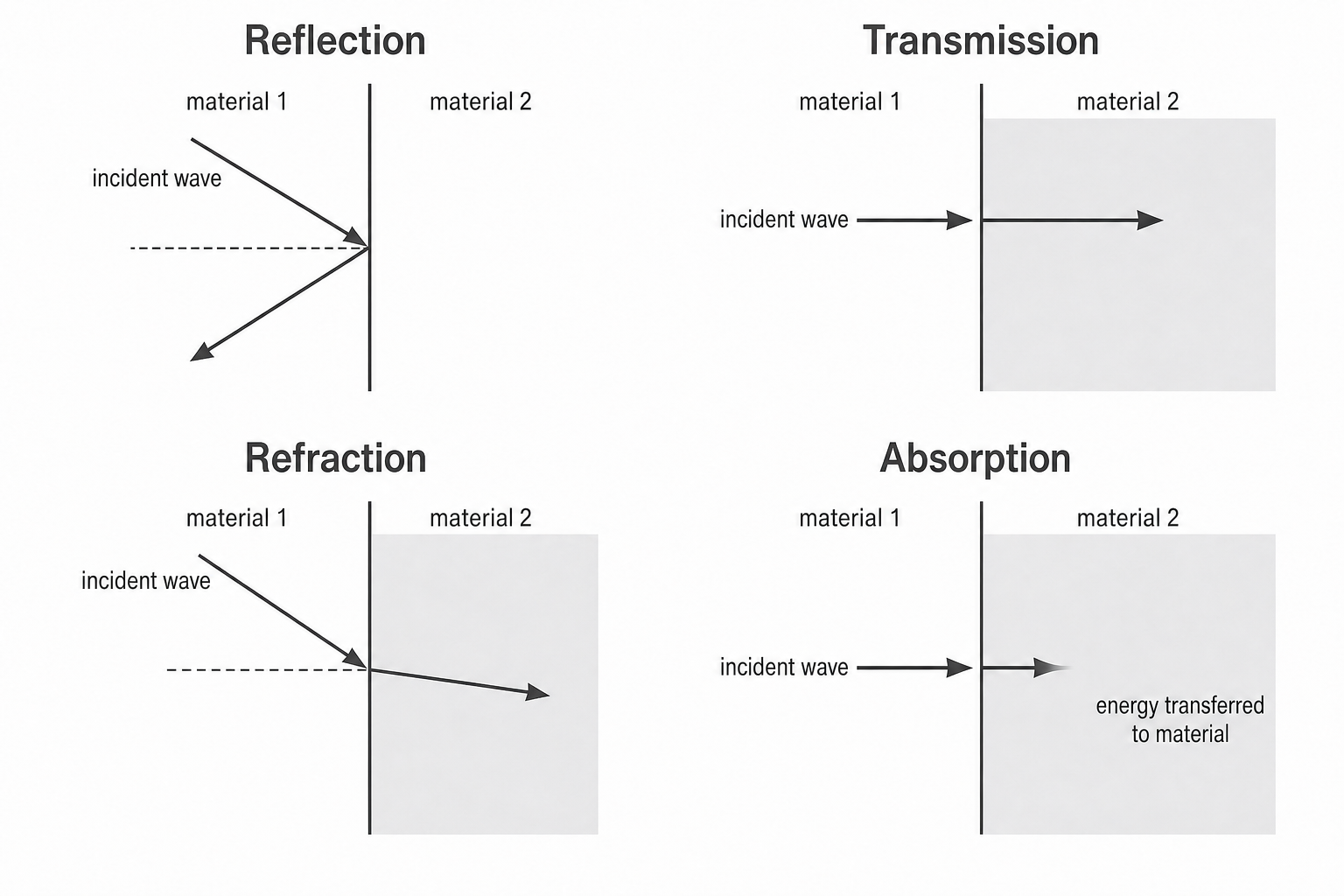
The four panels isolate one effect at a time so that each is easy to recognise. A real boundary does not have to choose only one: an incident wave can be partly reflected, partly transmitted and partly absorbed. Refraction describes the change in direction of the transmitted part when its speed changes at an angle.
Energy is still conserved. If the only outcomes are reflection, transmission and absorption, their shares of the incident energy add to 100%. Greater absorption usually leaves less energy available for reflection or transmission; this is why a sound-absorbing surface can reduce echoes.
Code 4.9P is separate-Physics content, but it applies at both Foundation and Higher tier.
Refraction, speed and direction
To describe direction precisely, draw a normal at the point where the wave crosses the boundary. The normal is an imaginary reference line at 90 degrees to the boundary. Angles are compared with the normal, not with the boundary surface.
[DIAGRAM: asset_name: 15_1PH0-P1-04C_4.8P-4.11 - Wave interactions and refraction - diagram 02; asset_slug: edexcel-gcse-physics-4-8p-4-11-wave-interactions-refraction_diagram_02; recommended_method: image_gen; description: paired monochrome ray-model panels comparing a wave slowing and speeding at a boundary, with perpendicular normals, correct bending directions and wavelength changes]
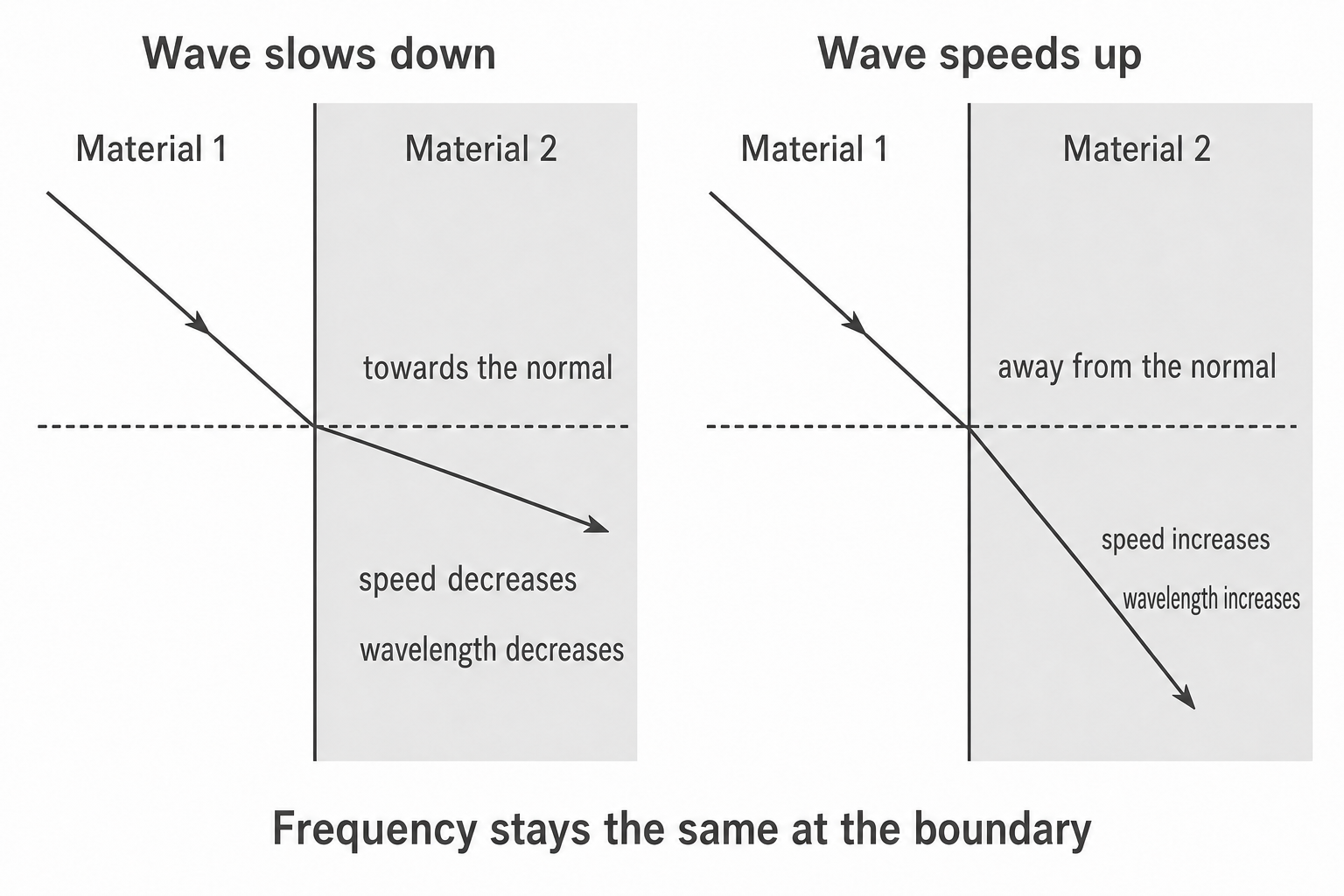
Higher tier: the speed explanation in 4.10. For a wave crossing a stationary boundary at an angle:
- if its speed decreases, it refracts towards the normal;
- if its speed increases, it refracts away from the normal.
The change of speed causes the change of direction. One side of an angled wavefront reaches the boundary first and changes speed first, so the wavefront turns as the rest crosses. A ray is a convenient representation drawn at right angles to the wavefront; it shows the overall direction of travel.
If the wave arrives along the normal, every part of its wavefront reaches the boundary together. Its speed can still change, but it does not change direction. This is why "refraction always means visible bending" is not a reliable rule.
For a stationary boundary, the source still controls how many oscillations arrive each second, so frequency stays the same. Let v be wave speed, f be frequency and be wavelength. Their relationship is:
wave speed = frequency × wavelength
If f stays constant, a decrease in v means wavelength decreases, while an increase in v means wavelength increases. Do not say that the wave slows because its frequency decreases.
The direction-change part of code 4.10 applies at both tiers. Explaining the refraction in terms of the speed change is Higher-tier content.
Higher tier check
Why wavelength and material both matter
Higher tier: code 4.11 says that absorption, transmission, refraction and reflection depend on both the substance and the wavelength. There are two comparisons to keep separate:
- At the same wavelength, two different substances may interact with a wave differently.
- For the same substance, waves of different wavelengths may interact differently.
| Example | What the comparison shows |
|---|---|
| Earth's atmosphere largely transmits visible light but absorbs or reflects many other wavelength ranges. | A substance can transmit one range of wavelengths without transmitting every range. |
| Different visible wavelengths refract by different amounts in a glass prism. | The speed change, and therefore the refraction, can vary with wavelength. |
| A hard rocky seabed gives a stronger reflected sonar signal than a soft muddy seabed, which absorbs more sound energy. | Different materials can divide incident wave energy differently. |
These examples do not mean that a wave changes its frequency merely because it crosses a boundary. In the refraction model, one wave keeps its frequency while its speed and wavelength change. Code 4.11 instead compares how a material responds when different incoming wavelengths are used.
Words such as "transparent", "reflective" and "absorbing" are therefore incomplete unless the relevant wave or wavelength range is clear. A window may be transparent to visible light but not equally transmitting at every electromagnetic wavelength; a wall can reflect some sound while absorbing another share.
Predicting an interface outcome requires both parts of the pair: which material, and which wavelength of wave is incident on it.