3.1-3.2 - Gravitational and kinetic energy calculations
Raising an object increases its gravitational potential energy; making it move gives it kinetic energy. Learn to choose the right relationship, convert units, rearrange equations and explain why a change in speed has a squared effect.
Choosing quantities and units
Imagine a stationary equipment case on the floor. Raising it changes its position relative to Earth; setting the case moving gives it kinetic energy. These are different physical situations, so they require different equations.
Both results are measured in joules (J), but the input quantities are not identical:
| Situation | Quantities needed | Required units |
|---|---|---|
| Object is raised | mass, gravitational field strength, change in vertical height | kg, N/kg, m |
| Object is moving | mass, speed | kg, m/s |
Both equations are included on the Edexcel equation sheet and apply to both tiers. The sheet does not decide which equation fits a situation, convert units or complete the algebra.
Use the same routine for each calculation:
- Identify the quantity being found and choose the equation.
- Convert every value into the unit required by that equation.
- Substitute values with the square or square root shown clearly.
- Calculate without rounding intermediate values too early.
- Give the final unit, round as requested and check whether the size of the answer is sensible.
Change in gravitational potential energy
Gravitational potential energy is associated with the positions of the object and Earth. A reference level is chosen, often the ground, so this equation calculates the change between an initial and a final height rather than an absolute value.
[DIAGRAM: asset_name: 09_1PH0-P1-03A_3.1-3.2 - Gravitational and kinetic energy calculations - diagram 01; asset_slug: edexcel-gcse-physics-3-1-3-2-gravitational-kinetic-energy_diagram_01; recommended_method: image_gen; description: monochrome before-and-after model of the same equipment case with an exact vertical double-headed arrow showing change in vertical height from the aligned ground reference]
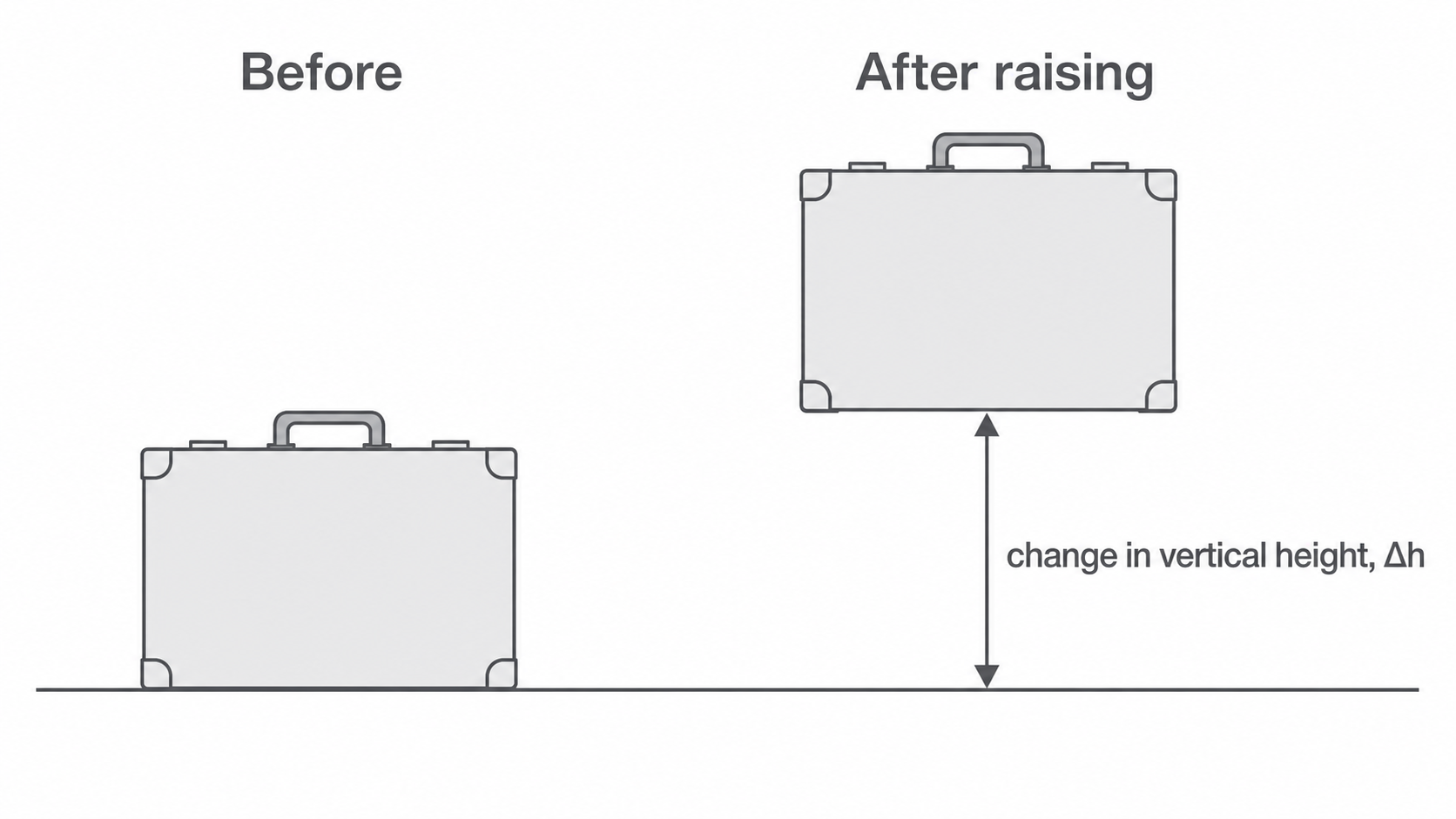
The height in the equation is the vertical height change. It is not the distance an object travels along a ramp, staircase or winding route.
change in gravitational potential energy = mass × gravitational field strength × change in vertical height
- is the change in gravitational potential energy in joules (
J). mis mass in kilograms (kg).gis gravitational field strength in newtons per kilogram (N/kg).- is the change in vertical height in metres (
m).
The symbol g means gravitational field strength, not gravitational potential energy. Use the value given in the question; values such as 10 N/kg, 9.8 N/kg or 9.81 N/kg may be supplied for Earth.
Worked example
An equipment case of mass 750 g is raised vertically through 1.60 m. The gravitational field strength is 9.8 N/kg. Calculate the change in gravitational potential energy.
First convert the mass:
Choose and substitute into the equation:
Rounded to two significant figures, the final result is 12 J. If a question specifies a precision, follow it; otherwise give sensible precision and keep extra digits during the calculation. The answer is positive because the case was raised. A sense-check using its weight gives ; multiplying this by a height a little greater than 1.5 m should give an energy a little greater than 11 J, which it does.
Kinetic energy of a moving object
Kinetic energy is the energy associated with an object's motion. The equation uses speed, so the direction of travel is not needed. Speed must be in metres per second and must be squared before the remaining multiplication is completed.
kinetic energy = 1/2 × mass ×
KEis kinetic energy in joules (J).mis mass in kilograms (kg).vis speed in metres per second (m/s).
Worked example
A loaded delivery cart has a mass of 1.20 tonnes and travels at 12.0 m/s. Calculate its kinetic energy in kilojoules.
Convert the mass before substitution:
1.20 tonnes = 1.20 × kg
Choose the equation and square the speed:
The question asks for kilojoules, and :
The data are given to three significant figures, so 86.4 kJ is appropriate. The unit conversion makes the number smaller by a factor of 1000 but does not change the amount of energy.
Comparing mass, height and speed
The equations show how changing one quantity affects the energy when the other quantities stay fixed.
| Controlled comparison | Effect on energy |
|---|---|
Double m, with g and unchanged | doubles |
Double , with m and g unchanged | doubles |
Double m, with v unchanged | KE doubles |
Double v, with m unchanged | KE becomes times as large |
Triple v, with m unchanged | KE becomes times as large |
Mass has a linear effect in both equations: multiplying mass by a factor multiplies the energy by the same factor. Vertical height also has a linear effect on the change in GPE. Speed is different because it is squared in the kinetic-energy equation.
For example, two identical trolleys moving at 4.0 m/s and 8.0 m/s have a speed ratio of 2. The faster trolley therefore has times the kinetic energy, not twice the kinetic energy. This comparison only isolates the effect of speed because the masses are the same.
Before making a proportional comparison, state what stays constant. Then check whether the changed quantity appears normally or is squared in the equation.
Rearranging to find a missing quantity
An equation can be rearranged before values are substituted. Keeping the symbols visible reduces the chance of dividing by the wrong quantity.
The missing quantity determines the rearrangement. For mass, divide the energy by everything multiplying mass: . A 147 J increase through 3.0 m, with , therefore corresponds to .
To find the vertical height change:
For example, if a 15 kg load gains 540 J of GPE where :
to two significant figures.
To find speed from kinetic energy, first make the subject and then take the positive square root because speed is a non-negative magnitude:
v = sqrt((2 × KE) / m)
The square root is essential. If , then , not 225 m/s.