2.32P-2.33P - Braking distance and work-energy
A small increase in speed can require much more braking distance. Use typical stopping data and a work-energy model to explain the difference between a sensible estimate and a controlled calculation. Separate Physics content for both tiers.
Estimating emergency stopping distance
An emergency stop has two stages. During the driver's reaction time, the vehicle travels the thinking distance. Once the brakes act, it travels the braking distance before coming to rest.
overall stopping distance = thinking distance + braking distance
The table gives the UK Highway Code’s typical values. The speeds in metres per second are rounded conversions, useful when a physics calculation needs SI units.
| Speed (mph) | Approximate speed (m/s) | Thinking distance (m) | Braking distance (m) | Overall stopping distance (m) |
|---|---|---|---|---|
| 20 | 9 | 6 | 6 | 12 |
| 30 | 13 | 9 | 14 | 23 |
| 40 | 18 | 12 | 24 | 36 |
| 50 | 22 | 15 | 38 | 53 |
| 60 | 27 | 18 | 55 | 73 |
| 70 | 31 | 21 | 75 | 96 |
[DIAGRAM: asset_name: 08_1PH0-P1-02G_2.32P-2.33P - Braking distance and work-energy - diagram 01; asset_slug: edexcel-gcse-physics-2-32p-2-33p-braking-distance_diagram_01; recommended_method: matplotlib; description: exact line graph of Highway Code data showing thinking, braking and overall stopping distances against speed from 20 to 70 mph, with labelled axes and distinct monochrome line styles]
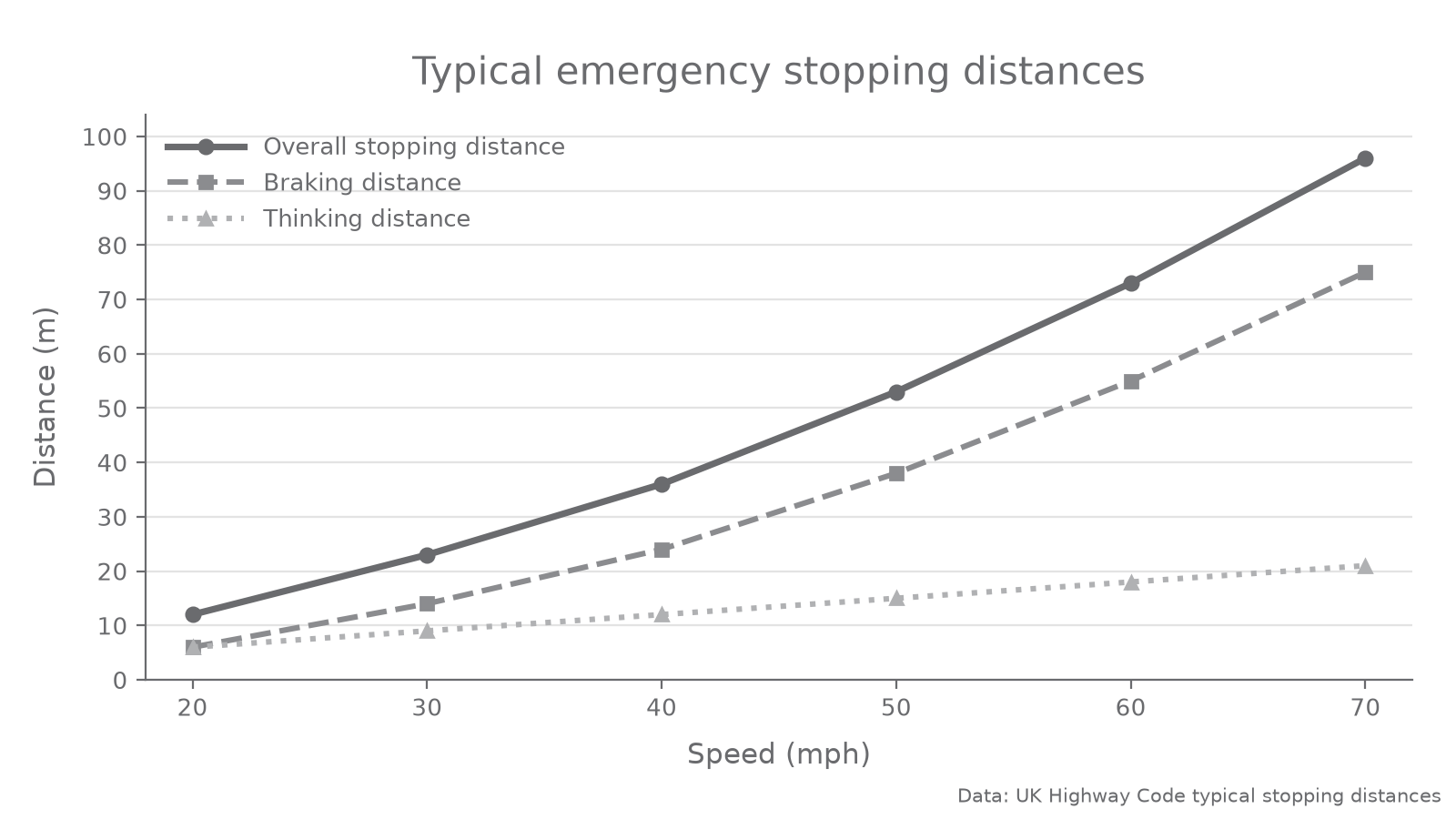
The graph and table show that all three distances increase with speed, but not in the same way. Thinking distance is close to a straight-line pattern because, for the same reaction time, travelling faster means covering proportionally more distance before braking starts. Braking distance curves upward because the energy that must be removed increases with speed squared.
For a speed between two rows, read between the nearest values and make it clear that the result is an estimate. At 45 mph, for example, the overall distance lies between 36 m and 53 m; reading between the two nearby points gives roughly 45 m. It is not sensible to report a very precise value because real vehicles, drivers and road conditions vary.
Connecting braking work and kinetic energy
Now consider only the braking stage. Let v be the vehicle's speed at the instant the brakes begin to act, m its mass, F the average resultant braking force and d the braking distance. The braking force on the vehicle acts opposite to its motion.
Because force and displacement are in opposite directions, the braking force does negative work on the moving vehicle: the vehicle's kinetic energy decreases. For the positive magnitudes used in a stopping calculation, the work done to bring the vehicle to rest equals the initial kinetic energy lost.
work done to stop = initial kinetic energy
Rearranging for braking distance gives:
Here F is in newtons (N), d is in metres (m), m is in kilograms (kg), v is in metres per second (m/s), and both work done and kinetic energy are in joules (J). An average force is used because the braking force may change during a real stop.
The specification refers to initial velocity squared. Braking distance is a scalar, so this one-dimensional calculation uses the magnitude of the initial velocity, which is the speed v; squaring it gives a positive . The opposite direction of the braking force is accounted for by the loss of kinetic energy.
For the same vehicle under the same braking conditions, m and average F are constant. The equation then shows:
d is proportional to
Doubling the speed multiplies , and therefore the braking distance, by four. Tripling the speed multiplies the braking distance by nine. This square relationship applies to braking distance, not automatically to the overall stopping distance, because the overall distance also includes thinking distance.
Calculating a braking distance
An equation sheet can supply the kinetic-energy and work-done equations separately. The important reasoning is knowing that they describe the same energy change during the stop and then combining them correctly.
Worked example
A car of mass begins braking at 20.0 m/s. The average resultant braking force has magnitude 9.00 kN. Calculate its braking distance on a level road.
First convert the force to newtons:
Calculate the initial kinetic energy:
The magnitude of the work done by the braking force equals this energy:
The input data are given to three significant figures, so 30.0 m is an appropriate result. A reverse check gives , which matches the initial kinetic energy.
Using the speed-squared relationship
When mass and average braking force stay the same, two braking situations can be compared without recalculating every energy and force value:
For the vehicle in the previous calculation, suppose the initial speed rises from 15.0 m/s to 30.0 m/s while its mass and average braking force remain unchanged. The speed ratio is , so:
The speed doubled, but the calculated braking distance increased from 22.5 m to 90.0 m, which is four times as large. This is the dependence required by the work-energy model.
The model is a controlled comparison. It assumes the same mass, the same average resultant braking force, a final speed of zero and no significant change in gravitational potential energy. On a real road, the available braking force can change with tyres, brakes, surface and weather, so published stopping distances are estimates rather than guarantees. The Highway Code's rounded values also need not follow a perfect square pattern.
To predict the effect of speed alone, keep mass and average braking force constant. If either changes, use with the new values instead of applying the speed ratio by itself.