2.23-2.26 - Force pairs and momentum
Start by distinguishing forces that balance on one object from a third-law pair acting on two objects. That equilibrium reasoning is for both tiers. Higher-tier sections then explain momentum, collisions and forces during a change in momentum.
Balanced forces and third-law pairs
Newton's third law applies whenever two objects interact:
If object A exerts a force on object B, object B simultaneously exerts an equal-magnitude force in the opposite direction on object A.
A reliable way to name a pair is:
- force of A on B;
- force of B on A.
The two forces are the same interaction type, equal in magnitude and opposite in direction, but they act on different objects. They therefore do not cancel when considering the motion of either object separately.
This is different from equilibrium. A book resting on a table has an upward normal contact force from the table and a downward weight from Earth. These two forces act on the same object, the book. When they are equal, their resultant on the book is zero and the book is in equilibrium. They are not a third-law pair because they come from different interactions.
One third-law pair is the normal force of the table on the book and the normal force of the book on the table. Another pair is the gravitational force of Earth on the book and the gravitational force of the book on Earth. Naming both objects prevents the common mistake of pairing any two equal and opposite arrows.
Balanced forces may cancel because they act on one object. Third-law forces form an interaction pair across two different objects.
Higher tier: Momentum has size and direction
Momentum combines an object's mass with its velocity. It is defined by:
- is momentum in kilogram metres per second, kg m/s.
- is mass in kilograms, kg.
- is velocity in metres per second, m/s.
This Higher-tier equation is supplied on the current Edexcel equation sheet, but you must still select it and handle direction correctly. Because velocity is a vector, momentum is also a vector and points in the same direction as the velocity.
For motion along one line, choose one direction as positive before calculating. Momentum in the opposite direction is negative. The sign records direction; it does not mean that the object has less mass.
Worked example
An 850 kg car travels east at 12 m/s. Taking east as positive:
To two significant figures, the momentum is , or . A stationary object has zero momentum because its velocity is zero.
Higher tier: Force pairs and conserved momentum
During a collision, each object exerts a force on the other. The force on A from B and the force on B from A form a Newton's third-law pair: they are equal in magnitude, opposite in direction, act for the same collision time, and act on different objects.
These paired forces cause equal-magnitude, opposite changes in the two objects' momenta. One object's momentum gain is the other's momentum loss. If the resultant external force on the chosen two-object system is negligible during the collision, the total momentum of the system is conserved:
[DIAGRAM: asset_name: 06_1PH0-P1-02E_2.20-2.26 - Circular motion and momentum - diagram 02; asset_slug: 1ph0-p1-02e-circular-motion-and-momentum_diagram_02; recommended_method: image_gen; description: Three-stage monochrome trolley collision diagram showing signed momentum arrows before, equal-length opposite contact-force arrows during, and unchanged total system momentum after within a clearly labelled boundary.]
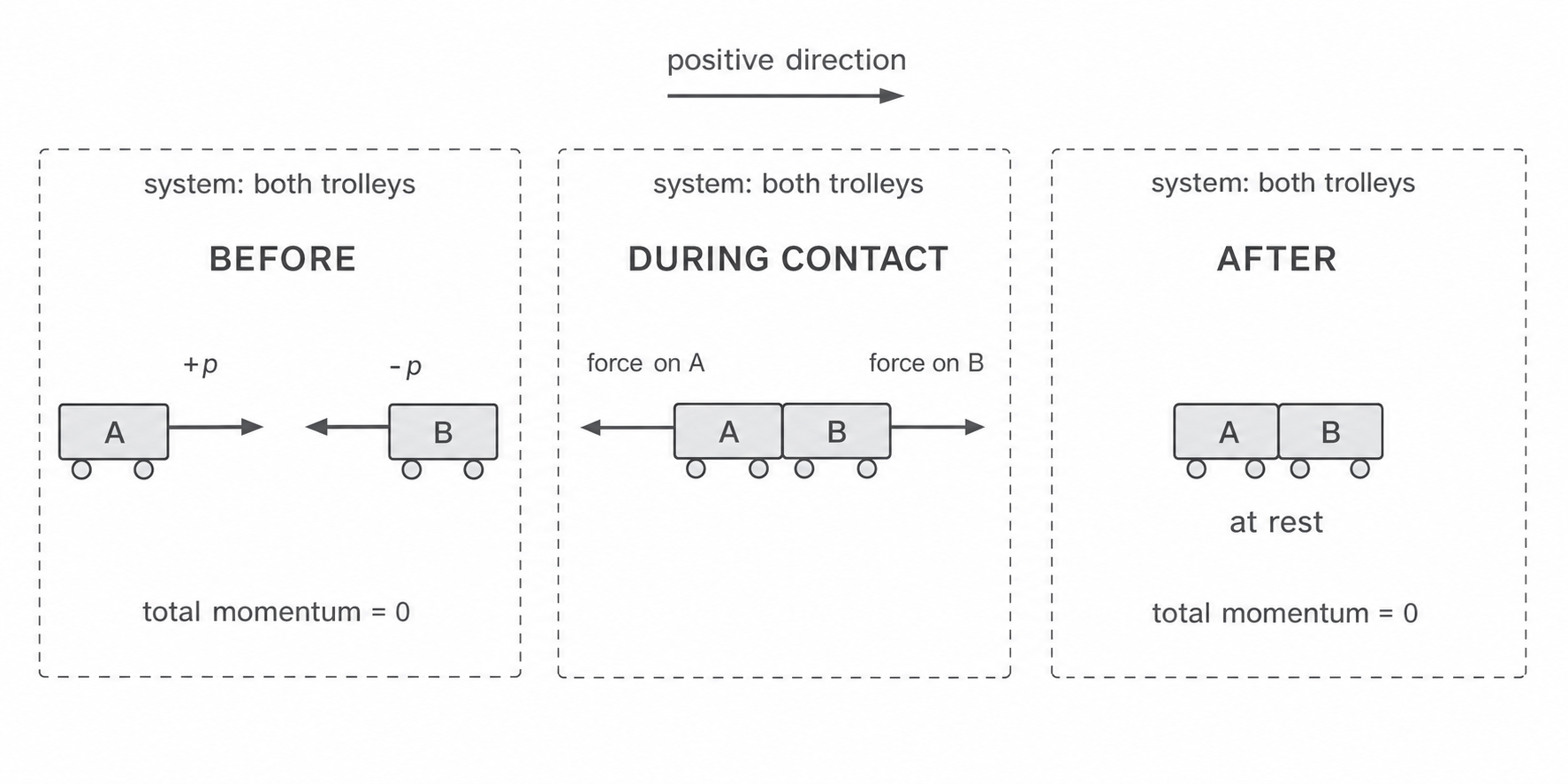
The pictured example starts with equal and opposite momenta and the trolleys remain together after impact, so they finish at rest. Other collisions need not end at rest.
Newton's third law and momentum conservation are linked, but they are not the same statement. The third law describes the two forces during the interaction. Conservation compares the total vector momentum of a defined system before and after the interaction.
Collision examples include:
- Two identical trolleys approaching at equal speeds in opposite directions have equal-magnitude but opposite momenta, so their total momentum is zero. If they remain together at rest after colliding, the total is still zero.
- A moving trolley striking a stationary trolley can transfer some momentum to it. Whether they separate or remain together, their signed momenta after the collision must add to the initial total when external forces are negligible.
- A ball that rebounds from a wall reverses its momentum direction. The wall and Earth receive an opposite momentum change. Momentum is not conserved for the ball alone because the wall exerts an external force on that one-object system; it is conserved for a sufficiently large closed system.
Worked example
A 0.50 kg trolley moves right at 4.0 m/s and collides with a stationary 1.5 kg trolley. They then move together. Take right as positive and treat the two trolleys as the system.
Before the collision:
After the collision, the combined mass is . Conservation of momentum gives:
The positive result means both trolleys move right. Checking: , equal to the total before the collision.
Higher tier: Force from a change in momentum
Newton's second law can be written as the rate of change of momentum. For a constant-mass object:
- is the average resultant force in newtons, N.
- is mass in kilograms, kg.
- is initial velocity and is final velocity, both in m/s.
- is the time for the momentum change in seconds, s.
This Higher-tier equation is also supplied on the current Edexcel equation sheet. The subtraction is always final momentum minus initial momentum. Choose a positive direction first, convert time to seconds, and keep velocity signs through the calculation.
Worked example: coming to rest
A 60 kg athlete moving right at 5.0 m/s comes to rest in 0.20 s. Take right as positive.
The average resultant force has magnitude and acts to the left, opposite the athlete's initial motion. The negative sign gives direction.
Worked example: rebound and milliseconds
A 0.16 kg ball travels right at 12 m/s, hits a wall and rebounds left at 8.0 m/s. Contact lasts 40 ms. Take right as positive.
First assign signs and convert the time:
Now find the change in momentum:
Then calculate the average force:
To two significant figures, the force on the ball is to the left. A rebound gives a larger momentum change than merely stopping from the same initial velocity because the final momentum points in the opposite direction. For the same momentum change, increasing the stopping time would reduce the average force.
The ball exerts an equal-magnitude force to the right on the wall: that is the third-law partner of the wall's force on the ball.