4.1-4.6 - Wave properties and equations
Learn how waves transfer energy, describe a repeating wave, and choose the measurements and equations that give its speed.
Energy and information without matter transfer
Drop a small stone into still water. Circular ripples spread away from the impact, and they can make a floating marker bob even though the stone never touches it. Energy has travelled from the impact to the marker.
A wave is a travelling disturbance that transfers energy and can transfer information without transferring matter overall from the source to the receiver.
Without transferring matter overall does not mean that particles stay still. In a mechanical wave, particles of the material move locally and pass the disturbance to neighbouring particles. After a complete cycle, each particle is back at or near its original position rather than travelling with the wave all the way to the receiver.
There are two useful pieces of evidence:
- Water waves: a floating marker moves up and down and a little backwards and forwards as crests pass. The crests travel across the surface, but the marker remains around the same place. The water moves locally while the disturbance and its energy travel onwards.
- Sound waves in air: a loudspeaker cone vibrates to and fro, making nearby air particles vibrate to and fro. The changing pressure pattern reaches a listener and makes the eardrum vibrate, but there is no continuous flow of air from the speaker to the listener. Speech or music carries information, and the sound carries energy that can make another object vibrate.
Real currents and breaking waves can move water from one place to another. That movement is separate from the ideal wave model used here: an unbroken travelling wave does not carry its medium along with it overall.
Describing one wave cycle
A repeated wave can be described in space and in time. The diagram is a model: the profile is not a path followed by one particle, and each wavefront is an imaginary line joining points at the same stage of a cycle.
[DIAGRAM: asset_name: 13_1PH0-P1-04A_4.1-4.6 - Wave properties and equations - diagram 01; asset_slug: edexcel-gcse-physics-4-1-4-6-wave-properties_diagram_01; recommended_method: matplotlib; description: an exact two-panel plot with a sinusoidal wave profile showing amplitude, equilibrium and wavelength, plus scaled parallel wavefronts with wavelength spacing and propagation direction]
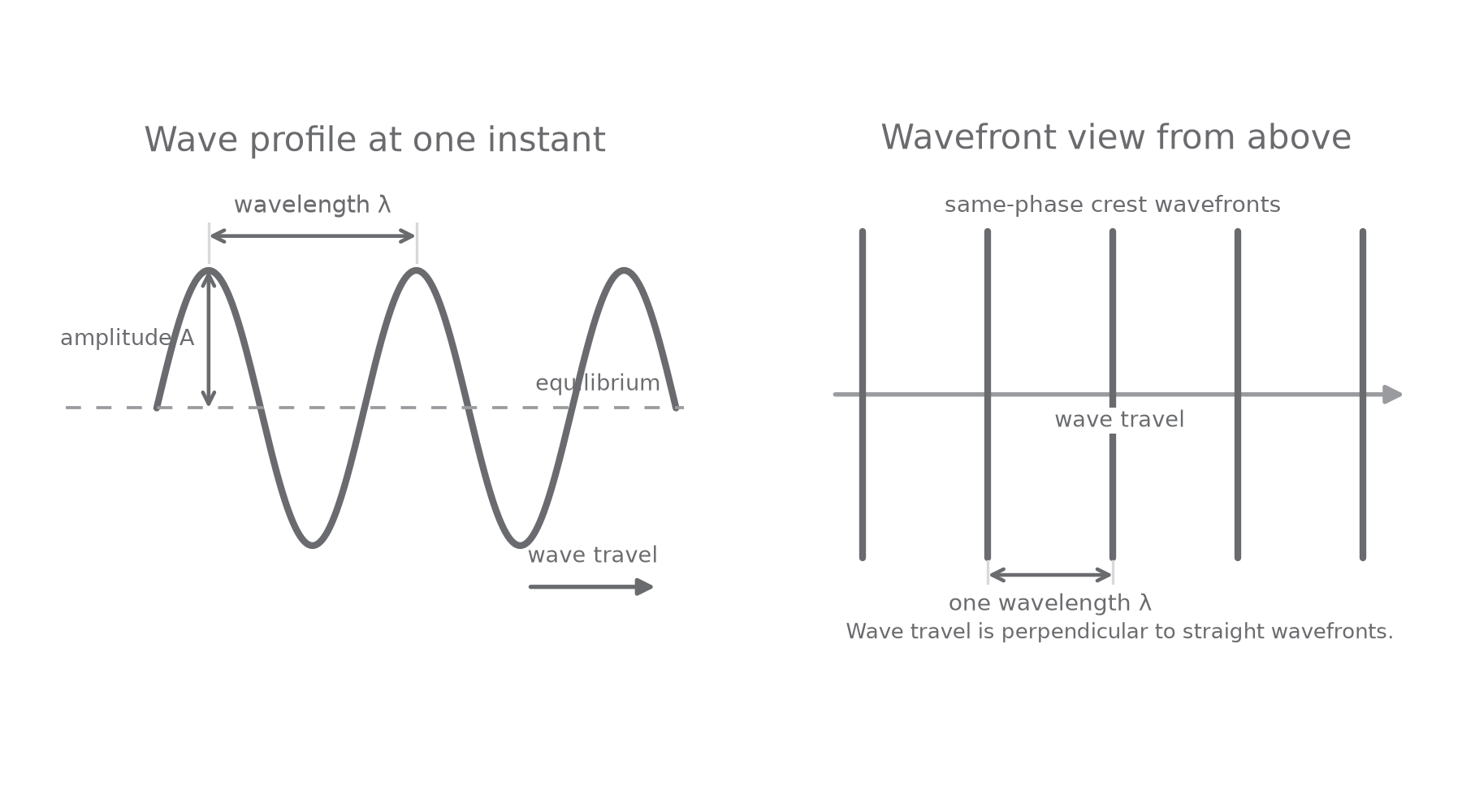
| Quantity | Meaning | Unit |
|---|---|---|
amplitude, A | maximum displacement from the equilibrium position | metre, m |
wavelength, λ | shortest distance between two adjacent points at the same stage of the cycle, measured parallel to wave travel | metre, m |
frequency, f | number of complete waves or cycles passing a fixed point each second | hertz, Hz |
period, T | time taken for one complete cycle to pass a fixed point | second, s |
wave velocity, v | speed and direction in which the disturbance or wavefront travels | metre per second, m/s |
The equilibrium position is the undisturbed or central position. Amplitude is measured from equilibrium to a crest or to a trough; the full crest-to-trough height is twice the amplitude.
Wavelength must cover one complete repeat. On a transverse profile it can be measured crest to next crest or trough to next trough, but not crest to the neighbouring trough. In a longitudinal wave it can be measured from the centre of one compression to the centre of the next compression, or from one rarefaction to the next.
Frequency and period describe the same repeating motion from different viewpoints. If N complete cycles pass in a measured time t, calculate f = N/t and T = t/N. Therefore T = 1/f when frequency is in hertz and period is in seconds. If four complete crests pass a fixed point each second, the frequency is 4 Hz. If one complete cycle takes 0.25 s, its period is 0.25 s; a higher frequency means a shorter period.
A wavefront is a line, or a surface in three dimensions, joining points that are at the same stage of the cycle. A circular crest on a ripple tank is one wavefront. Straight, parallel crest lines model straight wavefronts; the wave travels perpendicular to them, and adjacent crest wavefronts are one wavelength apart.
Wave velocity belongs to the travelling disturbance. It is not the changing velocity of an individual water particle, air particle or floating marker as that matter oscillates locally.
Transverse and longitudinal waves
To classify a wave, compare two directions:
- the direction in which the particles or fields vibrate;
- the direction in which the wave travels and transfers energy.
[DIAGRAM: asset_name: 13_1PH0-P1-04A_4.1-4.6 - Wave properties and equations - diagram 02; asset_slug: edexcel-gcse-physics-4-1-4-6-wave-types_diagram_02; recommended_method: image_gen; description: a clear monochrome two-panel scientific comparison showing perpendicular vibration and energy-transfer arrows for a transverse wave, and parallel arrows with compressions and rarefactions for a longitudinal wave]
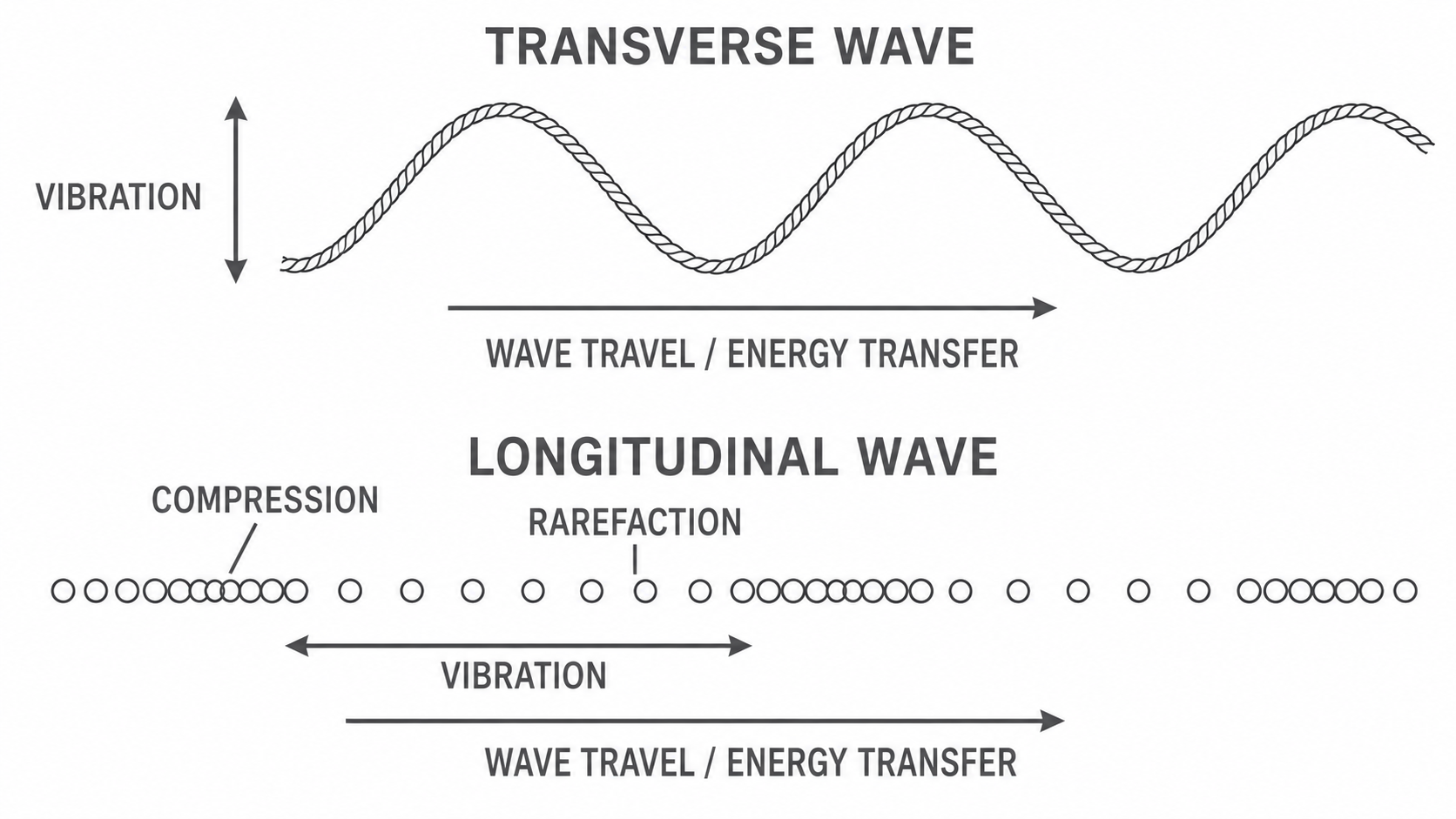
In a transverse wave, the vibration is perpendicular to the direction of wave travel and energy transfer.
In a longitudinal wave, the vibration is parallel to the direction of wave travel and energy transfer.
The shape drawn on a page is not enough to decide the type. A longitudinal sound wave is often drawn as a wavy pressure graph, but the air still vibrates parallel to the direction the sound travels.
| Example | Classification and reason |
|---|---|
| sound in air | longitudinal: air particles vibrate backwards and forwards, producing compressions and rarefactions parallel to wave travel |
| electromagnetic waves | transverse: the oscillating electric and magnetic fields are perpendicular to the direction of wave travel |
| seismic waves | P waves are longitudinal because rock vibrates parallel to propagation; S waves are transverse because rock vibrates perpendicular to propagation |
| water surface waves | a simplified side profile highlights transverse up-and-down displacement, but real surface particles move in roughly circular or elliptical paths, combining parallel and perpendicular motion |
A compression is a region where particles in a longitudinal wave are closer together. A rarefaction is a region where they are farther apart. The particles do not travel with a compression; they vibrate about their equilibrium positions as the pressure disturbance moves on.
Choosing a wave-speed equation
The supplied Physics equation list includes both wave-speed relationships for Foundation and Higher tier. The task is to choose the relationship that matches the available measurements and use consistent units.
wave speed = frequency × wavelength
wave speed = distance travelled by the wave / time taken
In these equations:
vis wave speed in metres per second,m/s;fis frequency in hertz,Hz;λis wavelength in metres,m;xis the distance travelled by a wavefront in metres,m;tis the travel time in seconds,s.
The x in is the distance travelled by the wave or a named wavefront. It is not the small displacement of a particle as it vibrates.
| Data available | Most direct equation |
|---|---|
| frequency and wavelength | |
| distance travelled by a wavefront and travel time |
Worked example
A wave machine produces 8.0 complete waves each second. Adjacent crests are 0.45 m apart. Calculate the wave speed.
The number of waves each second is the frequency, so . The crest-to-next-crest distance is the wavelength, so .
Both data values have two significant figures, so 3.6 m/s is appropriate. The result is sensible: eight wavelengths pass each second, and each wavelength is just under half a metre, giving a speed just under 4 m/s.
Rearranging and linking the equations
Sometimes the required quantity is not wave speed. Rearrange symbolically before substituting, and convert prefixes so the units match the equation.
Worked example
A sound wave travels through air at 340 m/s and has a frequency of 2.5 kHz. Calculate its wavelength.
First convert the frequency to hertz:
Select and rearrange the equation:
Substitute values with SI units:
Both given values have two significant figures, so the wavelength is 0.14 m to two significant figures. A frequency of thousands of cycles each second giving a wavelength much less than one metre is physically plausible for sound in air.
The two equations can also be linked. Direct distance and time measurements can give wave speed first; that speed can then be combined with frequency to find wavelength.
The linked calculation uses the speed of the travelling crest in the second equation; it does not use the local speed of one water particle.
Choose the equation from the measurements, convert to metres, seconds and hertz, rearrange before substituting, and check that the result describes the travelling wave rather than the local particle motion.