2.14-2.18 - Newton’s laws, mass and weight
Forces explain changes in motion, while weight explains the pull of gravity. Learn to find the resultant force before using Newton’s laws, distinguish mass from weight, and make a valid force-meter measurement.
Resultant force and Newton's first law
A force is a push or pull on an object. Force is a vector, so both its magnitude and direction matter. The resultant force is the single force that has the same effect as all the forces acting on the object together.
Suppose a car has a 2000 N driving force forwards and 2000 N of air resistance and friction backwards. The forces cancel, so the resultant force is 0 N. This does not mean that no forces act; it means their vector sum is zero.
Newton's first law: if the resultant force on an object is zero, an object at rest remains at rest and a moving object continues at constant velocity.
Constant velocity means constant speed in a straight line. Therefore, an object moving steadily can have balanced forces. It does not need a resultant force to keep moving.
If the resultant force is not zero, velocity changes. The object accelerates: it may speed up, slow down and/or change direction. In a straight line, a resultant force in the direction of motion increases speed, while one opposite to the motion decreases speed. A resultant force in another direction changes the direction of motion.
The logic works both ways:
- resultant force = 0 N means acceleration = 0 m/, so velocity is constant;
- changing speed and/or direction means there is acceleration, so the resultant force is not zero.
Newton's second law
Newton's first law tells us when velocity changes. Newton's second law gives the size of that change for an object of constant mass.
resultant force = mass × acceleration
Fis resultant force in newtons,Nmis mass in kilograms,kgais acceleration in metres per second squared,
The F in this equation is not automatically the driving force or any other single force. First combine the forces, with their directions, to find the resultant force on the named object. Acceleration is in the direction of that resultant force.
For the same mass, a larger resultant force produces a larger acceleration. For the same resultant force, a larger mass produces a smaller acceleration. When using an equation sheet, select the equation that matches the quantities and convert to consistent SI units before substituting.
Worked example: accelerating a car
A car of mass 1200 kg increases its velocity from 0 m/s to 18 m/s in 6.0 s. Calculate the resultant force on the car.
- Find the acceleration: a = change in velocity / time = 18 / 6.0 = 3.0 m/.
- Check the units: mass is already in
kgand acceleration is in , so no conversion is needed. - Select Newton's second law: .
- Substitute: .
- Calculate: in the direction of the acceleration.
This is plausible: accelerating a car requires a force of thousands of newtons, not a few newtons. To rearrange the equation, divide both sides by the quantity you do not need: and .
Mass, weight and gravitational field strength
In everyday speech, mass and weight are often confused. In physics they are different quantities.
| Quantity | Meaning | Unit |
|---|---|---|
| mass | how much matter an object contains; a measure of its inertia | kilogram, kg |
| weight | the gravitational force acting on the object | newton, N |
Weight acts towards the centre of the body creating the gravitational field. Near Earth's surface, this direction is vertically downwards.
weight = mass × gravitational field strength
Wis weight in newtons,Nmis mass in kilograms,kggis gravitational field strength in newtons per kilogram,N/kg
Near Earth's surface, use unless a question supplies another value. The same symbol also describes free-fall acceleration, . These have the same numerical value near Earth's surface but different unit descriptions: N/kg tells us the force on each kilogram, while tells us how velocity changes in free fall.
Worked example: finding weight
Find the weight of a student whose mass is 68 kg, using .
- Both values already use the required units,
kgandN/kg. - Select the relationship: .
- Substitute: .
- Calculate: .
- Sense-check: each kilogram weighs about
10 N, so a mass of several tens of kilograms should weigh several hundred newtons.
For an unchanged mass, weight is directly proportional to gravitational field strength. If g doubles, weight doubles; if g halves, weight halves. Mass itself does not change just because the gravitational field strength changes.
| Mass | Gravitational field strength | Weight |
|---|---|---|
3 kg | 4 N/kg | 12 N |
3 kg | 10 N/kg | 30 N |
3 kg | 20 N/kg | 60 N |
The constant ratio W / g is the mass, 3 kg, in every row.
Measuring weight with a newton meter
Weight is measured using a newton meter (also called a force meter or spring balance). A force stretches or compresses its calibrated spring, and the scale reports force in newtons.
[DIAGRAM: asset_name: 04_1PH0-P1-02C_2.12-2.18 - Everyday speeds, forces and weight - diagram 01; asset_slug: 04_1ph0-p1-02c_2-12-2-18-everyday-speeds-forces-and-weight_diagram_01; recommended_method: image_gen; description: A monochrome scientific apparatus diagram showing a vertical zeroed newton meter, a stationary suspended object, eye-level scale reading, and newton units.]
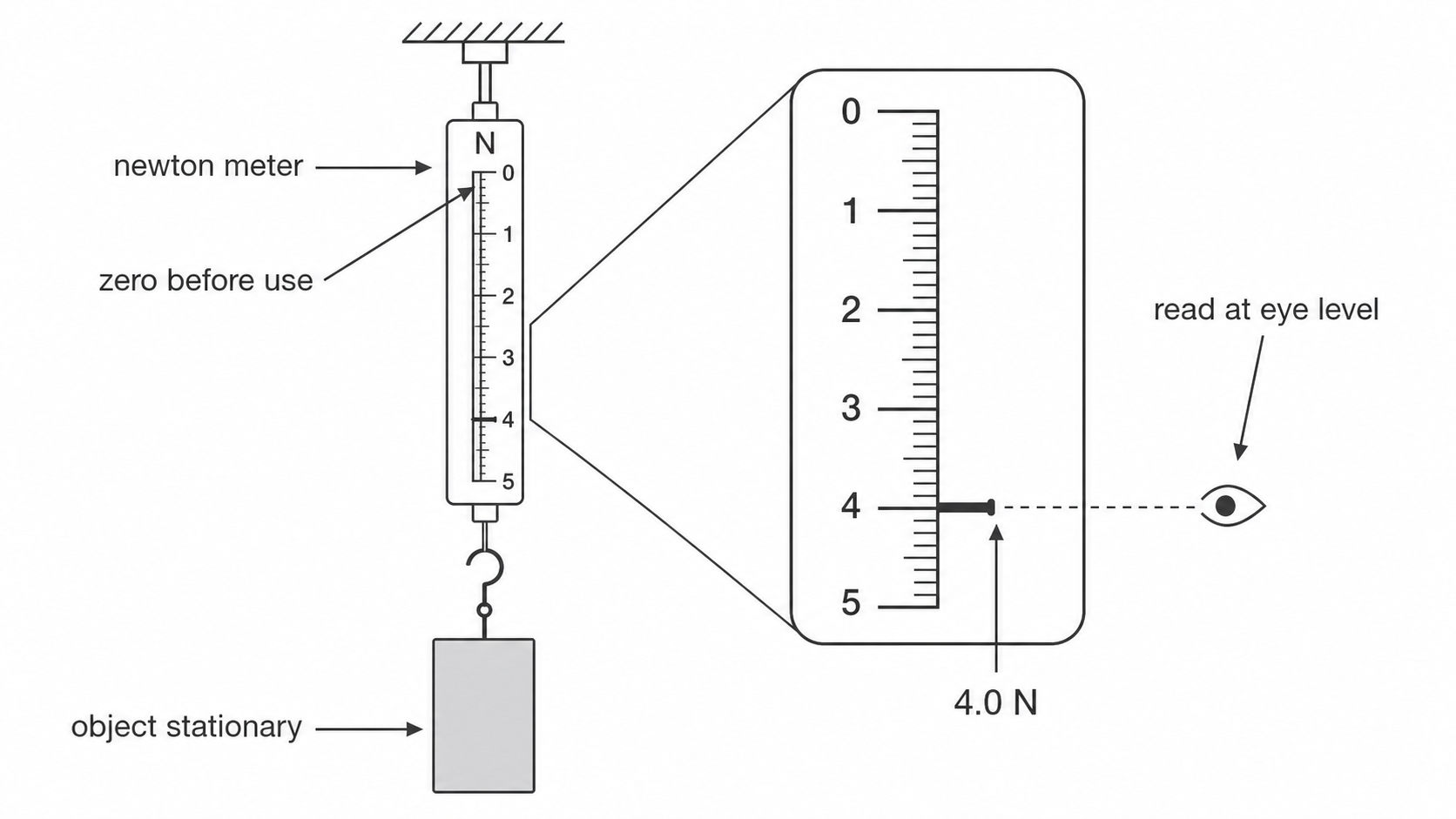
The enlarged pointer reads 4.0 N; the illustration is schematic, so use an actual instrument’s calibrated subdivisions for a precise measurement.
To measure an object's weight:
- Choose a newton meter with a suitable range and check that it reads
0 Nbefore loading it. - Hold the meter vertically and attach the object securely to the hook.
- Keep the object clear of the bench and allow it to become stationary.
- Read the scale at eye level and record the value in newtons, using the scale resolution.
When the object hangs stationary, its acceleration is zero. The upward force from the meter balances the downward weight, so the meter reading equals the object's weight. If the object or meter is accelerating, the reading need not equal the weight; this is why the stationary condition matters.